

Trump judge dismisses case for lack of standing, in latest setback by government entities and factory farming interests seeking to overturn states’ most consequential farm animal protection laws
WASHINGTON, D.C. – Animal Wellness Action and the Center for a Humane Economy celebrated a U.S. District Court for the Central District of California ruling tossing the U.S. Department of Justice’s lawsuit against the State of California’s landmark series of laws forbidding cage confinement of laying hens and the sale of eggs from confined hens. Both animal welfare groups had intervened in the case to uphold California’s right to enact these laws.
In its filing in a U.S. District Court in California, the Department of Justice argued that the state’s laws conflict with the provisions of the federal Egg Products Inspection Act and is therefore preempted. The lawsuit represents the latest in a long line of failed legal assaults by USDA and by factory farming interests to overturn common-sense, immensely popular laws that give animals more space and promote safer foods for consumers.
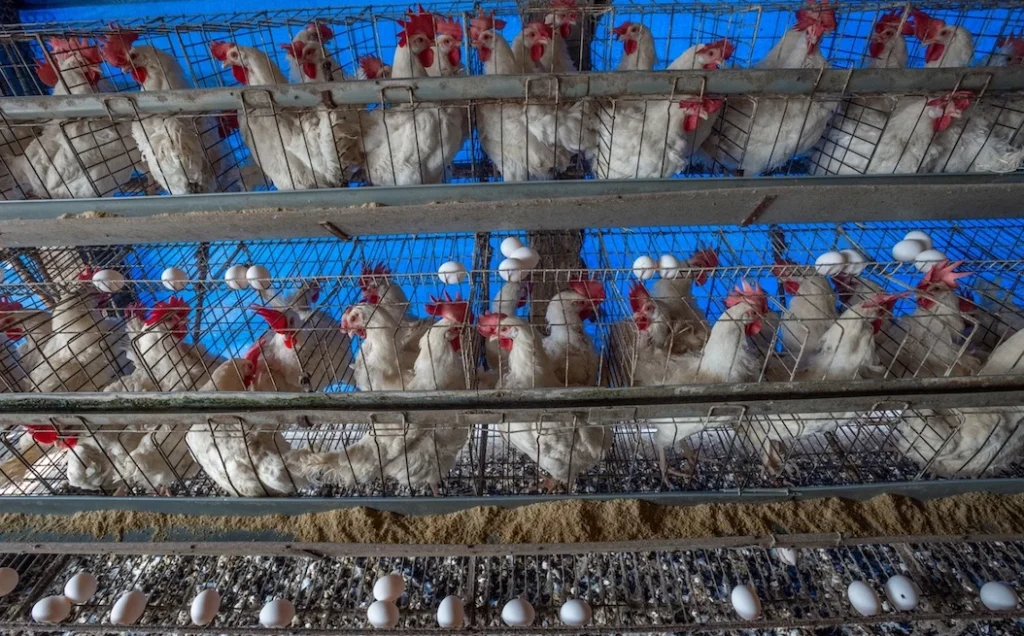
“Without requiring the United States to show some redressable injury, the federal government might initiate a campaign of preemption suits under the aegis of its sovereignty to bring state laws in line with its own political agenda,” wrote District Court Judge Mark C. Scarsi in his 11-page ruling. “The potential for abuse of the federal courts for political purposes is manifest.”
“The attempt by the Department of Justice to upend immensely popular laws to give laying hens some space to move was absurd on its face, and this ruling is spot on,” said Wayne Pacelle, president of Animal Wellness Action and the Center for a Humane Economy and a key architect of the state’s farm animal welfare laws. “The egg industry was turned upside down because of a three-year and still-running H5N1 outbreak that resulted in the ‘depopulation” of 145 million laying hens. Egg prices spiked because of disease, not cage-free standards. Giving hens more space to move lowers stress and reduces crowding and is an antidote to further disease spread.”
The preemption argument is particularly baseless because Congress has had countless opportunities to establish minimal animal welfare standards for animals on farms, but it’s been convinced by animal agriculture groups to do not a thing legislatively on this front. “When it comes to federal animal welfare standards on the farm, there are no standard whatsoever, so the claim that state farm animal welfare laws are preempted is laughable on its face,” adds Pacelle, who was a key architect of Prop 2, Prop 12, and all other state ballot measures promoting farm animal welfare.
The Egg Products Inspection Act does not, in either its plain language or its intent, touch on the humane treatment of chickens, but rather is focused on consumer safety in a post-production environment. Research has shown that providing farm animals, including egg layers, with the minimal space requirements that the California law provides for actually benefits, food safety, and consumer protection.
“The legal premise contained in DOJ’s lawsuit is so tenuous and unfounded that it bordered on being frivolous,” said Scott Edwards, general counsel of Animal Wellness Action. “DOJ’s legal action was clearly brought by the federal government simply to send a message to California for political reasons. The judge even recognized in his decision that allowing this case to go forward would open the floodgates for the potential for abuse of the federal for political purposes.”
The claim now being advanced by the Department of Justice built on prior unsuccessful attempts by a coalition of six states in 2014. In that case, the Ninth Circuit Court of Appeals firmly rejected the effort to invalidate Proposition 2 on similar grounds, dismissing the case outright given the states’ lack of standing to bring the claims. Moreover, the DOJ’s action closely mirrors a recent preemption claim brought by the pork industry against Massachusetts’ Question 3 and its own anti-cruelty confinement measures under the Federal Meat Inspection Act—a case that was dismissed by the federal district court in Massachusetts. While that case is currently pending a decision on appeal, there is every indication that the First Circuit will uphold the lower court’s dismissal.
Propositions 2 and 12 were overwhelmingly approved by California voters and represent a powerful mandate for animal protection. Similar laws have since been enacted in multiple other states, including Colorado, Massachusetts, Michigan, Oregon, and Washington. These laws reflect evolving consumer values, as Americans increasingly demand higher welfare standards, including cage-free housing for egg-laying hens.
In 2010, just 4.4% of laying hens, or 12.2 million birds, lived in cage-free environments across the United States. Now that number is 46%, and the number of laying hens in cage-free environments exceeds 130 million. “There’s been 10X growth for cage-free production in the last 15 years because that what consumers and food retailers are increasingly demanding,” noted Pacelle. “The egg industry has responded and invested billions in more extensive housing systems. This lawsuit wants to send Americans back to the drawing board on farm animal welfare, causing harm to all key stakeholders, including the animals at the center of the business.”