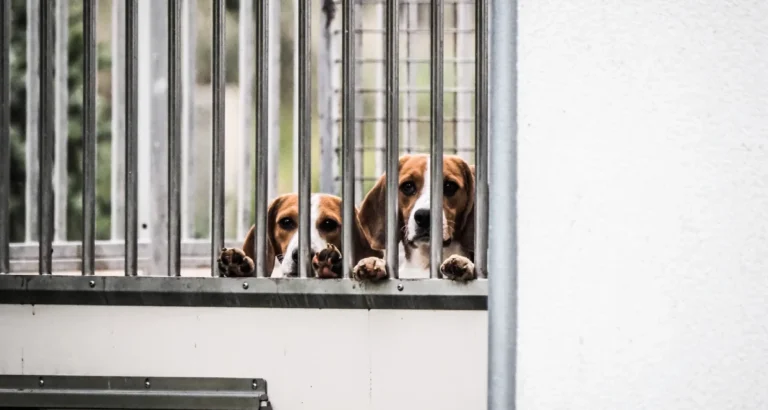
A Berlin Wall Moment on Animal Testing?
Our work, in tandem with congressional and federal agency actions, may usher in a new era of health and well-being for people and for animals
- Wayne Pacelle and Tamara Drake
As the U.S. military newspaper Stars and Stripes reported in late December, Congress included a provision in a larger bill related to the military to end “exercises that involved shooting, critically wounding and killing goats and pigs to help educate medics in treating combat injuries,” directing the Army to use “technologically advanced human simulators instead.”
Within days of its passage, President Trump signed the National Defense Authorization Act, applying the anti-animal testing provisions to the Department of Defense, allowing animal welfare advocates to declare victory in a 30-year fight to end “wound labs” and complete the transition toward using innovative methods for addressing the challenges of treating wounded soldiers in the field.
In a normal year, the enactment of such a provision would warrant headline treatment for animal welfare groups and their news outlets. But in a year of game-changing movement on animal testing, it is an especially important and thoroughly practical example of changes within the public and private sectors to reduce the use of animals in science and testing—which historically has constituted one of the biggest and most intractable domains for the exploitation of millions of animals annually.
Congress and Trump Team Address Animal Testing in Unprecedented Ways
The change in direction on animal testing—in sharp focus at the Pentagon, the U.S. Food and Drug Administration, National Institutes of Health, Centers for Disease Control and Prevention, the Environmental Protection Agency, and other federal agencies that conduct and fund animal testing—was set in motion by our work within the Congress to pass the FDA Modernization Act 2.0 in 2022. That law, written by Senators Rand Paul, M.D., R.-Ky., and Cory Booker, D-N.J., lifted an animal testing mandate that had shackled our $1.35 trillion pharmaceutical industry since 1938.
But laws are effective only when enforced or implemented, and implementation has been a hallmark of key public health officials within the Trump administration, especially FDA Commissioner Marty Makary and Health and Human Services Secretary Robert F. Kennedy, Jr. Adopting the principles that undergird the FDA Modernization Act 2.0 promises not only to spare countless primates, dogs, and other animals, but also to reboot and improve our nation’s safety and efficacy reviews of new drugs, chemicals, and pesticides. This shift will also improve outcomes in biomedical research and surgery, touching the lives of billions of people and so many sectors of our economy.
Building on its prior work in this space, the U.S. Senate passed the FDA Modernization Act 3.0, led by Sens. Booker, and Eric Schmitt, R-Mo., to update regulatory language to clarify FDA’s authority to rely on non-animal test methods. The House is expected to follow suit. And there are more than 15 other major animal testing bills under consideration in Congress, from the bipartisan CARGO Act, led by Reps. Troy Nehls, R-Texas, and Dina Titus, D-Nev., and Sens. Rick Scott, R-Fla., and Booker, to defund experiments on animals in foreign nations where animal care standards are lacking, to legislation to adopt retired beagles out of laboratories.
FDA Takes Concrete Steps to Reduce Animal Testing, Stirs Action Across Public Health Agencies
In April 2025, in his first public-facing action after Senate confirmation, FDA Commissioner Dr. Marty Makary released “Roadmap to Reduce Animal Testing in Preclinical Safety Studies,” committing the agency to make animal tests the exception rather than the norm within three to five years. This was followed in December by new FDA draft guidance, marking the first concrete regulatory application of the Roadmap. The guidance explicitly encourages drug developers to use non-animal methods, including organoids, microphysiological systems, computational modeling, and other human-relevant technologies.
“I don’t believe God made these creatures on planet Earth for us to torture and abuse.”
— FDA Commissioner Dr. Marty Makary
Rather than treating the option to use animal-free methods as an afterthought, this new guidance empowers drug sponsors to forgo certain traditional animal toxicity studies in favor of modern approaches like in vitro systems, microphysiological models, and well-validated computational tools.
Not to be outdone, Dr. Makary’s counterpart, NIH Director Jay Bhattacharya, followed the FDA’s landmark Roadmap by announcing an expansion of his agency’s commitment to human-relevant research, including new funding priorities focused on advanced in vitro systems, computational models, and the launch of a dedicated organoid research center. NIH leadership framed the initiative as a necessary step to improve scientific predictivity and accelerate medical progress—a refreshingly direct acknowledgment that animal models often fail to translate to human outcomes. NIH is the world’s largest funder of biomedical research, and its decision-making influences protocols in public and private labs across our nation and the world.
The NIH also shut down its last remaining in-house beagle laboratory, ending a decades-old practice of government-run dog testing. We now hope to see NIH redirect its grant awards toward researchers who do not conduct invasive experiments on beagles or primates. We sent a letter to Dr. Bhattacharya to detail the value of these new approaches soon thereafter. And just last month, 10 Republicans and 10 Democrats in Congress provided even more granular arguments in writing to NIH, demanding answers about continued primate research funding and calling for a shift toward animal-free alternatives.
The lawmakers, led by Reps. Diana Harshbarger, R-Tenn., and Nanette Barragán, D-Calif., were encouraged by news from the CDC that it is ending its primate research program, and asked Dr. Bhattacharya to reassess NIH funding priorities accordingly, since HHS Secretary Kennedy is seeking to apply these principles with consistency.
In a televised interview on “My View with Lara Trump,” Kennedy noted that “there are more than 100,000 monkeys in labs around the country for research purposes” and “another 20,000 that are imported every year,” adding “we are trying to put an end to that completely.” The message was unmistakable: continued reliance on primate testing, and the global trade that sustains it, is increasingly incompatible with modern biomedical science.
“The badge of a really humane nation is the way that it takes care of its animals.”
— HHS Secretary Robert F. Kennedy Jr.
Kennedy observed that “the primate centers have a profit motive” and that they often resist adopting better, animal-free methods even “when it doesn’t make any sense to do these kinds of experiments.”
Action by Congress and Federal Agencies Have Spillover Effects to Private Sector
Through the years, the public has come to understand the grim details of the corporate supply chain that feeds primates, dogs, and other animals to labs for invasive experiments. In 2022, federal authorities seized 145 dogs and puppies experiencing “acute distress” at the Envigo beagle-breeding operation in rural Virginia.
According to pleadings from federal prosecutors, Envigo was “failing to meet the minimum standards for handling and housing the beagles” and “allowed beagles to die from malnutrition, treatable and preventable conditions …” There were 300 puppies found dead from “unknown causes” in a six-month period, and 173 beagle puppies dead and in such a state of decomposition that forensic work was impossible. At the facility, Envigo employed one veterinarian for 5,000 dogs, making comprehensive care an impossibility. Just imagine a single doctor attempting to treat 5,000 patients at a hospital.
The financial fallout was stark. Following the collapse of its Envigo subsidiary, shares of Inotiv fell by more than 70% from their 2021 peak, wiping out hundreds of millions of dollars in market value as criminal charges, federal investigations, and a court-ordered shutdown mounted.
This year, with the FDA Modernization Act 2.0 enshrined in law and federal agencies moving away from animal use, Ridglan Farms, one of the two remaining beagle-breeding facilities for labs, agreed to surrender its dog breeding license to avoid criminal prosecution for animal cruelty. The decision followed mounting investigations and enforcement actions that documented chronic neglect, systemic suffering, and repeated violations of animal welfare standards. Now, just one beagle-breeding operation, Marshall BioResources, continues to operate in the United States, but with an astounding 25,000 beagles as “inventory.” It’s our goal to upend its business model or to help shutter it.
In February 2023, the stock market shares of the primate-importer and largest supplier of laboratory animals, Charles River Laboratories, dropped by 10% when they announced they had been served a federal subpoena regarding trafficking of endangered macaques from Cambodia. The medical-research contractor was the second-worst performer in the S&P 500 Index that month. While hiding behind the high-minded rhetoric of “research saves lives,” these folks appear to have been involved in trafficking endangered wildlife.
More recently, Charles River announced a $500 million investment in non-animal testing methods. It remains to be seen whether this marks an effort to replace animals in its business model or if it’s a public-relations move to temper criticism of the company. Either way, though, the Charles River business model has long depended on the wide acceptance of animal use. With researchers and institutions finally moving in a more humane direction, this is one more company that will have to follow the adage “adapt or die.”
If it adapts, it will be joining an increasingly competitive market. Stepping into the role of supplying laboratories are innovative scientists and biotech companies pioneering animal-free testing methods such as computational toxicology, in vitro testing, and generative AI. A multidisciplinary team at Harvard’s Wyss Institute has adapted computer microchip manufacturing methods to create organs-on-chips that recapitulate the complex structures and functions of living human organs. These three-dimensional cross-sections of human organs “provide a window into their inner workings and the effects that drugs can have on them, without involving humans or animals,” write the scientists at the Wyss Institute.
Modernizing Testing Helps All of Humanity While Sparing Animals
More than a decade ago, the former NIH director, Dr. Elias Zerhouni, acknowledged the problem with primate research, saying we “have moved away from studying human diseases in humans… We need to refocus and adapt new methodologies for use in humans to understand disease biology in humans.”
A few years later, NIH Director Dr. Francis Collins predicted that the use of animals in drug development and safety testing would be mostly replaced by 2026. He said this replacement would be due to increasing adoption of animal-free technologies, “giving results that are more accurate, at lower cost and with higher throughput.”
Dr. Zaher Nahle, senior scientific advisor to the Center for a Humane Economy, has warned in a peer-reviewed analysis that animal-free methods should not be used as “complementary” tools to animal tests but should fully replace them because they are more than sufficient to provide accurate insights into human biology—precisely the impetus for the shift now underway at FDA and envisioned by the FDA Modernization Acts 2.0 and 3.0.
With so much scientific momentum, along with plain evidence that the animal testing model is badly broken and dysfunctional, the actions of Congress and federal public health agency leaders are combining to drive punctuated change on the testing front.
In 2026, we’ll continue to drive outcomes in this space, working to do the following:
- Work with Reps. Buddy Carter, R-Ga., and Nanette Barragán, D-Calif., the bill’s House leaders, to shepherd the FDA Modernization Act 3.0 to enactment, and collaborate with the FDA to ensure follow-through on its three- to five-year timeline for phasing out animal tests in drug development.
- Free and rehome all remaining dogs at Ridglan Farms, which will cease breeding and sales of beagles by July, and work to end animal use at Marshall BioResources and free its 25,000 beagles.
- Work with Congress to press the NIH to wind down funding for the National Primate Research Centers and their satellites and see that the animals are placed in sanctuaries.
- Work to eliminate large-scale investments, existing and new, alongside legacy projects historically developed to stand, bolster and subsidize animal-centric testing programs.
- Work with the NIH to condition its grantmaking on commitments from researchers to use animal-free approaches instead of dogs, primates, or other animals.
- Engage pharmaceutical companies to embrace more cost-effective, 21st-century, human-relevant tests and wind down their use of all animals.
This is a Berlin Wall moment for change on animal testing. An ossified, broken system in place since the Great Depression is breaking down under the weight of accumulated science and hammer blows of moral concern. When that wall falls, cutting-edge science will be unleashed and we’ll see a boundless flourishing of life for both humans and animals. The effects will generate economic growth, better health outcomes, and great longevity for people, and a respect for the creatures who share our planet with us and depend on our compassion and endless ingenuity.
Wayne Pacelle, a two-time New York Times best-selling author, is president of Animal Wellness Action and the Center for a Humane Economy. Tamara Drake is director of research and regulatory affairs for the Center for a Humane Economy.
Dear reader: If you support substantive policy work to protect animals, please consider donating to Animal Wellness Action here. You can give any amount one time, or make it a monthly gift, as many of our supporters do. Thank you for helping us fight for all animals.