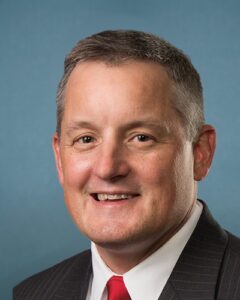
Tenure: 114th–119th Congresses
Years of Service: 2015–Present
Rep. Bruce Westerman, an Arkansan with a master’s degree in forestry from the Yale School of the Environment, has become one of the most influential congressional opponents of federal wildlife protections. As chairman of the House Natural Resources Committee, he has played a central role in advancing legislation that would weaken the Endangered Species Act, transfer greater authority to states, remove federal protections for gray wolves, and impede efforts to reduce the use of toxic lead ammunition, which hurts hunting families and indiscriminately poisons wildlife.. A critic of animal welfare policies and an ally of the NRA and the Safari Club International, Westerman has used his committee leadership position to shape the House’s broader approach to wildlife policy.
He has rarely supported animal welfare policies, notably by favoring extending prohibitions on animal fighting to the U.S. territories in a floor amendment to the House Farm bill in 2018. He led House opposition in the 117th Congress to the Big Cat Public Safety Act and was ultimately unsuccessful as the ranking member of the Committee on Natural Resources.
Wildlife issues have been a defining feature of Westerman’s congressional career. He has repeatedly argued that the Endangered Species Act requires substantial reform and has sponsored legislation aimed at reducing federal protections for listed species. In 2025, he introduced the ESA Amendments Act, a sweeping proposal that conservation organizations described as one of the most significant attempts in decades to weaken the Endangered Species Act. The measure became a major flashpoint in Congress before House leadership ultimately pulled it from floor consideration.
Westerman’s voting record reinforces that legislative agenda. He supported H.R. 845, the Pet and Livestock Protection Act, which would remove federal Endangered Species Act protections for gray wolves. He also championed H.R. 556, the Protecting Access for Hunters and Anglers Act, serving as one of its leading advocates in Congress. These actions reflect a consistent preference for reducing federal animal
protections and expanding state authority over wildlife management.
Farm-animal welfare issues present a similarly concerning record. Westerman voted for the Farm, Food, and National Security Act of 2026, which included language modeled on the Save Our Bacon Act. That provision would preempt state laws that condition the sale of certain livestock products on production standards, threatening measures such as California’s Proposition 12 and Massachusetts’ Question 3. On that same bill, on House Roll Call Vote 149, Westerman voted for the Moore Amendment, which sought to exempt West Virginia from the federal prohibition on commercial greyhound racing, even though Arkansas bans the practice of greyhound racing.
In 2022, Westerman also led efforts to block the Big Cat Public Safety (BCPS) Act, which ended the trade in big cats for use as pets and halted commercial cub petting, placing him at odds with the majority of House, including dozens of Republican lawmakers, who voted the bill into law. In May 2026, in the Transportation and Infrastructure Committee, Westerman also opposed an amendment to prohibit the export of American horses for slaughter for human consumption. That amendment to protect horse passed by a vote of 34 – 30, leaving Westerman on the losing side, as with the BCPS Act, which was signed into law by President Biden.
To his credit, Westerman has occasionally participated in bipartisan conservation efforts, including some work related to wildlife refuges and forest management. However, those initiatives have generally focused on land management and resource policy rather than strengthening protections for animals themselves. His overall record remains dominated by efforts to narrow the scope of federal wildlife laws and reduce regulatory protections for imperiled species.
Taken as a whole, Westerman’s record places him firmly in the Animal Opponent category. Unlike many members who simply vote with party leadership on animal-related legislation, Westerman has frequently been a leader and architect of efforts to weaken wildlife protections. His influence as committee chairman has amplified the impact of those positions well beyond his individual voting record.
Notable Actions
119th Congress
❌ Voted “Nay” on the Van Drew–Titus Amendment (Recorded Vote No. 98-pg. 46) to H.R. 8870 (Transportation and Infrastructure Committee Vote), which would have incorporated key provisions of the Save America’s Forgotten Equines (SAFE) Act into the Build America 250 Act. The bipartisan amendment would permanently prohibit the export of American horses to Canada, Mexico, or other countries for slaughter for human consumption and ban the use of dangerous double-decker trailers to transport horses. The amendment was adopted by a 34–30 vote. A “Nay” vote is the anti-animal position because it opposed ending the export of American horses for slaughter.
✅ Supported House passage of the FDA Modernization Act 3.0, H.R. 2821, which passed by voice vote under suspension of the rules on July 20, 2026. The bipartisan legislation directs the FDA to update its regulations to fully implement the 2022 law allowing scientifically valid non-animal methods to be used instead of animal testing in drug development.
❌ Voted “Aye” on H.R. 556, the Protecting Access for Hunters and Anglers Act (House Roll Call Vote 93), to prohibit federal land management agencies from restricting the use of toxic lead ammunition and fishing tackle on public lands and waters to protect wildlife from poisoning. The bill passed the House 215–202. An “Aye” vote is the anti-animal position because it limited the federal government’s ability to restrict toxic lead ammunition and fishing tackle that poison wildlife and contaminate the environment.
❌ Voted “Aye” on H.R. 845, the Pet and Livestock Protection Act (House Roll Call Vote 360), to remove federal Endangered Species Act protections for gray wolves across much of the United States and restricted judicial review of future wolf management decisions. The bill passed the House 211–204. An “Aye” vote is the anti-animal position because it removed Endangered Species Act protections for gray wolves and limited judicial review of future wolf management decisions.
❌ Voted “Aye” on the Riley Moore Amendment (House Roll Call Vote 149), to weaken the Farm Bill’s Greyhound Protection Act provisions by creating a special exemption allowing commercial greyhound racing to continue in West Virginia indefinitely. The House rejected the amendment 187–237. An “Aye” vote is the anti-animal position because it sought to weaken greyhound protections by allowing commercial greyhound racing to continue indefinitely in West Virginia.
❌ Voted “Aye” on H.R. 7567, the Farm, Food, and National Security Act (House Roll Call Vote 154), to pass the Farm Bill, which included a provision to overturn state laws in California and Massachusetts restricting in-state sales of fresh pork sourced from farms that do not provide minimum space requirements for the housing of pregnant pigs. The bill passed the House 224–200. An “Aye” vote is the anti-animal position because it supported overturning state farm animal welfare laws that require more humane housing standards for pregnant pigs.
❌ Voted “Aye” on the Biggs Amendment to H.R. 3838 (House Roll Call Vote 259), to exempt defense-related activities from the requirements of the Endangered Species Act, eliminating protections for endangered and threatened species and their critical habitat on military lands and during defense operations. The House rejected the amendment 200–228. An “Aye” vote is the anti-animal position because it sought to weaken Endangered Species Act protections for threatened and endangered wildlife on military lands.
❌ Voted “Aye” on the Greene Amendment to H.R. 3838 (House Roll Call Vote 254), to prohibit the Department of Defense from using FY2026 funds for the research, development, procurement, or promotion of cell-cultured meat, an emerging alternative to conventional slaughter-based meat production. The House rejected the amendment 194–236, with 1 voting present. An “Aye” vote is the anti-animal position because it sought to block federal support for the development of slaughter-free, cell-cultured meat alternatives that could reduce the number of animals raised and killed for food.
❌ Voted “Aye” on the Northeast Lobster Protection Act, H.R. 9436 (House Roll Call Vote 291), which would extend a pause on new federal fishing gear regulations intended to protect critically endangered North Atlantic right whales from 2028 to 2035, delaying potential protections for an additional seven years. An “Aye” is an anti-animal position because it supports extending the delay in fishing rope, a leading cause of injury and death.
118th Congress
❌ Voted “Aye” on H.R. 764 (House Roll Call Vote 169), legislation to remove federal protections for gray wolves under the Endangered Species Act across most of the United States and return management authority to the states. Wildlife advocates warned that the bill would undermine science-based wildlife management and threaten the long-term recovery of gray wolf populations. The House passed the bill 209–205. An “Aye” vote is the anti-animal position because it removed Endangered Species Act protections for gray wolves across much of the United States, despite concerns that doing so would undermine their long-term recovery and science-based wildlife management.
❌ Voted “Aye” on H.R. 615 (House Roll Call Vote 167), legislation to bar the Department of the Interior and the Department of Agriculture from prohibiting or regulating the use of toxic lead ammunition and fishing tackle on federal lands and waters made available for hunting or fishing. Lead ammunition and tackle poison wildlife, including eagles, loons, condors, and other animals that ingest spent lead fragments or lost fishing gear. The House passed the bill 214–201. An “Aye” vote is the anti-animal position because it blocked federal agencies from restricting toxic lead ammunition and fishing tackle that poison eagles, loons, condors, and other wildlife.
117th Congress
❌ Voted “Nay” on the motion to suspend the rules and pass Prevent All Soring Tactics (PAST) Act, H.R. 5441 (House Roll Call Vote 478). The bill would strengthen enforcement of the Horse Protection Act and help end the cruel practice of “soring” Tennessee Walking Horses, Racking Horses, and Spotted Saddle Horses. Soring involves intentionally inflicting severe pain on horses’ legs and hooves through caustic chemicals, chains, pressure devices, or other abusive methods to force an exaggerated, high-stepping gait known as the “Big Lick.” The motion was agreed to by a vote of 304–111, exceeding the two-thirds majority required under the suspension of the rules procedure. A “Nay” vote is the anti-animal position because it opposed stronger enforcement against the deliberate infliction of pain on horses to produce an exaggerated gait for competition.
❌ Voted “Nay” on Big Cat Public Safety Act, H.R. 263 (House Roll Call Vote 415), legislation to end the private possession and commercial breeding of lions, tigers, leopards, cheetahs, jaguars, cougars, and other big cats while prohibiting public contact with these animals. The bill targeted the exploitative cub-petting industry and roadside zoos, where big cats are repeatedly bred, handled, and discarded, while strengthening protections for both animals and public safety. A “Nay” vote is the anti-animal position because it opposed ending the commercial exploitation and private ownership of big cats.
116th Congress
❌ Voted “Nay” on the Big Cat Public Safety Act (House Roll Call Vote 232), legislation to prohibit private ownership and breeding of lions, tigers, and other big cats while restricting public contact with these dangerous wild animals. The bill was designed to curb the exploitation of big cats in roadside zoos and cub-petting operations, improve animal welfare, and enhance public safety by limiting private possession of these species. The House passed the bill 272–114. A “Nay” vote is the anti-animal position because it opposed ending the private ownership, breeding, and commercial exploitation of lions, tigers, and other big cats in roadside zoos and cub-petting operations.
❌ Voted “Nay” on the Stevens Amendment (House Roll Call Vote 373) to the FY2020 Commerce, Justice, Science, and Related Agencies Appropriations Act, allocating $2 million to create an Animal Cruelty section within the Department of Justice. A “Nay” vote is the anti-animal position because it opposed dedicating additional Department of Justice resources to investigate and prosecute animal cruelty and other federal animal welfare crimes.
❌ Voted “Nay” on the Buchanan Amendment (House Roll Call Vote 380) to the FY2020 Interior, Environment, and Related Agencies Appropriations Act, prohibiting the Department of the Interior from issuing import permits for trophies of threatened elephant and lions from Tanzania, Zambia, and Zimbabwe. A “Nay” vote is the anti-animal position because it opposed stronger protections for threatened elephants and lions by allowing the continued import of hunting trophies from those species.
115th Congress
❌ Voted “Aye” on H.J. Res. 69, a Congressional Review Act (House Roll Call Vote 98) resolution to overturn an Obama administration rule protecting wildlife on National Wildlife Refuges in Alaska. The rule prohibited controversial predator-control practices, including killing bear cubs and wolf pups in their dens, baiting bears with food to shoot them at close range, and targeting predators solely to increase populations of game animals for hunters. The resolution passed Congress and was signed into law, eliminating these federal wildlife protections. An “Aye” vote is the anti-animal position because it removed safeguards against some of the cruelest predator hunting practices on federal refuge lands.
✅ Voted “Aye” on the Roskam–Blumenauer Amendment (House Roll Call Vote 202), to H.R. 2, the Agriculture and Nutrition Act of 2018, to strengthen the federal animal fighting law by clarifying that its prohibitions apply throughout all U.S. territories. The amendment closed a legal loophole that had allowed organized dogfighting and cockfighting to continue in certain U.S. territories despite being illegal elsewhere in the United States. An “Aye” vote is the pro-animal position because it strengthened federal protections against organized animal fighting.