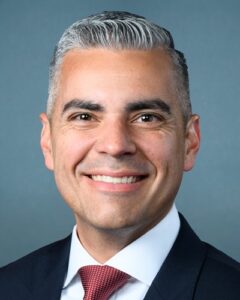
Tenure: 118th–119th Congresses
Years of Service: 2023–Present
Rep. Juan Ciscomani has developed a more substantial record on animal-related issues than many freshman and sophomore members of Congress, though his record reflects competing priorities. On one hand, he has demonstrated meaningful engagement on animal cruelty enforcement and humane treatment issues. On the other, he has supported several high-profile measures opposed by animal protection advocates, particularly concerning predators and wildlife management.
Unlike many lawmakers whose involvement in animal issues is limited to voting records, Ciscomani has taken an active role in introducing and cosponsoring legislation directly related to animal welfare. In 2025, he joined a bipartisan coalition to reintroduce the Animal Cruelty Enforcement (ACE) Act, legislation designed to strengthen federal prosecution of animal cruelty offenses by establishing a dedicated Animal Cruelty Crimes Section within the Department of Justice. Ciscomani publicly described animal cruelty as having “no place in our society” and emphasized the need to hold offenders accountable.
He has also emerged as an unexpected leader on wild horse and burro issues. In 2025, Ciscomani helped advance the bipartisan Wild Horse and Burro Protection Act and serves as a co-chair of the Congressional Wild Horse Caucus. The legislation seeks to end the controversial use of helicopters in wild horse roundups and replace them with more humane management practices. Ciscomani argued that these iconic western animals should be treated humanely while still allowing for responsible population management.
These efforts demonstrate a willingness to engage on animal welfare issues beyond companion animals and suggest that Ciscomani views humane treatment as a legitimate policy concern. His support for stronger cruelty enforcement and humane wild-horse management distinguishes him from many Republicans who have little visible involvement in animal protection legislation.
At the same time, Ciscomani’s record is far from uniformly supportive of animal protection priorities. He has aligned with agricultural and ranching interests on several wildlife-management issues, including support for legislation to remove Endangered Species Act protections from gray wolves.
His voting record reflects that mixed approach. Ciscomani supported the Farm, Food, and National Security Act of 2026, which included provisions opposed by many animal welfare advocates for preempting state farm-animal confinement standards. At the same time, his legislative activity on cruelty enforcement and humane treatment issues demonstrates a level of engagement rarely seen among rank-and-file House Republicans.
Taken together, Ciscomani’s record places him squarely in the mixed-record category. He has shown genuine interest in certain animal welfare issues and has taken leadership roles on humane treatment legislation, but those efforts are balanced by support for several anti-animal measures. His record suggests a lawmaker who is open to animal welfare concerns but who generally weighs them alongside agricultural, ranching, and western land-management priorities.
Notable Actions
119th Congress
✅ Cosponsor of the Save America’s Forgotten Equines (SAFE) Act, H.R. 1661, to ban U.S.-based horse slaughter and the export of horses for slaughter for human consumption.
✅ Cosponsor of the Fighting Inhumane Gambling and High-Risk Trafficking (FIGHT) Act, H.R. 3946, to strengthen federal enforcement against animal fighting and related criminal activity.
✅ Cosponsor of the No Flight, No Fight Act, H.R. 7371, to stop the smuggling of fighting birds via commercial airlines—an illicit practice that has gone largely unenforced since Congress prohibited the interstate and foreign transport of fighting birds in 2002.
✅ Cosponsor of the Animal Cruelty Enforcement (ACE) Act, H.R. 1477, to establish a dedicated DOJ unit to investigate and prosecute animal cruelty crimes.
✅ Cosponsor of the Prevent All Soring Tactics (PAST) Act, H.R. 1684, to strengthen enforcement against the cruel practice of soring horses. The bill would ban devices associated with soring, require independent USDA-trained inspectors, increase penalties for violations, and strengthen the Horse Protection Act to better protect Tennessee Walking Horses and other affected breeds from intentional abuse.
✅ Cosponsor of the Puppy Protection Act, H.R. 2253, bipartisan legislation to strengthen federal standards of care for dogs kept by commercial breeders by improving requirements for housing, veterinary care, exercise, socialization, and humane breeding practices.
✅ Cosponsor of the Better CARE for Animals Act, H.R. 3112, to strengthen enforcement of the Animal Welfare Act by expanding federal authority to investigate and prosecute animal cruelty violations and improve coordination between the U.S. Department of Agriculture and the Department of Justice.
✅ Signed a congressional letter to President Donald J. Trump urging him to permanently prohibit the export of American horses to Mexico for slaughter.
✅ Supported House passage of the FDA Modernization Act 3.0, H.R. 2821, which passed by voice vote under suspension of the rules on July 20, 2026. The bipartisan legislation directs the FDA to update its regulations to fully implement the 2022 law allowing scientifically valid non-animal methods to be used instead of animal testing in drug development.
❌ Voted “Aye” on H.R. 556, the Protecting Access for Hunters and Anglers Act (House Roll Call Vote 93), to prohibit federal land management agencies from restricting the use of toxic lead ammunition and fishing tackle on public lands and waters to protect wildlife from poisoning. The bill passed the House 215–202. An “Aye” vote is the anti-animal position because it limited the federal government’s ability to restrict toxic lead ammunition and fishing tackle that poison wildlife and contaminate the environment.
❌ Voted “Aye” on H.R. 845, the Pet and Livestock Protection Act (House Roll Call Vote 360), to remove federal Endangered Species Act protections for gray wolves across much of the United States and restricted judicial review of future wolf management decisions. The bill passed the House 211–204. An “Aye” vote is the anti-animal position because it removed Endangered Species Act protections for gray wolves and limited judicial review of future wolf management decisions.
✅ Voted “Nay” on the Riley Moore Amendment to H.R. 7567 (House Roll Call Vote 149), to weaken the Farm Bill’s Greyhound Protection Act provisions by creating a special exemption allowing commercial greyhound racing to continue in West Virginia indefinitely. The House rejected the amendment 187–237. A “Nay” vote is the pro-animal position.
❌ Voted “Aye” on H.R. 7567, the Farm, Food, and National Security Act (House Roll Call Vote 154), to pass the Farm Bill, which included a provision to overturn state laws in California and Massachusetts restricting in-state sales of fresh pork sourced from farms that do not provide minimum space requirements for the housing of pregnant pigs. The bill passed the House 224–200. An “Aye” vote is the anti-animal position because it supported overturning state farm animal welfare laws that require more humane housing standards for pregnant pigs.
❌ Voted “Aye” on the Biggs Amendment to H.R. 3838 (House Roll Call Vote 259), to exempt defense-related activities from the requirements of the Endangered Species Act, eliminating protections for endangered and threatened species and their critical habitat on military lands and during defense operations. The House rejected the amendment 200–228. An “Aye” vote is the anti-animal position because it sought to weaken Endangered Species Act protections for threatened and endangered wildlife on military lands.
❌ Voted “Aye” on the Greene Amendment to H.R. 3838 (House Roll Call Vote 254), to prohibit the Department of Defense from using FY2026 funds for the research, development, procurement, or promotion of cell-cultured meat, an emerging alternative to conventional slaughter-based meat production. The House rejected the amendment 194–236, with 1 voting present. An “Aye” vote is the anti-animal position because it sought to block federal support for the development of slaughter-free, cell-cultured meat alternatives that could reduce the number of animals raised and killed for food.
118th Congress
✅ Cosponsor of the Animal Cruelty Enforcement Act, H.R. 8923, to establish a dedicated DOJ unit to investigate and prosecute animal cruelty crimes.
✅ Cosponsor of the Fighting Inhumane Gambling and High-Risk Trafficking (FIGHT) Act, H.R. 2742, to strengthen federal enforcement against animal fighting and related criminal activity.
✅ Cosponsor of the Save America’s Forgotten Equines (SAFE) Act, H.R. 3475, to ban U.S.-based horse slaughter and the export of horses for slaughter for human consumption.
✅ Cosponsor of the Puppy Protection Act, H.R. 1624, bipartisan legislation to strengthen federal standards of care for dogs kept by commercial breeders by improving requirements for housing, veterinary care, exercise, socialization, and humane breeding practices.
✅ Cosponsor of the Prevent All Soring Tactics (PAST) Act, H.R. 3090, bipartisan legislation to strengthen enforcement against the cruel practice of soring horses. The bill would ban devices associated with soring, require independent USDA-trained inspectors, increase penalties for violations, and strengthen the Horse Protection Act to better protect Tennessee Walking Horses and other affected breeds from intentional abuse.
✅ Cosponsor of the Better CARE for Animals Act, H.R. 5041, to strengthen enforcement of the Animal Welfare Act by expanding federal authority to investigate and prosecute animal cruelty violations and improve coordination between the U.S. Department of Agriculture and the Department of Justice.
❌ Voted “Aye” on H.R. 764 (House Roll Call Vote 169), legislation to remove federal protections for gray wolves under the Endangered Species Act across most of the United States and return management authority to the states. Wildlife advocates warned that the bill would undermine science-based wildlife management and threaten the long-term recovery of gray wolf populations. The House passed the bill 209–205. An “Aye” vote is the anti-animal position because it removed Endangered Species Act protections for gray wolves across much of the United States, despite concerns that doing so would undermine their long-term recovery and science-based wildlife management.
❌ Voted “Aye” on H.R. 615 (House Roll Call Vote 167), legislation to bar the Department of the Interior and the Department of Agriculture from prohibiting or regulating the use of toxic lead ammunition and fishing tackle on federal lands and waters made available for hunting or fishing. Lead ammunition and tackle poison wildlife, including eagles, loons, condors, and other animals that ingest spent lead fragments or lost fishing gear. The House passed the bill 214–201. An “Aye” vote is the anti-animal position because it blocked federal agencies from restricting toxic lead ammunition and fishing tackle that poison eagles, loons, condors, and other wildlife.