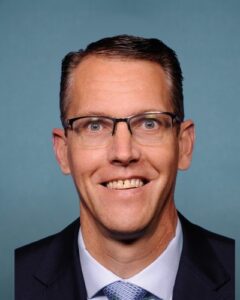
Tenure: 117th–119th Congresses
Years of Service: 2021–Present
Rep. Randy Feenstra’s record on animal-related policy is defined less by neutrality than by a consistent alignment with the interests and paranoia of agricultural trade associations and large-scale industrial animal producers, often at the expense of animal-welfare considerations. Representing one of the country’s most livestock-intensive districts, Feenstra has made clear that his priority is protecting the status quo when it comes to agricultural production models – not engaging with efforts to strengthen animal-protection standards. This orientation has shaped both his legislative activity and his voting record, placing him firmly within the most industry-aligned wing of the Republican conference.
Feenstra has not sponsored any meaningful animal-protection legislation. His fealty to agribusiness concerns seems to spill over to any and all animal issues, taking the “slippery slope” approach. During consideration of the Farm, Food and National Security Act, the Farm bill, he supported efforts to gut the core provisions of the FIGHT Act, even though it is the most bipartisan animal welfare bill in the Congress. He did not express support for the Greyhound Protection Act. His most consequential engagement in this space has come through support for efforts that would limit or roll back existing welfare standards. He has backed federal preemption proposals such as the End Agricultural Trade Suppression (EATS) Act and related measures like the Save Our Bacon Act, which are designed to nullify state-level laws governing farm-animal treatment. These proposals were developed largely in response to measures like California’s Proposition 12, which established minimum confinement standards for certain livestock.
In supporting these efforts, Feenstra has aligned himself with a coalition of major agricultural interests seeking to prevent states from setting higher welfare standards within their own markets. While these proposals are often framed as protecting interstate commerce, their practical effect would be to override state-level reforms and constrain future policy innovation. Feenstra’s position in this debate is not merely passive—it reflects an affirmative preference for limiting the reach of animal-welfare regulation when it conflicts with prevailing industry practices.
His voting record reinforces this pattern. On measures that would expand oversight of livestock production or uphold state authority to implement stronger welfare protections, Feenstra has generally supported positions that reduce regulatory requirements on producers. At the same time, he is quick to align with extreme hunting interests and even with exotic animal owners. He has consistently supported congressional removal of gray wolves from the list of threatened and endangered species. He voted to forbid federal agencies from restricting the use of toxic lead ammunition on federal lands even though it’s known to poison mass numbers of wild animals and threaten brain and heart health of hunting families who consume wild-game-meat. He even opposed the Big Cat Public Safety Act, which was drafted to halt the trade in powerful wild cats as pets and to stop breeding of tigers and other large carnivores for commercial cub petting operations. That legislation passed the Senate unanimously and passed the House by a two-to-one vote and was signed into law by President Biden. He has shown little to no engagement in other areas of animal policy – such as animal cruelty enforcement, companion animal protections, or wildlife conservation – where bipartisan participation is common and politically low-risk.
Publicly, Feenstra frames his approach in terms of defending farmers and preserving economic stability. However, critics argue that the policies he supports disproportionately benefit the largest producers while limiting the ability of states, consumers, and smaller market actors to drive higher standards. His rhetoric often emphasizes “family farms,” but the structural impact of the legislation he backs would tend to reinforce existing industry consolidation and maintain lower baseline welfare conditions.
Within the Republican caucus, Feenstra stands out not simply as agriculture-focused, but as consistently resistant to the expansion of animal-protection policy. Unlike members who occasionally support bipartisan welfare measures, his record shows little evidence of cross-cutting engagement or willingness to support even narrowly tailored reforms.
Taken together, Feenstra’s record reflects a lawmaker who is instinctively hostile to any animal welfare reform. While framed as a defense of agricultural interests, his approach has the practical effect of placing him at odds with family farmers, law enforcement, and even large-scale egg producers concerned about the spread of disease by fighting animals.
Notable Actions
119th Congress
❌ Voted “Aye” on House Agriculture Committee Record Vote No. 24, approving Rep. Tracey Mann’s second-degree amendment to Rep. Shri Thanedar’s Amendment No. 119 during markup of the 2026 Farm Bill. The Mann amendment stripped away nearly all of the bipartisan FIGHT Act’s enforcement provisions—including measures targeting the trafficking and shipment of fighting birds, expanded civil enforcement authority, and other tools to combat organized animal fighting—leaving primarily language related to gambling on animal fighting. The committee adopted the amendment by a 29–22 vote. An “Aye” vote is the anti-animal position because it substantially weakened the FIGHT Act before the committee unanimously adopted the amended Thanedar amendment.
✅ Supported House passage of the FDA Modernization Act 3.0, H.R. 2821, which passed by voice vote under suspension of the rules on July 20, 2026. The bipartisan legislation directs the FDA to update its regulations to fully implement the 2022 law allowing scientifically valid non-animal methods to be used instead of animal testing in drug development.
❌ Voted “Aye” on H.R. 556, the Protecting Access for Hunters and Anglers Act (House Roll Call Vote 93), to prohibit federal land management agencies from restricting the use of toxic lead ammunition and fishing tackle on public lands and waters to protect wildlife from poisoning. The bill passed the House 215–202. An “Aye” vote is the anti-animal position because it limited the federal government’s ability to restrict toxic lead ammunition and fishing tackle that poison wildlife and contaminate the environment.
❌ Voted “Aye” on H.R. 845, the Pet and Livestock Protection Act (House Roll Call Vote 360), to remove federal Endangered Species Act protections for gray wolves across much of the United States and restricted judicial review of future wolf management decisions. The bill passed the House 211–204. An “Aye” vote is the anti-animal position because it removed Endangered Species Act protections for gray wolves and limited judicial review of future wolf management decisions.
❌ Voted “Aye” on the Riley Moore Amendment (House Roll Call Vote 149), to weaken the Farm Bill’s Greyhound Protection Act provisions by creating a special exemption allowing commercial greyhound racing to continue in West Virginia indefinitely. The House rejected the amendment 187–237. An “Aye” vote is the anti-animal position because it sought to weaken greyhound protections by allowing commercial greyhound racing to continue indefinitely in West Virginia.
❌ Voted “Aye” on H.R. 7567, the Farm, Food, and National Security Act (House Roll Call Vote 154), to pass the Farm Bill, which included a provision to overturn state laws in California and Massachusetts restricting in-state sales of fresh pork sourced from farms that do not provide minimum space requirements for the housing of pregnant pigs. The bill passed the House 224–200. An “Aye” vote is the anti-animal position because it supported overturning state farm animal welfare laws that require more humane housing standards for pregnant pigs.
❌ Voted “Aye” on the Biggs Amendment to H.R. 3838 (House Roll Call Vote 259), to exempt defense-related activities from the requirements of the Endangered Species Act, eliminating protections for endangered and threatened species and their critical habitat on military lands and during defense operations. The House rejected the amendment 200–228. An “Aye” vote is the anti-animal position because it sought to weaken Endangered Species Act protections for threatened and endangered wildlife on military lands.
❌ Voted “Aye” on the Greene Amendment to H.R. 3838 (House Roll Call Vote 254), to prohibit the Department of Defense from using FY2026 funds for the research, development, procurement, or promotion of cell-cultured meat, an emerging alternative to conventional slaughter-based meat production. The House rejected the amendment 194–236, with 1 voting present. An “Aye” vote is the anti-animal position because it sought to block federal support for the development of slaughter-free, cell-cultured meat alternatives that could reduce the number of animals raised and killed for food.
118th Congress
❌ Voted “Aye” on H.R. 764 (House Roll Call Vote 169), legislation to remove federal protections for gray wolves under the Endangered Species Act across most of the United States and return management authority to the states. Wildlife advocates warned that the bill would undermine science-based wildlife management and threaten the long-term recovery of gray wolf populations. The House passed the bill 209–205. An “Aye” vote is the anti-animal position because it removed Endangered Species Act protections for gray wolves across much of the United States, despite concerns that doing so would undermine their long-term recovery and science-based wildlife management.
❌ Voted “Aye” on H.R. 615 (House Roll Call Vote 167), legislation to bar the Department of the Interior and the Department of Agriculture from prohibiting or regulating the use of toxic lead ammunition and fishing tackle on federal lands and waters made available for hunting or fishing. Lead ammunition and tackle poison wildlife, including eagles, loons, condors, and other animals that ingest spent lead fragments or lost fishing gear. The House passed the bill 214–201. An “Aye” vote is the anti-animal position because it blocked federal agencies from restricting toxic lead ammunition and fishing tackle that poison eagles, loons, condors, and other wildlife.
117th Congress
❌ Voted “Nay” on the motion to suspend the rules and pass Prevent All Soring Tactics (PAST) Act, H.R. 5441 (House Roll Call Vote 478). The bill would strengthen enforcement of the Horse Protection Act and help end the cruel practice of “soring” Tennessee Walking Horses, Racking Horses, and Spotted Saddle Horses. Soring involves intentionally inflicting severe pain on horses’ legs and hooves through caustic chemicals, chains, pressure devices, or other abusive methods to force an exaggerated, high-stepping gait known as the “Big Lick.” The motion was agreed to by a vote of 304–111, exceeding the two-thirds majority required under the suspension of the rules procedure. A “Nay” vote is the anti-animal position because it opposed stronger enforcement against the deliberate infliction of pain on horses to produce an exaggerated gait for competition.
❌ Voted “Nay” on Big Cat Public Safety Act, H.R. 263 (House Roll Call Vote 415), legislation to end the private possession and commercial breeding of lions, tigers, leopards, cheetahs, jaguars, cougars, and other big cats while prohibiting public contact with these animals. The bill targeted the exploitative cub-petting industry and roadside zoos, where big cats are repeatedly bred, handled, and discarded, while strengthening protections for both animals and public safety. A “Nay” vote is the anti-animal position because it opposed ending the commercial exploitation and private ownership of big cats.