Gestation Crates Have No Future in American Agriculture
Our new report dismantles the arguments of the National Pork Producers Council and the China-owned and operated Smithfield Foods to unwind Prop 12 and Question 3
- Wayne Pacelle
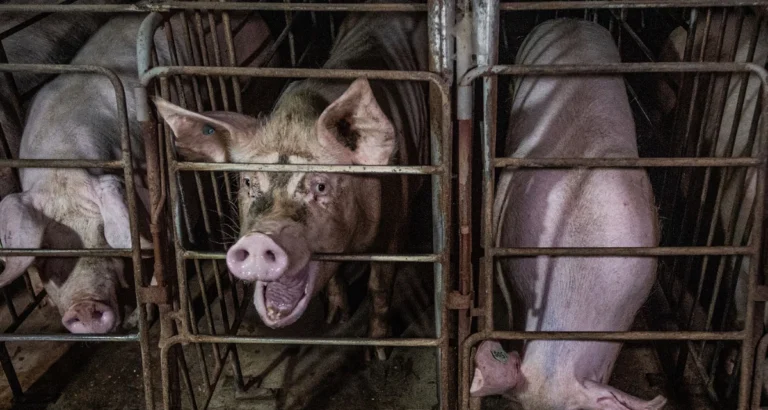
Earlier this month, Ohio became the 11th state to limit the use of gestation crates for breeding sows, restricting an extreme confinement measure that keeps pigs in metal traps so small the animals are unable to turn around or fully extend their limbs.
Enactment by the Ohio Livestock Care Standards Board fulfills the final provision of a landmark eight-point animal welfare agreement I worked to execute 15 years ago between animal advocates and Ohio’s leading agricultural organizations.
Fifteen years is a long time to wait for that provision to kick in, but the adoption of the policy does come at a propitious time: the leader of the U.S. House Agriculture Committee has promised in a month to bring forward a Farm bill — a bundle of agriculture-related policies that typically is enacted every five years but that is now nearly three years overdue.
Accommodating the wishes of the National Pork Producers Council (NPPC), the committee chairman has been dogged in pushing a so-called “Prop 12 fix” — which is legislative-speak for repealing Prop 12 in California and Question 3 in Massachusetts. Those state laws are two of the most consequential anti-confinement measures, banning not just inhumane production practices, but restricting in-state sales of cuts of fresh pork if the meat comes from factory farms that immobilize sows.
It’s been a long-time aspiration of the NPPC to prevent states from enacting such policies. But the NPPC lost this battle on the two prior Farm bills — in 2014 and 2018. And the group is paddling upstream in this Congress, too.
Nor has the trade association had better outcomes in the courts. By my count, the NPPC and its surrogates have now lost 21 straight cases challenging state farm animal welfare laws. Most importantly, the NPPC came up short in May 2023 to a dormant Commerce Clause claim against Prop 12 before the U.S. Supreme Court. The high court determined that California’s law was a proper exercise of its authority to promote animal welfare and food safety within the boundaries of the state.
The Shift Against Gestation Crates is Much Bigger Than Prop 12
It’s one thing for Congress to prevent states from passing agriculture-related policies — itself an unwarranted assault on states’ rights. But remember, Prop 12 and Question 3 are already in place. The Save Our Bacon Act (H.R. 4673) threatens to upend supply chains and distribution strategies working right now for consumers, retailers, and farmers.
The California Department of Food and Agriculture has certified 1,300 Prop 12-compliant suppliers and distributors. Many of them invested in new, higher-welfare housing systems, and they need markets, revenues, and certainty to offset those investments.
“We’ve given our producers choice,” said Brad Clemens, president of the Clemens Food Group, a top 10 U.S.-based pork producer. “This is their choice to be able to make this conversion, and a lot of them have…and it will absolutely take away a choice they have if the EATS Act [now the SOB Act] were to pass.”
The same is true for smaller producers. “Our farmers have invested millions to become compliant with Proposition 12. The EATS Act threatens the livelihoods of our farmers and the future of our business,” said Phil Gatto, co-founder and CEO of True Story Foods. And Russ Kremer, head of Farm Partnerships, added recently: “Voters made their voices heard, and we agree with them that animals deserve space to move… . Prop 12 gives small farms like ours the opportunity to survive during a time when agriculture is heavily consolidated and independent farmers are being pushed out.”
And it’s also hard for many of the NPPC’s biggest member companies to advocate for overturning Prop 12 when they are willingly participating in the California and Massachusetts marketplaces. The Oklahoma-based Seaboard Foods appears on the registry of companies supplying Prop 12-compliant pork and reports increased profits from “higher margins on pork products.” Tyson Foods’ CEO Donnie King acknowledged the company’s ability to supply Prop 12-compliant pork, stating, “we can align suppliers, and we can certainly provide the raw material to service our customers in that way.” Triumph Foods, which has led multiple lawsuits against Prop 12 and just lost a challenge to Question 3 in the U.S. Court of Appeals, maintains active California distribution.
Other industrial-scale pork companies are at odds with the NPPC on this issue. Iowa Select Brands and even the Brazil-based giant JBS appear to be actively opposing the NPPC on this campaign to overturn Prop 12 and may no longer be members of the trade association.
NPPC In Denial About Movement Against Crates
Nearly every major grocer, restaurant chain, and food distributor in the country has issued public statements against gestation crates. Two of the biggest names in American cost-conscious, high-volume food retail — McDonald’s and Costco — no longer sell any pork from farms that rely on gestation crates. But there are 60 other companies — from Cracker Barrel to Burger King to Walmart — that have made similar declarations, and it’s just a matter of time before they align their policy pronouncements with their supply-chain practices.
Congressional opposition to their campaign has also reached a new high-water mark. In November, 182 House Democrats — nearly 90% of the total number of Democrats in the House — wrote to Agriculture Committee leaders and declared their opposition to the SOB Act. In July, 32 Democrats in the Senate issued their own letter of opposition to its Senate counterpart, the Food Security and Farm Protection Act (S. 1326).
But the biggest blow came in September, when 14 Republicans sent a letter in opposition to the measures. The effort was led by Reps. Anna Paulina Luna, R-Fla., David Valadao, R-Calif., and Andrew Garbarino, R-N.Y., and joined by Michael Bilirakis, R-Fla., Vern Buchanan, R-Fla., Byron Donalds, R-Fla., Brian Fitzpatrick, R-Pa., Carlos Gimenez, R-Fla., Tom Kean, R-N.J., Young Kim, R-Calif., Michael Lawler, R-N.Y., Nancy Mace, R-S.C., Chris Smith, R-N.J., and Jeff Van Drew, R-N.J. Other Republicans are soon expected to join their ranks.
The Save Our Bacon Act “is a direct attack on America’s family farmers, states’ rights, and our food security,” wrote Rep. Luna, the lead author of the letter. “It hands Washington the power to override local control, while giving foreign adversaries like China an even tighter grip on our food supply. China already owns Smithfield Foods — and with it, nearly a quarter of America’s pork market. We cannot afford to let federal overreach put American agriculture in foreign hands. Congress must reject the EATS Act and stand with U.S. farmers.” Rep. Luna’s home state of Florida was the first state in the nation to ban gestation crates, and it did so through a vote of the people.
Rep. Luna is correct that no sector of American agriculture has a larger share of foreign control than the pig industry. Two companies — Smithfield Foods, owned by a Chinese company and indirectly controlled by that country’s authoritarian government, and JBS, based in Brazil — alone control 40% of American domestic pig production. These details are included in our newly released report on the methodical implementation of Prop 12 and the misguided efforts to overturn it. (You can read our new report here.)
That science-based and analytical report — coauthored by Jim Keen, DVM, Ph.D., Col. Thomas Pool, DVM, MPA, and Svetlana Feigin, Ph.D., — documents the measure’s many defects and its de facto invitation for China to expand its U.S. footprint even more, including use of high-rise hog factories, through its U.S.-based proxy, Smithfield Foods.
From the get-go, the NPPC has underestimated the adaptability of American farmers and misread the value systems of its customers. The evidence for the resourcefulness of farmers is evident in the evolving and more humane farming practices at work in states across the nation, while the value system of the consumers is reverberating and exerting its influence in so many ways: the supply-chain decisions of America’s leading food retailers, the landslide elections favoring an end to extreme confinement, and the cascade of decisions by judges and lawmakers affirming the good instincts of Americans to give the animals a chance to move.
Wayne Pacelle, president of the Center for a Humane Economy & Animal Wellness Action, is the author of two New York Times bestselling books, “The Bond” and “The Humane Economy.”
Dear reader: If you support substantive policy work to protect animals, please consider donating to Animal Wellness Action here. You can give any amount one time, or make it a monthly gift, as many of our supporters do. Thank you for helping us fight for all animals.