

Bipartisan coalition launches renewed effort to ban intentional use of snowmobiles and other vehicles to run down wolves, coyotes, and wildlife on federal lands
WASHINGTON — In a bipartisan effort to curb extreme cruelty to wildlife on federal lands, Reps. Val Hoyle, D-Ore., Mike Lawler, R-N.Y., Debbie Dingell, D-Mich., and Brian Fitzpatrick, R-Pa., today introduced the Snowmobiles Aren’t Weapons (SAW) Act, legislation to prohibit the intentional use of snowmobiles and other motor vehicles to injure and kill wolves, coyotes, and other native animals on public lands across the United States. They did so as the House takes up H.R. 845, a bill by Reps. Lauren Boebert, R-Colo., and Tom Tiffany, R-Wisc., to remove all federal protections for wolves, potentially opening up more “whacking” or “thumping” of wolves on federal lands outside of the Northern Rockies’ states.
“Running animals down with motor vehicles is a grotesque form of cruelty that has no place in our society, including on our national forests and other federal lands,” said Wayne Pacelle, president of Animal Wellness Action and the Center for a Humane Economy. “The SAW Act addresses a horrifying and unthinkable abuse—turning 500-pound vehicles into weapons to crush and kill wolves, coyotes, and other wildlife—and establishes a legal standard forbidding the practice.”
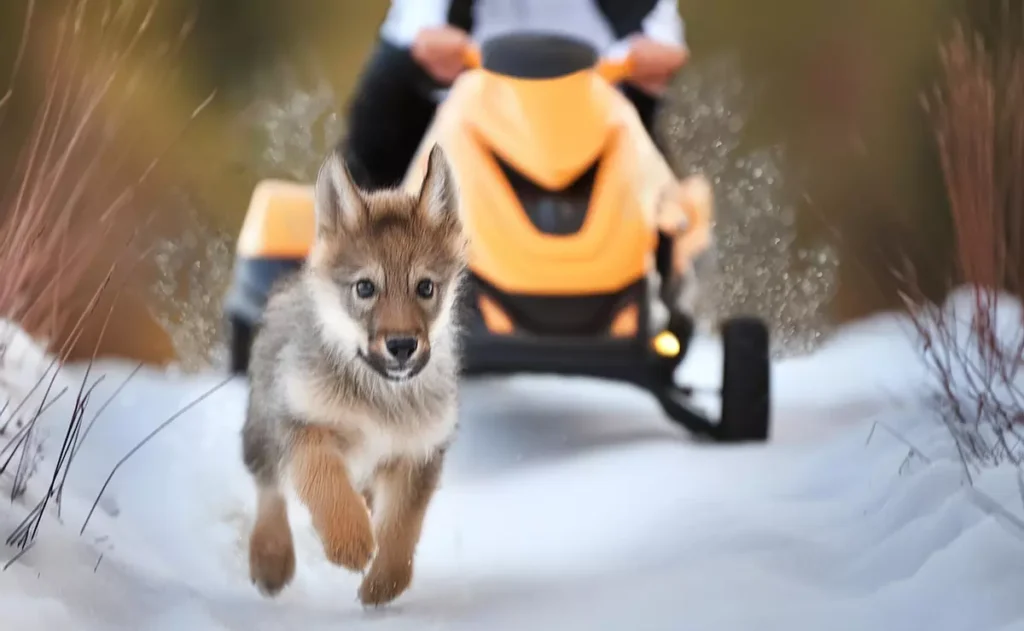
Awareness of the barbaric and cruel practices of “whacking” or “thumping” came to light after a wolf torture incident committed by Wyoming trophy hunter and rancher Cody Roberts spurred international outrage and condemnation. He used a snowmobile to run over and capture an adolescent female wolf. Roberts publicly tormented the wolf before patrons at a bar, celebrated the abuse on social media, and shot the animal to death behind a bar in Daniel, Wyo.
The SAW Act would close a glaring gap in federal wildlife protections by clearly prohibiting the intentional use of ground-based motor vehicles as weapons against wildlife on lands managed by the U.S. Department of the Interior, including national parks, national wildlife refuges, Bureau of Land Management lands, and other federal areas where wildlife roam and Americans recreate.
“At a time when the House is taking up problematic legislation to remove federal protections for gray wolves from the Endangered Species Act, it’s more important than ever to stand up for responsible stewardship of our public lands and wildlife,” said Congresswoman Hoyle. “This bipartisan legislation shows we can work through thoughtful policy debates on conservation and wildlife management without condoning cruel and dangerous practices that threaten animals and public safety.”
“Using motor vehicles as weapons against wildlife has no place on our federal lands. This legislation makes clear that intentionally harassing, hunting, or killing animals with motor vehicles is unacceptable and will be met with serious consequences. The SAW Act protects both public safety and wildlife while allowing for common-sense exceptions for self-defense,” said Congressman Lawler.
BACKGROUND
Most states do not have laws explicitly prohibiting the running over animals with snowmobiles or other motorized vehicles. But Colorado, Minnesota, and Oregon do have such laws and they have been working well to discourage this sort of cruelty to wildlife. In the nearly four decades since its enactment, the Minnesota law has generated no objections from ranchers, farmers, sportsmen, or other stakeholders involved in wolf and coyote policy. “Minnesota has more wolves than any other state in the lower 48 and is a snowmobiling mecca, so the law’s long-standing acceptance offers an important and practical example,” said Pacelle.
While several states prohibit hunting wildlife “from motor vehicles,” those statutes are vague and largely untested when it comes to “whacking,” in which the vehicle itself is used as a weapon to chase, injure, incapacitate, and kill animals. In light of recent incidents in Wyoming and documented use of snowmobiles to pursue and kill predators in neighboring Montana and Idaho, the SAW Act would close this legal loophole and make clear that such acts of cruelty have no place on America’s public lands.
Congress enacted the federal Airborne Hunting Act in 1971, after people took to the air to shot and kill wolves and polar bears from the air. These practices were rightly considered an affront to any notion of ethical or fair chase hunting – a concept that Teddy Roosevelt introduced in hunting in 1893 and that’s become a norm in the sport. Rep. Dingell’s late husband – the legendary John Dingell – was the last author of the Airborne Hunting Act.
So far, there are 254 groups that have endorsed the SAW Act. Full text of the SAW Act can be found here.