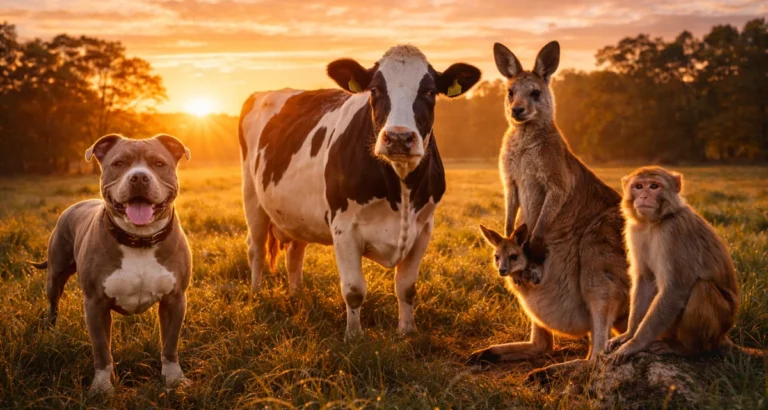
Our Top 10 Gains, Battles for Animals in 2025
Fighting for all animals, casting aside archaic and cruel practices, and embracing human ingenuity and resourcefulness
- Wayne Pacelle
This was one of the most consequential years ever for Animal Wellness Action and the Center for a Humane Economy in our quest to shape public and corporate policy in the economic sectors where animals are at risk. This was a year of unprecedented progress against animal testing and the global trade in kangaroo skins. We are also eliminating a national cow’s milk mandate that hurts cows and kids alike. We are poised to enhance the national response to malicious animal cruelty, as we zero in on animal fighting and work to dismantle the extensive networks in operation. We are in pitched battles to save wolves and North American owls, but we are confronting stiff resistance from trophy hunters, trappers, the timber industry, and even some misguided environmental organizations.
What follows are some highlights and concrete achievements we secured in 2025. We are only capable of driving game-changing results with your support.
KANGAROOS ARE NOT SHOES
Eliminating kangaroo skins for all global athletic shoe brands.
Adidas announced its plan to halt any sourcing of kangaroo skins for its soccer shoe models after the Center for a Humane Economy presented its case for this corporate policy reform at its Annual General Meeting in Germany. The Japanese companies ASICS and Mizuno followed suit, as did the U.K.-based Umbro. With earlier pledges from Nike, New Balance, Puma, and others, we’ve now run the table with all major global athletic shoe brands, just five years after the launch of our Kangaroos Are Not Shoes campaign. These companies sell to hundreds of millions of soccer players in more than 190 nations, and it’s that trade that has driven the annual slaughter of two million kangaroos in their native habitats in Australia. By reducing demand in these foreign markets, we are eliminating the commercial incentive for shooters to conduct their nighttime shooting sprees.
MODERNIZE TESTING (I)
Winding down animal testing in America.
In April, in his first public act as FDA commissioner, Dr. Marty Makary released his agency’s “Roadmap to Reduce Animal Testing in Preclinical Safety Studies,” explicitly noting our 2022 legislation, the FDA Modernization Act 2.0, as the legal basis for the policy. In December, for the second time in less than 13 months, the U.S. Senate unanimously passed our FDA Modernization Act 3.0 to formally align FDA’s regulations with the 2022 law, and we expect the House to act on it in the new year. Meanwhile, in a series of coordinated actions this year by the Environmental Protection Agency (EPA), U.S. Food and Drug Administration (FDA), National Institutes of Health (NIH), and the Centers for Disease Control and Prevention (CDC), the Trump Administration began taking concrete steps to wind down federal animal testing and embrace 21st-century, human-relevant science.
MODERNIZE TESTING (II)
Ending the use of a hundred thousand primates a year in invasive tests.
In a national television broadcast in December, HHS Secretary Bobby Kennedy raised serious concerns about the continued importation of primates and the operation of the National Primate Centers, explaining that researchers become locked into animal-based models because of profit motives even “when there are better ways and predictive models.” Kennedy also emphasized the Administration’s focus on expanding post-research retirement options for animals, stating, “now we are building sanctuaries across the country.” The CDC is already taking practical action to phase out all monkey research. Also in December, a powerful, bipartisan group of 20 lawmakers sent a letter urging the NIH to wind down primate testing as a show of support for the efforts of the public health agency leaders.
MODERNIZE TESTING (III)
Major supplier of beagles to labs to be shuttered.
In a non-governmental action, Ridglan Farms, a massive beagle breeding operation in Dane County, Wisc., that supplies dogs to laboratories for invasive use, will relinquish its license to breed and sell beagles for experimentation in mid-2026 after a coalition including the Center for a Humane Economy got involved. The company’s exit from the beagle lab trade comes three years after the federal government shut down a Virginia facility operated by Envigo, which also maintained thousands of dogs for sale to laboratories, following multiple animal welfare violations. Just one major beagle breeding supplier—Marshall Bioresources in upstate New York—will remain, and we’re focused on delivering the same outcome here.
DUNKING THE MILK MANDATE IN THE SCHOOLS
Eliminating an 80-year cow’s milk mandate in the National School Lunch Program.
Both chambers of Congress passed legislation to incorporate key provisions of our Freedom in School Cafeterias and Lunches (FISCAL) Act to eliminate a dairy-industry monopoly and give kids plant-based milk options in school meals. For decades, the milk mandate put bioengineered dairy cows through the rigors of hyper-production (the average Holstein now produces 25,000 pounds of milk a year) only to see much of their milk tossed in the trash. Dairy cows are often spent at a young age, sometimes becoming downers, on their way to slaughter. With our primary partner, Switch4Good, we built a coalition of 200 organizations, including food allergy and disease groups and educational associations, as well as educational associations, and lined up a bipartisan set of lawmakers in the House and Senate to drive forward this reform. With the provisions poised to become law with the president’s signature, we’ll be working with Switch4Good on a national campaign to alert kids to the human and animal health challenges associated with dairy consumption.
CAGE-FREE FUTURE
Protecting Prop 12 and Question 3 from attacks in the courts and in Congress.
Again in 2025, we’ve stymied attempts by the National Pork Producers Council (NPPC) and its factory farming surrogates to overturn the nation’s most important anti-farm-animal confinement laws—Prop 12 in California and Question 3 in Massachusetts. The U.S. Supreme Court chose not to take up a second case brought by factory farmers challenging the law and a key federal appeals court turned back an appeal by a Missouri-based factory farming company and upheld the Massachusetts farm-animal protection law. That case marked the 20th straight legal defeat of the NPPC and its surrogates on the subject. At the same time, in Congress, we’ve organized letters signed by 226 Democrats and Republicans opposing an effort to federally overturn these state laws. We’ll keep up the fight in 2026 and continue making the case that state sovereignty matters, that farm animals deserve to fully extend their limbs, and that thousands of American farmers who’ve spent billions to comply with the law do not deserve to lose their investment to the advantage of foreign-owned corporate factory farms.
ANIMAL FIGHTING IS THE PITS
Cockfighting derbies broken up at record pace, upgrade of federal law looms.
Our undercover investigations and tips to local law enforcement broke up major cockfighting derbies and produced a surge in arrests, including two outspoken cockfighters who’d been organizing a pro-cockfighting movement across the nation. As a result of our complaints, the Oklahoma Ethics Commission ordered the cockfighters to dismantle their PAC and fined them $10,000. A long-term investigation our team conducted has uncovered a vast criminal cockfighting network spanning from Tulsa to Dallas, exposing a Texas front company that acts as a broker for fighting animals reared in the United States and then trafficked to the Philippines to die in fighting arenas there. We called out Korean Air as the key link in the transport chain and also blew the whistle on sales of cockfighting implements on e-commerce platforms eBay and Etsy. Though Etsy quickly complied with our request to take the ads down, we are still contending with eBay. We’ve attracted more than 1,000 organizations and agencies as endorsers of the FIGHT Act in Congress, including nearly all major American law enforcement agencies.
ZERO TOLERANCE FOR CRUELTY
House calls on DOJ to fund new prosecutors’ unit to tackle animal abuse.
Our multi-year quest to create an animal cruelty crimes section at the Department of Justice, with a team of federal prosecutors to enforce our national laws against animal fighting and other forms of malicious cruelty, took a giant step closer to reality. The Fiscal Year 2026 House appropriations bill funding the Department of Justice urges the attorney general to allocate $2 million from funds provided to assemble a dedicated team of federal anti-cruelty prosecutors.
Meanwhile, the DOJ also issued guidance to all 93 U.S. Attorneys to make animal cruelty a priority. DOJ and USDA said they’ll create a task force to examine animal cruelty crimes.
SAVING OWLS
We have made the mass killing of forest owls in the Pacific Northwest a national scandal.
We’ve put the national spotlight on the U.S. Fish and Wildlife Service plan to kill a half million North American barred owls in three Pacific Coast states. We worked with allies in Congress to write letters and introduce resolutions to stop the slaughter. Senator John Kennedy’s floor speech against the owl kill has already generated more than 2 million views. What’s more, we’ve uncovered that the plan is even worse than originally described: it is not only an unprecedented assault on barred owls, but a maneuver by federal land management agencies and the timber industry to kill threatened Northern spotted owls and to start cutting some of the most precious old-growth forests in the Pacific Northwest. We’ve amassed testimonials from a dozen leading wildlife scientists (e.g., here, here, and here). Former top scientists at the National Park Service with the Coalition to Protect America’s National Parks asserted that the plan opens 14 iconic national parks to owl hunting and has no chance of success. Meanwhile, we are litigating in a U.S. District Court in Portland, Ore., to nullify the costly, inhumane, and entirely unworkable scheme.
PROTECTING WOLVES
Holding off federal delisting of wolves, but the battle continues.
For another year, we’ve held off efforts to strip federal threatened and endangered status from wolves across most of their range, but threats to their protected status continue to loom due to the machinations of some within Congress and the Interior Department. But we also went on the offense in the Northern Rockies region where they are not protected, securing a ruling that U.S. Fish and Wildlife Service was wrong to cast aside a petition to restore federal protections for wolves. Thus far, the agency has not acted to remediate the problems identified in the courts. And Wyoming rancher and trophy hunter Cody Roberts is being prosecuted in Wyoming after a relentless national campaign to demand justice for his savage act of animal cruelty—crushing a young female wolf with a snowmobile and then taking her captive and tormenting her. We’ve worked with allies in Congress to introduce the Snowmobiles Aren’t Weapons (SAW) Act in Congress to outlaw the use of motorized vehicles to chase, ram, crush, or kill wolves and other mammals on federal lands.
Wayne Pacelle, president of the Center for a Humane Economy & Animal Wellness Action, is the author of two New York Times bestselling books, “The Bond” and “The Humane Economy.”
Dear reader: If you support substantive policy work to protect animals, please consider donating to Animal Wellness Action here. You can give any amount one time, or make it a monthly gift, as many of our supporters do. Thank you for helping us fight for all animals.