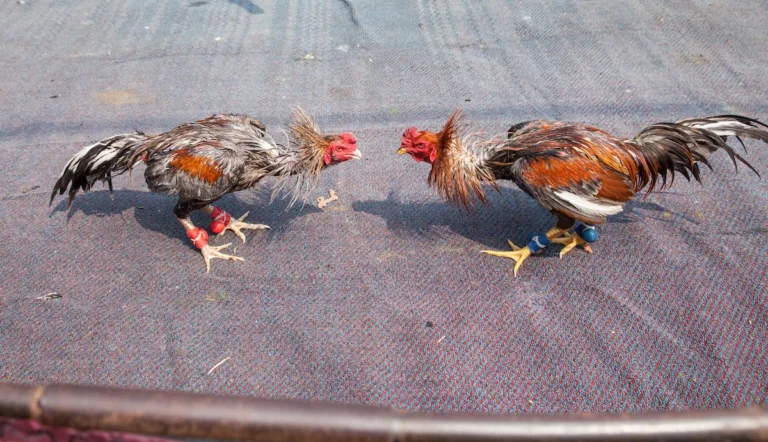
Political Dustup in St. Landry Parish in Louisiana Reminds Us Why the FIGHT Act is So Urgently Needed
Some Louisiana cockfighters are seeking an enclave for staged animal fights even as the movement against animal fighting has more momentum than ever
- Wayne Pacelle
The headlines tell the big-picture story of how animal fighting is held in contempt in American law and culture, yet the practice remains a persistent problem requiring urgent action to dismantle these criminal networks.
- “Multiple arrests made after MCSO busts cockfighting ring near Tonopah” in Arizona (January 11).
- “‘Over 400 roosters’: Large, organized cockfighting ring busted in Forsyth County” in North Carolina (January 16).
- “South Carolina man arrested in connection with organized dogfighting ring” (January 18).
Since we launched our Animal Fighting Is the Pits campaign a few years ago—with our investigations and research, our collaboration with law enforcement, and our field operations with Showing Animals Respect and Kindness (SHARK)—there have never been more enforcement actions against animal fighters. No animal fighter gets a pass any longer, even as tens of thousands of people are still involved in these heinous crimes against animals—with perhaps 20 million fighting birds in the nation and tens of thousands of pit bull-type dogs conscripted into bloody duels.
That’s why the initiative by cockfighters in St. Landry Parish—who somehow believe that parish officials can unilaterally make their jurisdiction a legal cockfighting enclave—is so bizarre. They’re wistful about the good old days when their parish hosted cockfighters from across the Southeast at one of the nation’s most infamous cockfighting pits, the Sunset Recreation Club, shuttered in 2008 after Louisiana became the 50th state to outlaw cockfighting.
Jim Demourelle and other cockfighters who came up with this cockamamie plan just can’t get over it. And they are utterly oblivious to the shift in American culture and law. Louisiana made cockfighting a felony offense, and there’s no opt-out for any parish. Animal fighting is also a federal felony, banned on every inch of U.S. soil—from Puerto Rico to Guam and everywhere in between.
The serious-minded effort on the legislative front is not the St. Landry Parish folly, but the work to advance the FIGHT Act in Congress. This measure—which seeks stronger enforcement tools to dismantle dogfighting and cockfighting crime syndicates—would be the sixth upgrade of the federal animal fighting law since 2002. And not one of the prior, successful efforts had the outpouring of support that the FIGHT Act has attracted.
The FIGHT Act Would Help Our Nation Eradicate Dogfighting and Cockfighting
Sen. John Kennedy, a conservative Republican who is arguably the most popular elected official in Louisiana and one of the best-known senators in America, thanks to his smarts and wit, is carrying the FIGHT Act with Sen. Cory Booker, D-N.J. In the House, Reps. Don Bacon, R-Neb., and Andrea Salinas, D-Ore., have the companion bill, and their measure is backed by more than 1,050 endorsing organizations, including the National Sheriffs’ Association, the National District Attorneys’ Association, 40 state sheriffs’ and prosecutors’ associations, the American Gaming Association, the United Egg Producers, and a vast roster of agricultural, law enforcement, animal welfare and conservation groups.
The National Sheriffs’ Association—representing all 3,000 elected county and parish sheriffs in the United States—says dogfighting and cockfighting are “crimes of violence,” noting that the FBI classifies them alongside offenses such as arson and burglary. It says animal fighting is linked to crimes against people, including “child abuse, murder, assault, theft, intimidation of neighbors and witnesses, and human trafficking.” The FBI warns that animal fighting investigations routinely uncover “intricate criminal networks” with connections to organized crime, narcotics trafficking, illegal firearms, and even attempted bribery of elected officials.
U.S. Homeland Security Investigations has tied animal fighting to illegal immigration networks, money laundering, and organized crime, and it has done raids against the activity, including in Alabama, Mississippi, and Puerto Rico.
U.S.-based cockfighters are engaging in a massive trade with Mexican cartels that control many of the major cockfighting venues south of the border, creating a separate border crisis centered around animal trafficking and the narcotics trade that has spawned mass shootings and other violent crime that has put Americans and Mexicans in the morgue. The second-largest market for foreign shipments of U.S.-reared fighting birds is the Philippines, where organized crime rackets have killed more than 100 people over gambling debts associated with cockfighting. American cockfighters are heading by the hundreds this month to enter their birds (with the transportation of their animals a federal felony) to participate in the World Slasher Cup in Manila.
Louisiana Already Settled This Question—Overwhelmingly
Perhaps the most striking aspect of the St. Landry proposal is its complete disconnect with reality by the cockfighters. By 2007, after voter-approved ballot measures outlawed the practice in Arizona, Missouri, and Oklahoma, and state lawmakers in New Mexico did the same, Louisiana was the last state in the nation where cockfighting remained legal. That status had become a national embarrassment, and lawmakers from both parties knew it.
The Louisiana House of Representatives passed the cockfighting ban by a staggering 102-1 vote. The Senate followed with a 34-4 vote in favor of prohibition. The debate was not about whether cockfighting should end, but whether it should be immediate or within 12 months. The final compromise phased out gambling at cockfights in 2007 and banned cockfighting outright in 2008. (Note: Also in 2007, Congress made animal fighting a federal felony, providing an overlapping prohibition on staged fights in the 50 states.)
The rapid-fire set of political actions amounts to a collective American rejection of cockfighting as incompatible with norms of decency and civil society. All staged animal fighting must end—just as society eventually treated bear baiting, foot-binding, burning “witches” at the stake, and gladiator fights as shameful and no longer tolerable.
Some Louisiana Cockfighters Acting Like It’s 1826, Not 2026
Cockfighters are delusional if they think St. Landry Parish officials can simply carve out an exception to settled state and federal law.
Louisiana law criminalizes cockfighting everywhere in the state. Federal law criminalizes cockfighting everywhere in the United States.
Let’s also understand that Congress now wants to make the federal law even tougher. And that effort is being led by a Louisianan.
And he’s standing on solid ground in doing so. Every major political figure in the state, and just about every state lawmaker, in the 21st century came out on the record against cockfighting. In 2004, Congressman David Vitter defeated Congressman Chris John in a U.S. Senate race in which John’s past support for cockfighting became his political undoing.
Former Sen. Mary Landrieu, a Democrat and an ideological opposite of Vitter’s, was onboard with the effort to make animal fighting a felony. Her successor, Sen. Bill Cassidy, a Republican, is a cosponsor of Sen. Kennedy’s FIGHT Act, aligning Louisiana’s two most prominent federally elected lawmakers on this issue.
In truth, St. Landry Parish is an amusing sideshow. The main arena is where the action is: that’s Congress, where the FIGHT Act is being considered.
Soon we’ll see who in Congress stands with the dogfighters and the cockfighters, and who stands for the rule of law, for dismantling the cartels and other organized crime networks at the center of the animal fighting crime business.
We’ll be telling that story far beyond the boundaries of St. Landry Parish.
Wayne Pacelle, president of the Center for a Humane Economy & Animal Wellness Action, is the author of two New York Times bestselling books, “The Bond” and “The Humane Economy.”
Dear reader: If you support substantive policy work to protect animals, please consider donating to Animal Wellness Action here. You can give any amount one time, or make it a monthly gift, as many of our supporters do. Thank you for helping us fight for all animals.