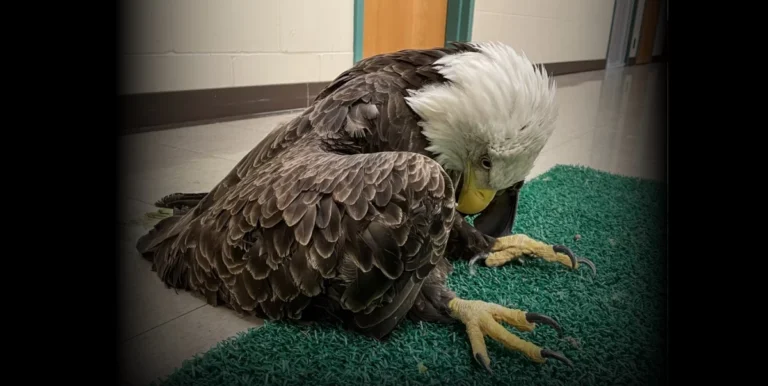
The Eagles Have Landed. With a Thud. After Ingesting Spent Lead Ammo
The U.S. House is taking up a bill today to allow hunters to keep dispersing thousands of tons of lead on our public lands
- Wayne Pacelle
I am just amazed at how people rationalize their needless killing and torment of animals.
I am talking today about the mass use of lead ammunition in sport hunting in America. Hunters disperse 40,000 to 80,000 tons of lead ammunition across three-quarters of the landmass of the United States — 1.5 billion acres.
And I am disgusted that the U.S. House of Representatives — with a raft of pro-animal welfare bills with bipartisan support waiting in the wings and suffering from congressional inattention — is spending its precious time today on H.R. 556, a bill to bar the U.S. Fish and Wildlife Service, the U.S. Forest Service, and the Bureau of Land Management from placing limits on the use of deadly lead ammunition in hunting.
The bill is the wish of the NRA and other extremist hunting groups, and it reminds us what’s wrong with Washington, D.C.
Lead kills just about any creature who ingests the toxic element. There’s no safe level of consumption for a human, an eagle, a fox, or any other life form.
We can avoid poisoning thousands of bald and golden eagles across America every year just by switching to non-toxic ammunition. Rounds made from copper, bismuth, tungsten, and other elements and alloys have plenty of killing power but don’t kill eagles and other wildlife long after they leave the barrel of a gun.
Let’s just take the plight of eagles, supposedly protected in America under two statutes — the Bald and Golden Eagle Protection Act and the Migratory Bird Treaty Act. Those protections prove hollow, given that our nation is permitting mass scattering of lead fragments from hunting on lands that the eagles frequent for feeding.
- A landmark 2022 study published in Science documented continent-wide lead poisoning in bald and golden eagles. The eight-year study of 1,210 eagles across 38 states found that nearly half of the eagles had bone lead levels consistent with chronic poisoning, and roughly one-third showed evidence of acute exposure.
- According to the Wildlife Center of Virginia and recent news reports about this facility in Waynesboro, veterinarians treated a record 76 bald eagles in 2025, with 70% testing positive for lead poisoning.
- Iowa Bird Rehabilitation staff and volunteers rescued three bald eagles — all suffering from lead poisoning — within hours of each other this winter. According to the Des Moines Register, “2026 has been an anomaly for SOAR. It has treated 18 eagles — 14 with lead poisoning — so far this year,” noting that the “eagles with lead poisoning usually don’t survive.”
- The Lansing State Journal said an Eaton Rapids wildlife rehab center in Michigan took in its fourth bald eagle with lead poisoning this winter, two of which have already died from ingesting the toxic heavy metal. “He was only 5 lbs.,” the center said of the eagle from mid-February, “starving to death because he no longer was able to hunt due to the lead poisoning shutting down his system… . He passed away overnight … . [J]ust barely 5 years old … we could tell because he still had some juvenile feathers. It’s sad, we’re sad.”
- The Cowboy State Daily reported last week that farmers in the small town of Elizabeth, Colorado, discovered a lethargic and severely underweight young male bald eagle, and that staff at a nearby raptor rehabilitation center in Sedalia had been working for more than a week to keep him alive and restore his health.
Hunting writer Ted Williams wrote in the (Maryland) Star Democrat that “[a]mmo companies introduced copper bullets — not to prevent plumbism, but to kill game more effectively, and they do.” He went to quote the New York Department of Environmental Conservation, which said, “Fortunately, today’s harder copper and other copper alloy bullets and [shotgun] slugs typically remain intact on impact, transferring more energy to the target by folding downward into ‘petals’ that greatly expand the surface area. The result is a very effective, quick, humane kill.”
This Pain and Suffering of Wildlife Is All Avoidable
A single round can shatter into millions of small fragments that travel up to 18 inches away from the bullet’s wound channel, especially when it strikes bone. One recent study shows that lead dust cannot even be picked up by a microscope or X-ray, never mind the human eye. High-velocity ballistic-tip lead bullets left an average of 141 fragments in a mean distance of 11 inches from the wound channel, according to one state fish and wildlife agency study.
The U.S. Fish and Wildlife Service required non-toxic shot for duck and goose hunting 35 years ago. This spares 3 million migratory waterfowl a year. With more ducks and geese in the fall flights, that’s more opportunity for hunting success.
Now, hunters can shop in the online marketplace and get ammo delivered to their door within days. If the transition to steel shot was doable 35 years ago, it’s a no-brainer today.
And it’s a threat to all people who consume wild game meat where hunters go afield with rifles and shotguns loaded with lead. In the United States, we have two federal agencies — the U.S. Food and Drug Administration and the U.S. Department of Agriculture — responsible for enforcing safety standards to keep us safe from dangerous substances in foods. But neither food safety agency would ever allow the levels of lead that impregnate the carcass of a deer or a dove that hunters take home for the pot or pan.
Top scientists with the U.S. Fish and Wildlife Service and the National Park Service, along with public health experts at Johns Hopkins University, say that we must put an end to the use of lead ammunition in sport hunting.
And invest in our campaign to rid the nation of lead ammunition. Non-toxic ammunition is better on all levels, including because it doesn’t keep killing long after it’s left the barrel.
Photo credit: The Raptor Center, University of Minnesota
Dear reader: If you support substantive policy work to protect animals, please consider donating to Animal Wellness Action here. You can give any amount one time, or make it a monthly gift, as many of our supporters do. Thank you for helping us fight for all animals.