Why Repealing the Roadless Rule Is a Direct Threat to Wildlife
Rolling back roadless protections would trade intact habitat for more roads, more killing, and fewer wild places.
by Ted Williams
On June 23, Agriculture Secretary Brooke Rollins announced the Administration’s decision to abolish the rule that provides protection for 58.5 million acres of roadless areas, only 30.3% of the 193 million acres managed by the U.S. Forest Service.
“I’m excited to announce today… our intent to repeal the disastrous ‘Roadless Rule,’” she declared. “The heavy hand of Washington will no longer inhibit the management of our nation’s forests under the leadership of President Trump. Once again, President Trump is removing absurd obstacles to common-sense management of our natural resources by rescinding the overly restrictive Roadless Rule.”
The Administrative Procedure Act requires a rulemaking process entailing notice in “The Federal Register” and a public comment period that ended last September. And the National Environmental Policy Act requires the Forest Service to review all comments and demonstrate that it considered them in its final decision.
Of the 183,000 public comments, 99% opposed Trump’s proposed abolishment of the Roadless Rule. Despite the extraordinary level of opposition, at this writing (mid-January 2026) the administration presses on with abolishment.
In 2020, when Trump announced his intent to remove roadless protection from the 9.3-million-acre roadless section of our biggest and wildest national forest, the 16.7-million-acre Tongass in southeast Alaska, 96% of the public comments were opposed. Trump then removed protection. (In January 2023, President Biden restored it.)
It's not like we don’t have enough logging roads. Our National Forest System is already sliced and diced with 370,000 miles of roads—enough to circle the globe 15 times.
As President Clinton’s Forest Service chief, Michael Dombeck—father of the Roadless Rule—declared, “No Forest Service program has dominance over another. Timber is not more important than wildlife and fisheries.” Congress and President Eisenhower said the same with the 1960 Multiple-Use Sustained Yield Act, a law the Forest Service now ignores.
Rollins’ excitement notwithstanding, abolishment of the Roadless Rule can’t remove “obstacles to common-sense management.” Roads are the obstacles. Roads serve as conduits for invasive species, which deplete native wildlife. The motor traffic that roads create destroys de facto wilderness along with the wildlife the Forest Service is mandated to protect, such as species dependent on big, connected tracts and species killed by poachers. Roads create landslides. And roads bleed silt and sediments into rivers and lakes, obliterating habitat of fish and other aquatic wildlife.
By 1995, road density in Idaho’s Nez Perce-Clearwater National Forests exceeded that of New York City. Logging roads caused 900 landslides that sent 50,000 dump truckloads worth of timber, rubble, and dirt cascading into streams and lakes. Meanwhile, all the road access caused a spike in roadkills and legal and illegal wildlife killing. For national forest users, there’s already road access on nearly 140 million acres of land. Isn’t that enough?
Wolves, elk, moose and forest-interior birds decline when their habitat is fragmented by roads, and imperiled grizzlies, lynx, and wolverines face extirpation. Roadless areas are among the last and best remaining habitats for these and other species. Northern goshawks and state-endangered marbled murrelets need old-growth forests for nesting, but logging roads result in clearcuts that wipe out old growth.
In the Pacific Northwest, roads and resulting forest clearing also exacerbate conflicts and competition between threatened Northern spotted owls and range-expanding barred owls. So the Fish and Wildlife Service proposes to kill 450,000 barred owls over the next 30 years. Shooters would draw them in with recorded barred owl vocalizations.
The proposal to kill barred owls is controversial to say the least. “The Fish and Wildlife Service failed to include a cost estimate in its 300-page ‘Environmental Impact Statement,’” writes Wayne Pacelle, president and founder of Animal Wellness Action and the Center for a Humane Economy. He goes on to explain that a recent $4.5 million grant from the National Fish and Wildlife Foundation to the Hoopa Valley Tribe to kill 1,500 barred owls computes to $3,000 per dead bird and that applying that cost estimate to killing 450,000 barred owls means “a potential outlay of $1.35 billion.” Basically, that would be one more cost of logging roads.
Pacelle goes on to say that, instead of safeguarding the intact old-growth forests protected under the original Roadless Rule, the Trump administration is moving to dismantle those protections and open the door to a new wave of roadbuilding that would permanently degrade critical habitat for spotted owls. At the same time, he argues, the administration appears willing to greenlight a costly plan to kill barred owls—an effort that many scientists warn will fail because surviving birds are likely to recolonize the same forests once the shooting stops.
The result, Pacelle says, would be a billion-dollar “hoot-and-shoot” that destroys no logging roads, saves no habitat, and leaves taxpayers footing the bill. Compounding the harm, he warns, the mass killing would scatter lead pellets and fragments across forests, poisoning not only barred owls but spotted owls and countless other species caught in the fallout.
As noted above, there are many other costs of roads—to fish, wildlife, timber, de facto wilderness, and recreation. And the public’s logs frequently don’t pay their way out of the public’s woods. The expense of constructing and maintaining many logging roads—factoring in all the heavy equipment required to fell and haul trees—is higher than the timber accessed is worth.
On private land, roadless areas are essentially absent. So, along with a few other federal parcels, the 30.3% of our national forests that remain roadless is about all that’s left.
Roads and Bears: Access That Leads to Death
Because roads allow easy motorized access by hunters, trappers and poachers, they’re a major threat to black bears and, especially, federally threatened grizzlies.
In 2017, Trump’s Interior Department stripped Endangered Species Act protection from grizzlies in the Greater Yellowstone Ecosystem (GYE), arguing that 1,900 square miles of “secure habitat for grizzly bears” existed within the roadless areas of GYE’s national forests, safeguarding the species from human incursion. In September 2018, a federal judge restored ESA protection to Greater Yellowstone grizzlies.
In 2019, the Alliance for the Wild Rockies prevailed in court against the Forest Service for its “ineffective road closures” in Montana’s Cabinet-Yaak Region, a grizzly recovery zone. The court ruled that the motorized access the agency allowed contradicted conservation efforts because most grizzly bears are illegally killed near roads.
According to the U.S. Fish and Wildlife Service, “roads probably pose the most imminent threat to grizzly habitat… Any unroaded land represents important and unique [bear-conservation] opportunities… Management should seek to maintain these areas as unroaded wherever possible.”
Studies in Yellowstone National Park and the Flathead River watershed reveal that survival of female grizzlies and their young cubs depends on less than a mile of road per square mile.
A study by the Interagency Grizzly Bear Study Team—a group of scientists responsible for long-term monitoring and research efforts on grizzly bears in the Greater Yellowstone Ecosystem—found that grizzly deaths are five times more likely in roaded areas.
Another study, in the Rocky Mountain Front, found that 63% of grizzly deaths caused by humans occur within six-tenths of a mile from a road.
Roads reduce habitat connectivity, isolating populations and shrinking genetic diversity. And roads allow bear baiters to haul in tons of meat scraps, old pizza, and other food waste to set up garbage dumps in 12 states—including Alaska, Idaho, Michigan, Minnesota, Utah, Wisconsin, and Wyoming, where this unsporting, reckless practice is permitted in national forests. Without the roads, baiters would never be able to haul in tons of garbage. Baiting and other human activities enabled by roadbuilding increase the likelihood of human-bear confrontations, resulting in dead black bears and grizzlies.
Elk, Deer, and Other Ungulates Cannot Survive a Roaded Landscape
Ungulates, valuable wildlife in their own right, are essential for survival of grizzlies and cougars. Ungulate meat accounts for about 63% of male and female cougar diet, 70% of male grizzly diet, and 50% of female grizzly diet. But most ungulates in the West are unlikely to survive in habitats where there are more than six miles of roads per square mile.
Elk are especially sensitive. Their habitat is reduced by 25% when there are just two miles of road per square mile. After construction of new logging roads on the Targhee half of Idaho’s Caribou-Targhee National Forest, the Idaho Department of Fish and Game saw fit to cut the elk rifle season from 44 days to five. Roads further threaten ungulates by blocking migration routes and by isolating populations, causing inbreeding.
Roads Enable the Systematic Killing of Wolves
Wolves are hunted, legally and illegally, strictly for fun. Their flesh is virtually never eaten. And wolves are inhumanely trapped with leghold sets. Logging roads enable this waste and cruelty.
Consider the plight of the diminutive Alexander Archipelago wolf, endangered in fact, if not by federal decree. In southeast Alaska, logging roads have opened previously inaccessible areas to legal and illegal wolf killing and gravely reduced this predator’s most important food source—Sitka black-tailed deer, which depend on unroaded, old-growth forests.
The Tongass National Forest’s 7.3-million-acre roaded section is already degraded with 5,100 miles of roads, 2,000 miles of them on Prince of Wales Island alone.
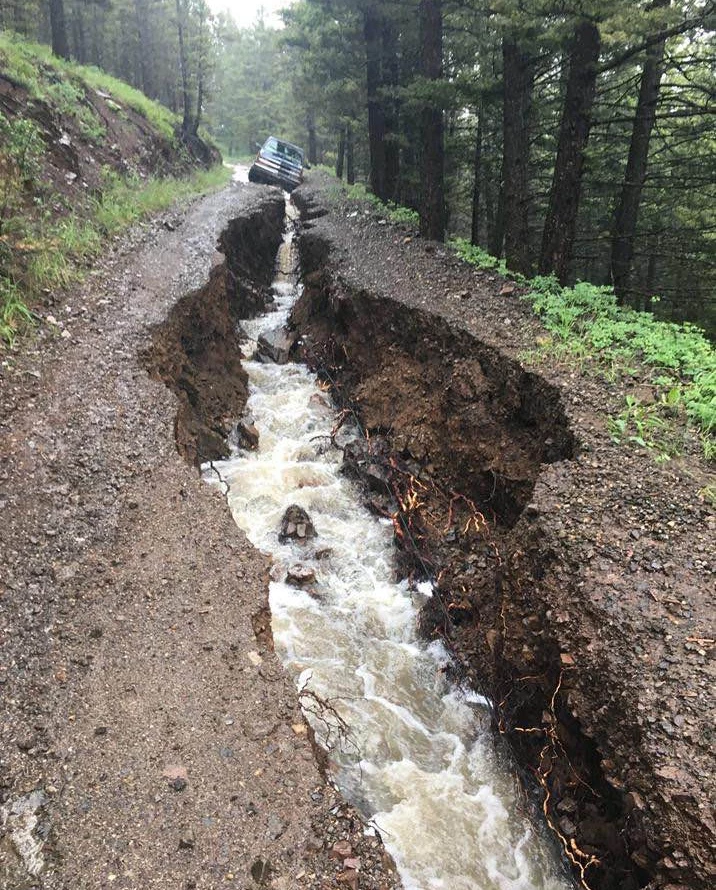
Logging road in Lolo National Forest, Montana. The Forest Service can’t begin to take care of the roads it already has. Many are more than half a century old, earoded and impassible. The agency’s road maintenance and reconstruction backlog is $8.4 billion. (Photo: Greg Munther)
The estimated population of the Alexander Archipelago wolf is only 2,240, with 1,250 in southeastern Alaska and 990 in coastal British Columbia. The Fish and Wildlife Service has concluded that this wolf may be extirpated from Prince of Wales Island within the next 30 years. Still, the agency declines to list it as endangered.
The Alaska Department of Fish and Game appears equally unmoved and unconcerned. In fall 2019, the estimated wolf population on Prince of Wales Island was between 170 and 202 individuals. Yet the department opened a two-month trapping season with no limit. The result: 168 dead wolves.
The Alaska Wildlife Alliance filed two emergency petitions to close wolf trapping on the island until the subspecies recovered. Both were denied. Currently, the alliance is suing the department and state for gross mismanagement of Alexander Archipelago wolves.
Because of the low number of Alexander Archipelago wolves on Prince of Wales Island, together with the loss of habitat connectivity caused by all the logging roads, the animals are severely inbred. A study published by the National Center for Biotechnology Information found that these wolves “exhibit an extent of inbreeding similar to that observed in [Lake Superior’s] Isle Royale National Park wolves, a population that has exhibited severe inbreeding depression.”
By 2017, only two northern gray wolves remained on Isle Royale. The following year, Wayne Pacelle and U.S. Senator Gary Peters, D-Mich., prevailed on the National Park Service to transplant 19 wolves from the mainland, thereby relieving the genetic bottleneck. Similar genetic rehabilitation via transplanting Alexander Archipelago wolves from elsewhere in the Tongass to Prince of Wales Island is eminently possible. But it has not been attempted, and there is no indication that it will be.
In addition to Sitka black-tailed deer, Alexander Archipelago wolves depend on salmon and trout, also valuable wildlife in their own right. In the roaded section of the Tongass, at least 700 elevated metal culverts, inserted where roads cross streams, cut off hundreds of miles of salmon and trout habitat.
Salmon and trout are coldwater species that depend on shade and bank stability provided by old growth, which in southeast Alaska is generally Sitka spruce, western hemlock, red cedar and yellow cedar, much of which has already been hacked out by clearcutters accessing logging roads.
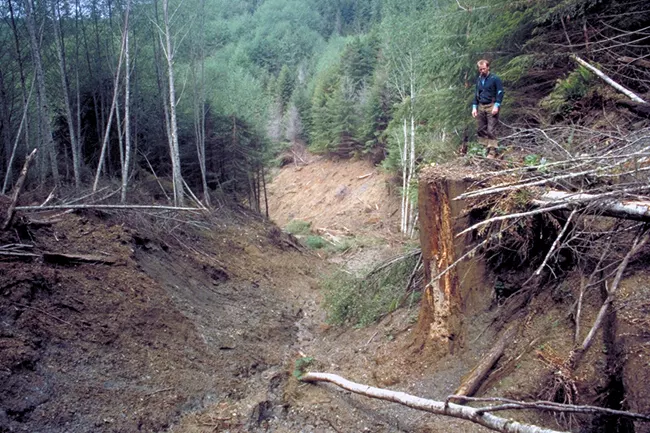
On January 1, 1997, failures of an old logging road across McArthur Creek caused more than 10,000 truckloads of dirt to rapidly erode downstream. (Photo: National Park Service)
Roadless Lands and the Quiet Majority of Hunters and Anglers
With few exceptions, America’s hunters and anglers remain silent on roadless-area protection—this despite the fact that about 85% of them want it.
Unfortunately, most of these exceptions are among the 15% who don’t want roadless protection. These include hunters and outdoor writers who imagine that the Roadless Rule was a conspiracy to separate their butts from their four-wheelers, snowmobiles and trail bikes. There are no restrictions on hunting, trapping and fishing in roadless areas. Sportsmen may access roadless areas on foot or horseback, and many of them enjoy the quiet, wilderness experience.
Exceptions also include make-believe conservation organizations such as the Ruffed Grouse Society and Blueribbon Coalition, which obtain funding from the timber lobby by whooping it up for logging roads.
Exceptions opposing Trump’s proposal include Backcountry Hunters and Anglers, Sportsmen for Wild Olympics, the Theodore Roosevelt Conservation Partnership and, especially, Trout Unlimited.
This from Trout Unlimited president and CEO, Chris Wood: “It is difficult to overstate the importance of roadless areas to native and wild trout and salmon. In Idaho, 75% of all chinook salmon and steelhead habitat is found in roadless areas. More than half of the strong populations of Redband trout in the Columbia basin are found in roadless areas. Nearly 70% of Wyoming’s Yellowstone cutthroat trout habitat is found in areas without roads. More than 70% of all the chinook, coho, pink, and chum salmon in southeast Alaska are found in areas without roads. Keeping roadless areas intact affects less than two-tenths of one percent of the nation’s timber demands from national forests. Oil and gas development in the entire national forest system supplies less than one-quarter of one percent of the nation’s energy, far less from roadless areas. Other uses such as grazing, off-road vehicle use, firefighting, hard-rock mining, and other recreation are essentially unaffected by the roadless rule.”
Roadbuilding, Not Roadless Areas, Is Fueling Wildfires
The Trump administration and the timber lobby argue that roadless areas prevent wildfire control by denying access to fire trucks and tree-thinning crews. “This misguided [roadless] rule prohibits the Forest Service from thinning and cutting trees to prevent wildfires, and when the fire starts, the rule limits firefighters’ access to quickly put them out,” avers Agriculture Secretary Rollins.
She could not be more incorrect. The Roadless Rule allows for extensive thinning and cutting of trees where there are wildfire risks. And logging roads increase wildfires by encouraging human activity, the main cause of wildfires. Roads create drier, windier conditions, facilitating wildfire spread. (About 85% of wildland fires are started by humans, and nearly 95% of those start within half a mile of a road.) Some of the worst wildfires occur in the dry slash left by clearcutters.
Especially threatened by wildfire are Canada lynx. In the Rocky Mountain West, lynx are restricted to high-elevation, subalpine forests that have undergone regular and natural disturbances for thousands of years. But now the disturbances are more frequent, more severe and less natural. These forests are warming about 40% faster than the global mean. So the spruce and fir lynx depend on dies, desiccates and burns.
“Prior to lynx listing [as federally threatened] in 2000, there was almost no fire in lynx habitat,” reports Dr. John Squires, the Forest Service biologist who for 20 years has led lynx studies from Montana through southern Colorado. “The world has definitely changed since then. Fire is now the issue. It dwarfs everything else. Not only are there more fires, but they’re more severe than they’ve ever been. And the continued rise in temperature is drying out forests… Lynx depend on high-elevation, moist, spruce-fir-dominated forests. With large-scale fires in Montana, spruce-fir forests are being converted to early-successional lodgepole pine forests.”
Squires’ team found that lynx do fine in natural, low-intensity burn sites but that they won’t return to the sites of large-scale fire caused by global warming until there’s at least 30 years of tree regeneration.
Logging Roads Spread Weeds That Kill Wildlife Habitat
Logging roads are highly efficient conduits for weeds, seeds of which are transported on the tires and frames of vehicles. Weeds destroy wildlife habitat. When wildlife loses habitat, it doesn’t “just go somewhere else,” it dies.
If weeds cut smoldering holes in the earth and left scorched wildlife carcasses, America would notice the 4,600 acres of wildlife habitat weeds destroy each day. But the public—including an element of the environmental community—doesn’t see or object to weeds because, to the untrained eye, most weeds look “pretty.” They’re green and often have colorful blossoms.
In 1984, just as some of the worst weeds were appearing in the Northwest’s best wildlife habitat, litigation by environmental groups produced a temporary injunction on all herbicide use on Forest Service land in Oregon and Washington and on Bureau of Land Management land in Oregon.
Years later, I saw some of the results along the Salmon River in Idaho’s Craig Mountain Wildlife Management Area. The topography of this area and adjacent federal lands once created tremendous habitat diversity. Low canyon grasslands sustaining desert-like plants and animals gave way to higher-elevation grasslands and shrub fields, then more and different grasslands, then trees, plateaus and subalpine fir—all within three miles of the river.
There used to be a corresponding diversity of wildlife—bighorns, sage grouse, sharp-tailed grouse, elk, moose, mule deer, white-tailed deer, wintering bald eagles, to mention just a few of the more spectacular species. But this diversity has been eroded by an invasion of yellow starthistle from southern Europe and western Asia. Even from the river, I could see it spreading in green lesions along the high rim rock.
No one likes herbicides, including the wildlife managers who use them. But frequently, there is no alternative for saving and restoring wildlife. Selective “point and squirt” use of short-lived, EPA-approved herbicides along the roads could have prevented the wildlife loss I witnessed. When the injunction was lifted and herbicides were legal again, yellow starthistle had gained access to the once-rich wildlife habitat.
Now, the vegetation native to Craig Mountain and adjacent federal lands that has been replaced by weeds is lost forever, as is the wildlife formerly sustained by that native vegetation. Apart from irrational fear of all herbicides in all situations, that loss is largely the result of logging roads.
The Real Reason the Roadless Rule Is Under Attack
It’s not like we don’t have enough logging roads. Our National Forest System is already sliced and diced with 370,000 miles of roads—enough to circle the globe 15 times.
What’s more, the Forest Service can’t begin to take care of the roads it already has. Many are more than half a century old, eroded and impassable. The agency’s road maintenance and reconstruction backlog is $8.4 billion.
But because the industry has extracted the best timber from its own lands and the public’s lands, it lusts after the 30.3% of the national forest system that is roadless. Trump is more than happy to oblige, even though the vast majority of the American public supports the roadless policy—one of the nation’s greatest conservation success stories.
Ted Williams, a lifelong hunter and angler, is a former information officer for the Massachusetts Division of Fisheries and Wildlife. He serves on the Circle of Chiefs of the Outdoor Writers Association of America.
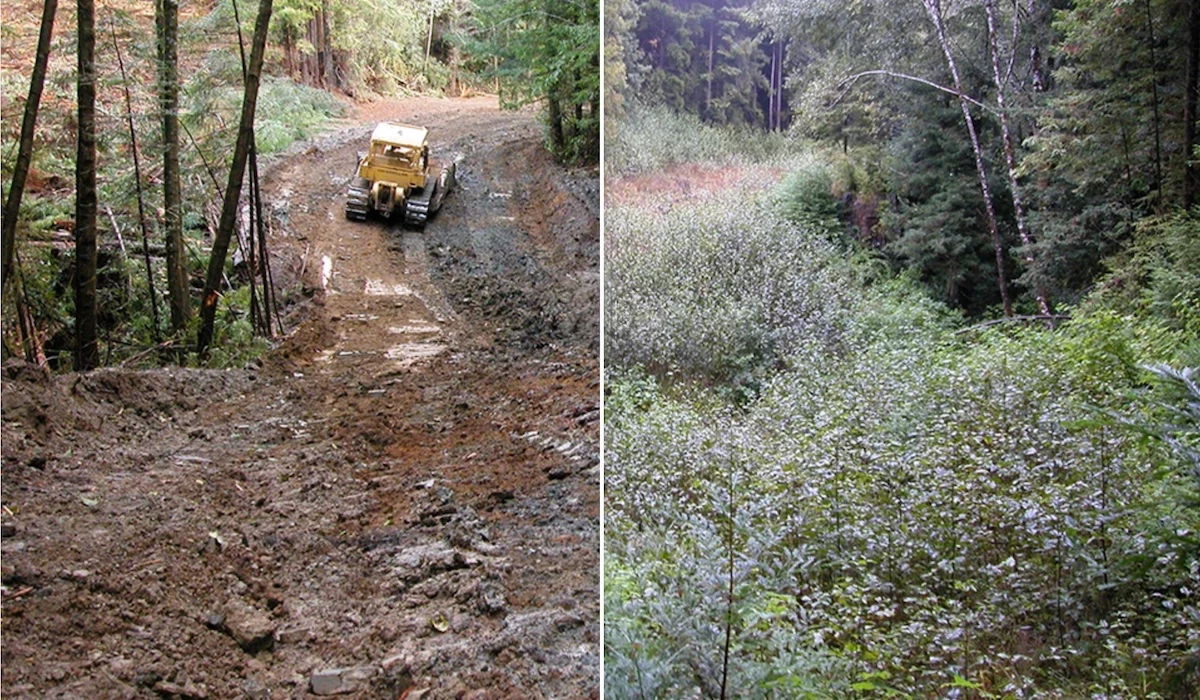
Photo caption: Left side of image: Heavy equipment is used to reoccupy logging roads. Right side: Ten feet of dirt was removed to get to the old hillslope, and logs are placed where the road was. (Photo: National Park Service/Neal Youngblood)