
U.S. Reps. Langworthy and Pocan take their campaign against cruelty nationwide as the March to Abolish Animal Testing nears the gates of Marshall BioResources
WASHINGTON, D.C. — Animal Wellness Action and the Center for a Humane Economy today applauded the introduction of the Companion Animal Protection Against Cruel Testing (COMPACT) Act, H.R. 10522, by U.S. Reps. Nick Langworthy, R-N.Y., and Mark Pocan, D-Wis., to end taxpayer-funded experiments on live dogs and cats through the Department of Health and Human Services (HHS). The bill coincides with a game-changing announcement Monday by HHS Secretary Robert F. Kennedy, Jr., that his department is launching 20 separate initiatives to scale down animal use in the government’s evaluation and funding of biomedical research. Original co-sponsors of the COMPACT Act include Reps. Mike Quigley, D-Ill., Randy Fine, R-Fla., Debbie Wasserman Schultz, D-Fla., Dina Titus, D-Nev., Veronica Escobar, D-Tex., Del. Eleanor Holmes Norton, D-D.C., Anna Paulina Luna, R-Fla., and Jeff Van Drew, R-N.J.
“Americans love dogs and cats as members of their families, and they do not want their tax dollars underwriting experiments on them for no public good,” said Wayne Pacelle, president of Animal Wellness Action and the Center for a Humane Economy. “Dog and cat testing is unreliable and ineffective, and there are 21st-century methods of testing — from organs-on-a-chip to AI computations — that will yield safer, more effective drugs that deliver more reliable treatments and cures for people.”
The FDA Modernization Act (FDAMA) 2.0, spearheaded by Animal Wellness Action and passed in 2022, eliminated an 84-year-old animal testing mandate for developmental new drugs. This Congress, both the House and Senate passed FDAMA 3.0, a follow-up measure led by Senators Cory Booker, D-N.J., Eric Schmitt, R-Mo., Rand Paul, M.D., R-Ky., and Reps. Buddy Carter, R-Ga., Nanette Barragán, D-Calif., Diana Harshbarger, R-Tenn., and Rosa DeLauro, D-Conn., to conform agency regulations with that law. The purpose of the follow-up bill was accomplished on Monday, when the FDA issued a direct final rule to rewrite its outdated regulations that mention “animal tests” and “animal studies.”
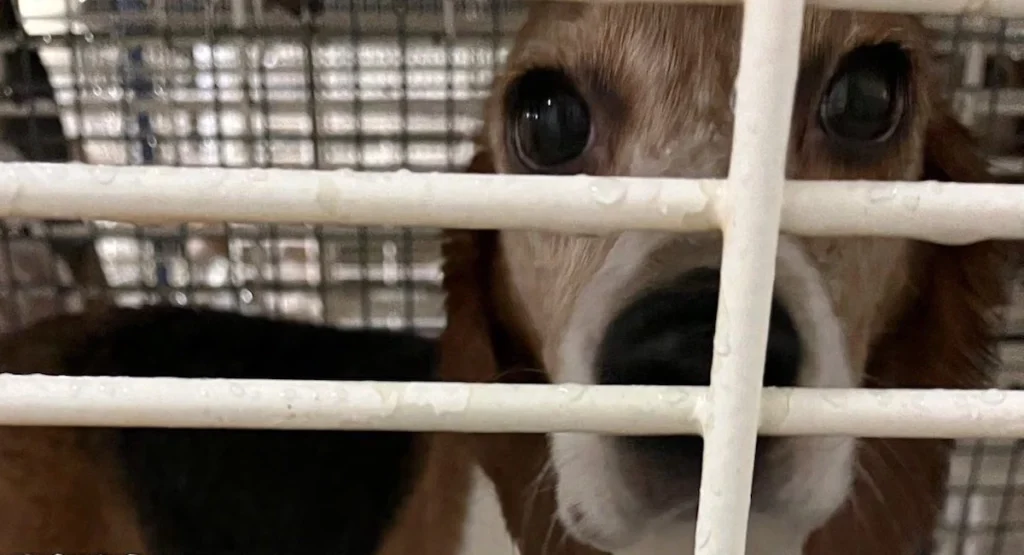
The introduction of the COMPACT Act also coincides with a 207-mile March to Abolish Animal Testing, scheduled to culminate this week at the gates of Marshall BioResources, the last major dog supplier for laboratories in America. Marshall currently holds approximately 16,000 beagles at its upstate New York facility. Earlier this year, the Center for a Humane Economy led negotiations to secure the release of 2,115 beagles from another major beagle supplier, Ridglan Farms in Wisconsin.
“The horrific abuse and barbaric treatment of beagles uncovered inside research facilities like Ridglan Farms and Marshall BioResources has outraged Americans from every corner of the country and political spectrum,”said Congressman Nick Langworthy. “Dogs and cats are companion animals and part of the family for millions of Americans; they should never have to endure inhumane suffering, particularly at expense to taxpayers and when science has evolved to develop more effective research methods. This is the most comprehensive legislation to date that moves our federal research system forward to better outcomes, while protecting innocent animals. I’m proud to work with my colleague, Congressman Pocan, on this thoughtful, bipartisan legislation.”
“What happened at Ridglan Farms was a wake-up call for our community and for the country,” said Congressman Mark Pocan. “We saw thousands of beagles confined in inhumane conditions and bred for research, and we saw what was possible when people came together to demand change. This is a nonpartisan issue, and I am glad to work with Congressman Langworthy to build on that progress with the COMPACT Act. For years, our federal research agencies have worked on reducing animal testing and turning to more humane and effective alternatives, and this legislation takes the important next step in modernizing our federally funded research and protecting animals.”
“The question is no longer whether biomedical research can move beyond traditional animal models, but how quickly we can accelerate that transition,” said Zaher Nahle, Ph.D., senior scientific advisor for Animal Wellness Action and the Center for a Humane Economy. “The COMPACT Act sends an important policy signal that federal research investments should help drive innovation rather than preserve legacy methods by default.”
“Congress has already rejected the idea that animal testing should be the default standard for evaluating new medicines, and HHS made clear this week that the federal government is moving towards human-based research,” said Tamara Drake, director of research and regulatory policy for the Center for a Humane Economy. “Halting taxpayer support for dog and cat experiments is an opportunity for Congress to unite around better science, responsible use of taxpayer dollars, and humane treatment of animals.”
“Here in Wisconsin, we saw firsthand what happens when dogs bred for laboratories are finally given the chance to become dogs — to walk on grass, sleep in soft beds, and become beloved members of families,” said Eilene Ribbens, executive director of the Wisconsin Puppy Mill Project.
According to USDA laboratory inspection reports, there were 42,026 dogs, nearly all beagles, and 12,632 cats used in or held for medical testing in 2025. Yet dogs and cats have limited value for predicting human outcomes because important differences in genetics, physiology, metabolism and disease biology can make results difficult to translate to people. In many areas where dogs and cats have traditionally been used — including drug safety and toxicity testing — human-based methods can provide information that is more directly relevant to human biology.