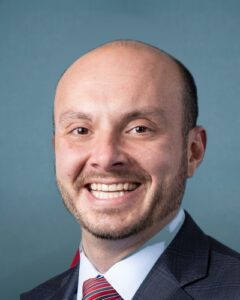
Tenure: 117th–119th Congresses
Years of Service: 2021–Present
Rep. Andrew Garbarino, chairman of the Committee on Homeland Security, has emerged as one of the Republican leaders on animal protection in Congress. He has been a leader in opposing efforts to overturn Prop 12 and Question 3 by some of his GOP colleagues, and he’s also leading in the effort to nix the U.S. Fish and Wildlife Service’s barred owl kill plan. In doing so, he’s at odds with some GOP committee chairs, and that’s significant given that he’s a GOP leader chairing one of the most important committees in Congress.
His work is anchored in areas that traditionally attract bipartisan support – animal cruelty enforcement, animal fighting, horse slaughter, and commercial greyhound racing – while also extending into more complex policy debates such as animal testing reform and farm animal welfare.
Garbarino has been a consistent supporter of stronger federal enforcement tools. His cosponsorship of the Animal Cruelty Enforcement Act reflects a law-and-order approach to animal protection, treating organized cruelty and animal fighting as serious criminal enterprises. This aligns with his support for the FIGHT Act, which targets animal fighting networks often linked to broader illegal activity. This policy area potentially intersects with his leadership of the Homeland Security Committee given that animal fighting and other forms of malicious cruelty are tied in with social violence and organized crime.
He has also backed long-standing humane priorities, including the SAFE Act to end the export of American horses for slaughter and the Greyhound Protection Act to phase out commercial dog racing. These positions place him firmly within the bipartisan mainstream of animal welfare policy.
On scientific and regulatory issues, Garbarino has supported the FDA Modernization Act 3.0, which aims to reduce reliance on animal testing in drug development by promoting alternative methods. This reflects a growing alignment between animal welfare and innovation-focused policy reform.
Most notably, Garbarino has distinguished himself within his party on farm animal policy and federalism. He has opposed efforts like the “Save Our Bacon Act,” a federal preemption proposal that would override state-level animal welfare laws such as California Proposition 12. Garbarino was one of three Republicans to vote against House passage of the 2026 Farm Bill, which included the language from this bill. By resisting this approach, he has helped defend the ability of states to set their own agricultural standards – an issue with major implications for the future of farm animal welfare policy nationwide.
Importantly, Garbarino is not, however, perfect on animal protection issues. He’s supported wolf delisting and barred federal public land agencies from restricting lead. But, as mentioned, he’s fought GOP colleagues on some especially important animal protection policies.
Taken together, Garbarino’s record reflects consistent engagement, ideological flexibility and strategic value. While not a primary architect of landmark legislation, he’s one of the go-to leaders on animal protection. He is, without question, in the top-tier of pro-animal GOP lawmakers, particularly in areas where bipartisan cooperation and intra-party persuasion are essential.
Read our press release here.
Read our endorsement letter here.
Notable Actions
119th Congress
✅ Cosponsor of the Save America’s Forgotten Equines (SAFE) Act, H.R. 1661, to ban U.S.-based horse slaughter and the export of horses for slaughter for human consumption.
✅ Cosponsor of the Fighting Inhumane Gambling and High-Risk Trafficking (FIGHT) Act, H.R. 3946, to strengthen federal enforcement against animal fighting and related criminal activity.
✅ Cosponsor of the Animal Cruelty Enforcement (ACE) Act, H.R. 1477, to establish a dedicated DOJ unit to investigate and prosecute animal cruelty crimes.
✅ Cosponsor of the Greyhound Protection Act, H.R. 5017, to phase out U.S. greyhound racing, a practice long in decline and operational at just two tracks.
✅ Cosponsor of the Stop Billion-Dollar FWS Plan to Kill Half a Million Owls, H.J. Res. 111, a Congressional Review Act resolution to nullify the U.S. Fish and Wildlife Service plan to kill approximately 450,000 barred owls to reduce competition with northern spotted owls.
✅ Cosponsor of the Better CARE for Animals Act, H.R. 3112, to strengthen enforcement of the Animal Welfare Act by expanding federal authority to investigate and prosecute animal cruelty violations and improve coordination between the U.S. Department of Agriculture and the Department of Justice.
✅ Cosponsor of Goldie’s Act, H.R. 349, bipartisan legislation to strengthen enforcement of the Animal Welfare Act by requiring more frequent inspections, faster reporting of violations, and improved protections for animals suffering abuse or neglect.
✅ Signed the bipartisan congressional letter opposing the large-scale killing of barred owls.
✅ Signed a congressional letter opposing the EATS/SOB Act that would erode states’ rights, undermine family farmers, and expand foreign influence over U.S. food production.
✅ Signed a congressional letter to President Donald J. Trump urging him to permanently prohibit the export of American horses to Mexico for slaughter.
✅ Supported House passage of the FDA Modernization Act 3.0, H.R. 2821, which passed by voice vote under suspension of the rules on July 20, 2026. The bipartisan legislation directs the FDA to update its regulations to fully implement the 2022 law allowing scientifically valid non-animal methods to be used instead of animal testing in drug development.
❌ Voted “Aye” on H.R. 556, the Protecting Access for Hunters and Anglers Act (House Roll Call Vote 93), to prohibit federal land management agencies from restricting the use of toxic lead ammunition and fishing tackle on public lands and waters to protect wildlife from poisoning. The bill passed the House 215–202. An “Aye” vote is the anti-animal position because it limited the federal government’s ability to restrict toxic lead ammunition and fishing tackle that poison wildlife and contaminate the environment.
❌ Voted “Aye” on H.R. 845, the Pet and Livestock Protection Act (House Roll Call Vote 360), to remove federal Endangered Species Act protections for gray wolves across much of the United States and restricted judicial review of future wolf management decisions. The bill passed the House 211–204. An “Aye” vote is the anti-animal position because it removed Endangered Species Act protections for gray wolves and limited judicial review of future wolf management decisions.
❌ Voted “Aye” on the Riley Moore Amendment (House Roll Call Vote 149), to weaken the Farm Bill’s Greyhound Protection Act provisions by creating a special exemption allowing commercial greyhound racing to continue in West Virginia indefinitely. The House rejected the amendment 187–237. An “Aye” vote is the anti-animal position because it sought to weaken greyhound protections by allowing commercial greyhound racing to continue indefinitely in West Virginia.
✅ Voted “Nay” on H.R. 7567, the Farm, Food, and National Security Act (House Roll Call Vote 154), to pass the Farm Bill, which included a provision to overturn state laws in California and Massachusetts restricting in-state sales of fresh pork sourced from farms that do not provide minimum space requirements for the housing of pregnant pigs. The bill passed the House 224–200. A “Nay” vote is the pro-animal position.
✅ Voted “Nay” on the Biggs Amendment to H.R. 3838 (House Roll Call Vote 259), to exempt defense-related activities from the requirements of the Endangered Species Act, eliminating protections for endangered and threatened species and their critical habitat on military lands and during defense operations. The House rejected the amendment 200–228. A “Nay” vote is the pro-animal position.
✅ Voted “Nay” on the Greene Amendment to H.R. 3838 (House Roll Call Vote 254), to prohibit the Department of Defense from using FY2026 funds for the research, development, procurement, or promotion of cell-cultured meat, an emerging alternative to conventional slaughter-based meat production. The House rejected the amendment 194–236, with 1 voting present. A “Nay” vote is the pro-animal position.
118th Congress
✅ Cosponsor of the Fighting Inhumane Gambling and High-Risk Trafficking (FIGHT) Act, H.R. 2742, to strengthen federal enforcement against animal fighting and related criminal activity.
✅ Cosponsor of the Save America’s Forgotten Equines (SAFE) Act, H.R. 3475, to ban U.S.-based horse slaughter and the export of horses for slaughter for human consumption.
✅ Cosponsor of Greyhound Protection Act, H.R. 3894, to phase out U.S. greyhound racing, a practice long in decline and operational at just two tracks.
✅ Cosponsor of the FDA Modernization Act 3.0, H.R. 7248, to direct the FDA to update its regulations consistent with a law passed by Congress in 2022 that made animal testing optional in new drug development.
✅ Cosponsor of Goldie’s Act, H.R. 1788, bipartisan legislation to strengthen enforcement of the Animal Welfare Act by requiring more frequent inspections, faster reporting of violations, and improved protections for animals suffering abuse or neglect.
✅ Cosponsor of the Better CARE for Animals Act, H.R. 5041, to strengthen enforcement of the Animal Welfare Act by expanding federal authority to investigate and prosecute animal cruelty violations and improve coordination between the U.S. Department of Agriculture and the Department of Justice.
❌ Voted “Aye” on H.R. 764 (House Roll Call Vote 169), legislation to remove federal protections for gray wolves under the Endangered Species Act across most of the United States and return management authority to the states. Wildlife advocates warned that the bill would undermine science-based wildlife management and threaten the long-term recovery of gray wolf populations. The House passed the bill 209–205. An “Aye” vote is the anti-animal position because it removed Endangered Species Act protections for gray wolves across much of the United States, despite concerns that doing so would undermine their long-term recovery and science-based wildlife management.
❌ Voted “Aye” on H.R. 615 (House Roll Call Vote 167), legislation to bar the Department of the Interior and the Department of Agriculture from prohibiting or regulating the use of toxic lead ammunition and fishing tackle on federal lands and waters made available for hunting or fishing. Lead ammunition and tackle poison wildlife, including eagles, loons, condors, and other animals that ingest spent lead fragments or lost fishing gear. The House passed the bill 214–201. An “Aye” vote is the anti-animal position because it blocked federal agencies from restricting toxic lead ammunition and fishing tackle that poison eagles, loons, condors, and other wildlife.
117th Congress
✅ Cosponsor of the Save America’s Forgotten Equines (SAFE) Act, H.R. 3355, to ban U.S.-based horse slaughter and the export of horses for slaughter for human consumption.
✅ Cosponsor of the FDA Modernization Act, H.R. 2565, bipartisan legislation to end the outdated federal presumption that new drugs must rely on animal testing before human clinical trials. The measure authorized the FDA to accept scientifically valid non-animal testing methods—including organ-on-a-chip technology, cell-based assays, and computer modeling—when appropriate. Core provisions of this legislation were later enacted as part of the FDA Modernization Act 2.0, signed into law in December 2022, marking a landmark reform that advanced more human-relevant research methods while reducing unnecessary animal testing.
✅ Cosponsor of the Shark Fin Sales Elimination Act, H.R. 2811, to end the U.S. commercial trade in shark fins by prohibiting their sale, purchase, and transport, helping reduce the global demand that drives the cruel practice of shark finning. Core provisions of the bill were later incorporated into the James M. Inhofe National Defense Authorization Act for Fiscal Year 2023, which was signed into law in December 2022, making the United States one of the world’s largest nations to ban the domestic shark fin trade.
✅ Voted “Aye” on the motion to suspend the rules and pass the Prevent All Soring Tactics (PAST) Act, H.R. 5441 (House Roll Call Vote 478). The bill would strengthen enforcement of the Horse Protection Act and help end the cruel practice of “soring” Tennessee Walking Horses, Racking Horses, and Spotted Saddle Horses. Soring involves intentionally inflicting severe pain on horses’ legs and hooves through caustic chemicals, chains, pressure devices, or other abusive methods to force an exaggerated, high-stepping gait known as the “Big Lick.” The motion was agreed to by a vote of 304–111, exceeding the two-thirds majority required under the suspension of the rules procedure. An “Aye” vote is the pro-animal position.
✅ Voted “Aye” Big Cat Public Safety Act, H.R. 263 (House Roll Call Vote 415), to end the private possession and commercial breeding of lions, tigers, leopards, cheetahs, jaguars, cougars, and other big cats while prohibiting public contact with these animals. The legislation targeted the exploitative cub-petting industry and roadside zoos, where big cats are repeatedly bred, handled, and discarded, while strengthening protections for both animals and public safety. An “Aye” vote is the pro-animal position.