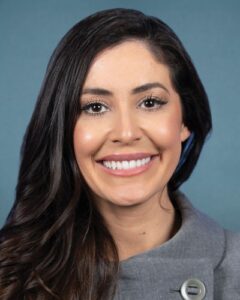
Tenure: 118th–119th Congresses
Years of Service: 2023–Present
Anna Paulina Luna is a broad-minded, outspoken advocate of federal animal protection policies, leading on animal issues and supporting a wide range of efforts to end painful and unnecessary taxpayer-funded animal testing while also supporting a range of bipartisan animal-protection initiatives involving horse slaughter, animal fighting, and other reforms.
She played a crucial role as one of two Republican cosponsors of the Freedom in School Cafeterias and Lunches (FISCAL) Act, H.R. 2539, to give kids access to a plant-based milk option in the National School Lunch Program, in addition to the existing cow’s milk offerings. Key portions of H.R. 2539 were included as a provision in the Whole Milk for Healthy Kids Act, enacted in January 2026, eliminating the cow’s milk mandate for kids who receive food assistance. Millions of kids, including Black, Latino, and Asian kids, are lactose intolerant, causing them to throw away milk in enormous volumes or to drink a fluid beverage product that makes them ill.
She’s also been very active in opposing the U.S. Fish and Wildlife Service’s efforts to slaughter 450,000 North American barred owls and to spend more than a billion taxpayer dollars on the unworkable and inhumane plan. In this case, she’s taken on the agency personnel from both the Biden and Trump administrations.
Luna has spearheaded oversight efforts questioning National Institutes of Health and Department of Veterans Affairs research involving dogs, cats, primates, and other animals, arguing that taxpayer dollars should be directed toward modern, scientifically advanced alternatives whenever possible. She has paired that oversight with legislative action, cosponsoring Violet’s Law to ensure healthy federally owned research animals are given the opportunity for adoption or sanctuary placement after research concludes rather than being routinely euthanized. Beyond legislation, she has pressed the National Institutes of Health to shift federal research funding away from costly primate experiments and toward more ethical, innovative, and scientifically advanced alternatives.
Luna has also become a strong advocate for cracking down on organized animal fighting and the criminal enterprises that profit from it. She is a cosponsor of the Fighting Inhumane Gambling and High-Risk Trafficking (FIGHT) Act, which strengthens federal enforcement against dogfighting and cockfighting operations, and the No Flight, No Fight Act, bipartisan legislation to stop the international trafficking of fighting birds aboard commercial airlines. The measure responds to investigations exposing the illegal shipment of thousands of fighting roosters from the United States to overseas cockfighting derbies tied to organized crime, illegal gambling, and animal cruelty. Her support for these measures reflects a law-and-order approach to animal protection that targets criminal networks while strengthening enforcement of existing federal law.
Luna has also demonstrated a willingness to lead on issues extending beyond animal research. She has been the leading voice in the House in opposing the repeal of state farm animal welfare laws and led letters to the Agriculture Committee in the 118th and 119th Congresses urging the striking of such a provision from any Farm bill. The so-called Save Our Bacon Act, formerly known as the EATS Act, would have nullified state farm-animal welfare laws, undermined family farmers, and weakened states’ rights. Given that outspoken leadership, it was perplexing though that she cast a vote in favor of the 2026 farm bill, which includes a provision to preempt/override Prop 12 and Question 3.
That inconsistency may be explained by legislative horse-trading. At the same time she was advocating for protection of states’ rights for animal welfare policies, she also led a successful floor amendment to the farm bill to block efforts to preempt state laws restricting dangerous pesticides. Perhaps in return for Republican leaders allowing her a vote on the anti-pesticide amendment, she made a deal to support the farm bill. Her win on the anti-pesticide provision should hearten every animal advocate, since some especially dangerous pesticides do not distinguish between human and non-human animal victims.
That said, to her great credit, she did file an amendment to the Farm bill to strike the SOB Act provision, gathering a very strong set of Republican and Democrat cosponsors. The House Rules Committee, however, denied her a vote, undoubtedly bending to the will of House Agriculture Chairman Glenn Thompson, who is strongly supported by China’s Smithfield Foods and the National Pork Producers Council. It is almost certain that the Luna amendment would have won a majority vote on that issue on the House floor, resulting in the striking of the SOB Act provision. Should the farm bill come to the floor in the form of a final conference report, and if it includes any provision striking state farm animal welfare laws, animal advocates can most likely count on her to oppose a farm bill.
She has also supported legislation to end horse slaughter and phase out commercial greyhound racing. Mysteriously though, she voted for an amendment from Rep. Riley Moore, R-W.V., to the farm bill to exempt West Virginia from the federal prohibitions on greyhound racing. Fortunately, 28 other Republicans broke ranks with Speaker Mike Johnson and opposed the Moore amendment, resulting in its defeat.
While her voting record is more inconsistent than other leading GOP animal protection leaders – she also voted to remove federal protections under the Endangered Species Act for gray wolves – she’s certainly in the top tier of GOP allies on animal protection. Her readiness to take on difficult issues within the Republican Conference has made her an increasingly important ally on some of the most significant animal-protection issues before Congress.
Notable Actions
119th Congress
✅ Cosponsor of the Companion Animal Protection Against Cruel Testing (COMPACT) Act, H.R. 10522, to prohibit the National Institutes of Health and other Department of Health and Human Services agencies from funding research, testing, education, or training that uses dogs or cats, while preserving veterinary clinical research involving client-owned animals.
✅ Cosponsor of the Save America’s Forgotten Equines (SAFE) Act, H.R. 1661, to ban U.S.-based horse slaughter and the export of horses for slaughter for human consumption.
✅ Cosponsor of the Fighting Inhumane Gambling and High-Risk Trafficking (FIGHT) Act, H.R. 3946, to strengthen federal enforcement against animal fighting and related criminal activity.
✅ Cosponsor of the No Flight, No Fight Act, H.R. 7371, to stop the smuggling of fighting birds via commercial airlines—an illicit practice that has gone largely unenforced since Congress prohibited the interstate and foreign transport of fighting birds in 2002.
✅ Cosponsor of the Greyhound Protection Act, H.R. 5017, to phase out U.S. greyhound racing, a practice long in decline and operational at just two tracks.
✅ Cosponsor of the Stop Billion-Dollar FWS Plan to Kill Half a Million Owls, H.J. Res. 111, a Congressional Review Act resolution to nullify the U.S. Fish and Wildlife Service plan to kill approximately 450,000 barred owls to reduce competition with northern spotted owls.
✅ Cosponsor of the Freedom in School Cafeterias and Lunches (FISCAL) Act, H.R. 2539, to give kids access to a plant-based milk option in the National School Lunch Program, in addition to the existing cow’s milk offerings.
✅ Cosponsor of the Puppy Protection Act, H.R. 2253, bipartisan legislation to strengthen federal standards of care for dogs kept by commercial breeders by improving requirements for housing, veterinary care, exercise, socialization, and humane breeding practices.
✅ Signed the bipartisan congressional letter opposing the large-scale killing of barred owls.
✅ Signed a bipartisan congressional letter to the National Institutes of Health (NIH) Director, urging the agency to redirect federal funds currently allocated for non-human primate (NHP) research centers toward more ethical and cost-effective uses.
✅ Supported House passage of the FDA Modernization Act 3.0, H.R. 2821, which passed by voice vote under suspension of the rules on July 20, 2026. The bipartisan legislation directs the FDA to update its regulations to fully implement the 2022 law allowing scientifically valid non-animal methods to be used instead of animal testing in drug development.
➖ Did Not Vote on H.R. 556, the Protecting Access for Hunters and Anglers Act (House Roll Call Vote 93), to prohibit federal land management agencies from restricting the use of toxic lead ammunition and fishing tackle on public lands and waters to protect wildlife from poisoning. The bill passed the House 215–202. A “Nay” vote is the pro-animal vote.
❌ Voted “Aye” on H.R. 845, the Pet and Livestock Protection Act (House Roll Call Vote 360), to remove federal Endangered Species Act protections for gray wolves across much of the United States and restricted judicial review of future wolf management decisions. The bill passed the House 211–204. An “Aye” vote is the anti-animal position because it removed Endangered Species Act protections for gray wolves and limited judicial review of future wolf management decisions.
❌ Voted “Aye” on the Riley Moore Amendment (House Roll Call Vote 149), to weaken the Farm Bill’s Greyhound Protection Act provisions by creating a special exemption allowing commercial greyhound racing to continue in West Virginia indefinitely. The House rejected the amendment 187–237. An “Aye” vote is the anti-animal position because it sought to weaken greyhound protections by allowing commercial greyhound racing to continue indefinitely in West Virginia.
❌ Voted “Aye” on H.R. 7567, the Farm, Food, and National Security Act (House Roll Call Vote 154), to pass the Farm Bill, which included a provision to overturn state laws in California and Massachusetts restricting in-state sales of fresh pork sourced from farms that do not provide minimum space requirements for the housing of pregnant pigs. The bill passed the House 224–200. An “Aye” vote is the anti-animal position because it supported overturning state farm animal welfare laws that require more humane housing standards for pregnant pigs.
❌ Voted “Aye” on the Biggs Amendment to H.R. 3838 (House Roll Call Vote 259), to exempt defense-related activities from the requirements of the Endangered Species Act, eliminating protections for endangered and threatened species and their critical habitat on military lands and during defense operations. The House rejected the amendment 200–228. An “Aye” vote is the anti-animal position because it sought to weaken Endangered Species Act protections for threatened and endangered wildlife on military lands.
❌ Voted “Aye” on the Greene Amendment to H.R. 3838 (House Roll Call Vote 254), to prohibit the Department of Defense from using FY2026 funds for the research, development, procurement, or promotion of cell-cultured meat, an emerging alternative to conventional slaughter-based meat production. The House rejected the amendment 194–236, with 1 voting present. An “Aye” vote is the anti-animal position because it sought to block federal support for the development of slaughter-free, cell-cultured meat alternatives that could reduce the number of animals raised and killed for food.
❌ Voted “Aye” on the Northeast Lobster Protection Act, H.R. 9436 (House Roll Call Vote 291), which would extend a pause on new federal fishing gear regulations intended to protect critically endangered North Atlantic right whales from 2028 to 2035, delaying potential protections for an additional seven years. An “Aye” is an anti-animal position because it supports extending the delay in fishing rope, a leading cause of injury and death.
118th Congress
✅ Cosponsor of the Fighting Inhumane Gambling and High-Risk Trafficking (FIGHT) Act, H.R. 2742, to strengthen federal enforcement against animal fighting and related criminal activity.
✅ Cosponsor of the Save America’s Forgotten Equines (SAFE) Act, H.R. 3475, to ban U.S.-based horse slaughter and the export of horses for slaughter for human consumption.
✅ Cosponsor of Greyhound Protection Act, H.R. 3894, to phase out U.S. greyhound racing, a practice long in decline and operational at just two tracks.
✅ Cosponsor of MINKS Are Superspreaders Act, H.R. 7670, to end mink farming in the U.S.
✅ Cosponsor of Violet’s Law, H.R. 1465, to provide a second chance for dogs, cats, rabbits, guinea pigs, hamsters, and nonhuman primates used in federally funded research by requiring facilities to pursue adoption or sanctuary placement whenever feasible.
✅ Cosponsor of the Puppy Protection Act, H.R. 1624, bipartisan legislation to strengthen federal standards of care for dogs kept by commercial breeders by improving requirements for housing, veterinary care, exercise, socialization, and humane breeding practices.
❌ Voted “Aye” on H.R. 764 (House Roll Call Vote 169), legislation to remove federal protections for gray wolves under the Endangered Species Act across most of the United States and return management authority to the states. Wildlife advocates warned that the bill would undermine science-based wildlife management and threaten the long-term recovery of gray wolf populations. The House passed the bill 209–205. An “Aye” vote is the anti-animal position because it removed Endangered Species Act protections for gray wolves across much of the United States, despite concerns that doing so would undermine their long-term recovery and science-based wildlife management.
❌ Voted “Aye” on H.R. 615 (House Roll Call Vote 167), legislation to bar the Department of the Interior and the Department of Agriculture from prohibiting or regulating the use of toxic lead ammunition and fishing tackle on federal lands and waters made available for hunting or fishing. Lead ammunition and tackle poison wildlife, including eagles, loons, condors, and other animals that ingest spent lead fragments or lost fishing gear. The House passed the bill 214–201. An “Aye” vote is the anti-animal position because it blocked federal agencies from restricting toxic lead ammunition and fishing tackle that poison eagles, loons, condors, and other wildlife.