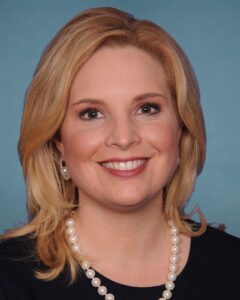
Tenure: 117th–119th Congresses
Years of Service: 2021–Present
Ms. Hinson graduated from the University of Southern California with a degree in broadcast journalism and worked as a local television reporter and anchor in multiple markets, including in northeast Iowa. She was elected to the Iowa State Legislature in 2016 and to Congress in 2020. In 2026, she won the Republican nomination for the U.S. Senate seat being vacated by Joni Ernst. This fall, she squares off against Democrat Josh Turek, who is an Iowa state representative, to determine the winner in that race.
In Congress, Congresswoman Hinson has been a leading opponent of animal welfare. She has worked to weaken federal wildlife protection and, most significantly, has become the leading congressional advocate for extreme confinement of animals on factory farms.
Without a doubt, Hinson’s most consequential action in the animal welfare policy area has been her high-profile leadership and sponsorship of the Save Our Bacon (SOB) Act, H.R. 4673. Introduced in July 2025, this legislation focuses on nullifying California’s Proposition 12 and Massachusetts’ Question 3, which restrict the sale of pork and other animal products produced using certain forms of extreme confinement.
The SOB Act would also forbid any future ballot measure from any state crafted to limit the sale of pork derived from factory farms that immobilize breeding sows in metal crates. The measure, as originally written, however, reaches far beyond sow confinement. The Harvard Law School Animal Law & Policy Program determined that H.R. 4673 could also jeopardize more than 600 state and local laws and regulations, including animal-welfare measures as well as rules addressing food safety, disease prevention in dairy cows, and other agriculture-related state policies adopted by state legislators and agriculture departments.
When it comes to sow confinement – which has been the flashpoint of controversy – this legislation would upend markets for thousands of hog farmers who have chosen to comply with Prop 12 and Question 3, including farmers who have collectively invested billions to access these markets. Conversely, the SOB Act rewards factory farmers who have not budged in giving animals room to stand up, lie down, and turn around, wiping out the very few markets for farmers who rely on more extensive and slightly more expensive housing systems.
Hinson has been fiercely criticized by thousands of farmers and a united animal welfare movement in carrying the top legislative priority for the China’s Smithfield Foods and the National Pork Producers Council, which has two board members from the Chinese-controlled company. No sector of American agriculture has more foreign control than the pig industry, and China’s control of 26 percent of American pig production is a startling fact pattern for Americans.
Hinson teamed up with House Agriculture Chairman Glenn Thompson, R-Pa., to deny nearly two dozen GOP and Democrat lawmakers the opportunity to offer an amendment to the Farm bill in April 2026 to strike the SOB Act provision from that omnibus agriculture policy bill. In short, a measure that would erase the votes of more than 10 million Americans in two landslide elections was denied a stand-alone vote of even the 435 Members of the U.S. House.
Hinson’s voting record on wildlife protection has also raised concerns for animal-welfare advocates. In the 119th Congress, she voted for H.R. 556, the Protecting Access for Hunters and Anglers Act, which would restrict federal land-management agencies from limiting toxic lead ammunition and fishing tackle on federal lands and waters. Lead ammunition and fishing tackle can poison wildlife, including eagles, loons, condors and other species that ingest spent ammunition or lost tackle. She also voted for H.R. 845, legislation to remove federal Endangered Species Act protections for gray wolves across much of the United States while restricting judicial review of future wolf-management decisions.
In the 119th Congress, she also voted for an amendment to gut the Greyhound Protection Act, even though Iowa forbids any form of greyhound racing. She supported an amendment to exempt defense activities from Endangered Species Act requirements on military lands, and an amendment that would have prohibited federal support for the development of alternative proteins. The House rejected both measures, again with substantial Republican opposition to these measures.
In the 117th Congress, she voted against the Prevent All Soring Tactics (PAST) Act, which sought to strengthen enforcement of the Horse Protection Act and combat the deliberate infliction of pain on Tennessee Walking Horses and other breeds to produce the exaggerated “Big Lick” gait. She also voted against the Big Cat Public Safety Act, legislation that ended private ownership and commercial breeding of big cats and prohibited the use of tiger cubs and kittens in roadside zoos. Both measures passed by commanding margins and with dozens of GOP lawmakers backing them.
Time after time, on a wide range of issues, Hinson voted against protecting animals. She’s not cosponsored any of the core anti-cruelty measures that Animal Wellness Action has advanced, including the FIGHT Act to combat dogfighting and cockfighting, the No Flight No Fight Act to halt international transports of fighting animals, or the Animal Cruelty Enforcement Act to create a prosecutors’ unit to combat animal cruelty crimes. The Iowa Sheriffs and Deputies Association and the North Central Poultry Association (representing Iowa’s entire poultry industry) have endorsed the FIGHT Act, but here again, she was unable to muster support for strengthening the law to combat these forms of malicious cruelty so often linked to other criminal conduct and social violence.
Taken as a whole, Hinson’s congressional record reflects a strong focus on protecting Iowa’s corporate agricultural interests and limiting federal and state regulation of agricultural production, frequently at the expense of animal-welfare protections. Her sponsorship of the Save Our Bacon Act is an especially distressing and consequential example of her body of work in Congress because the legislation would not merely establish standards for Iowa farmers; it would restrict other states from requiring higher standards for animal products sold within their borders.
While Hinson has supported the transition toward non-animal testing methods, her broader record includes repeated votes to weaken wildlife protections and oppose legislation addressing animal cruelty and exploitation. The Save Our Bacon Act stands out as the clearest expression of her approach to farm-animal welfare: prioritizing the policy agenda of Communist China and a segment of Iowa pork producers to attack states’ rights and to upend crucial markets for Iowa farmers who do not rely on extreme confinement.
Notable Actions
119th Congress
✅ Supported House passage of the FDA Modernization Act 3.0, H.R. 2821, which passed by voice vote under suspension of the rules on July 20, 2026. The bipartisan legislation directs the FDA to update its regulations to fully implement the 2022 law allowing scientifically valid non-animal methods to be used instead of animal testing in drug development.
❌ Voted “Aye” on H.R. 556, the Protecting Access for Hunters and Anglers Act (House Roll Call Vote 93), to prohibit federal land management agencies from restricting the use of toxic lead ammunition and fishing tackle on public lands and waters to protect wildlife from poisoning. The bill passed the House 215–202. An “Aye” vote is the anti-animal position because it limited the federal government’s ability to restrict toxic lead ammunition and fishing tackle that poison wildlife and contaminate the environment.
❌ Voted “Aye” on H.R. 845, the Pet and Livestock Protection Act (House Roll Call Vote 360), to remove federal Endangered Species Act protections for gray wolves across much of the United States and restricted judicial review of future wolf management decisions. The bill passed the House 211–204. An “Aye” vote is the anti-animal position because it removed Endangered Species Act protections for gray wolves and limited judicial review of future wolf management decisions.
❌ Voted “Aye” on the Riley Moore Amendment (House Roll Call Vote 149), to weaken the Farm Bill’s Greyhound Protection Act provisions by creating a special exemption allowing commercial greyhound racing to continue in West Virginia indefinitely. The House rejected the amendment 187–237. An “Aye” vote is the anti-animal position because it sought to weaken greyhound protections by allowing commercial greyhound racing to continue indefinitely in West Virginia.
❌ Voted “Aye” on H.R. 7567, the Farm, Food, and National Security Act (House Roll Call Vote 154), to pass the Farm Bill, which included a provision to overturn state laws in California and Massachusetts restricting in-state sales of fresh pork sourced from farms that do not provide minimum space requirements for the housing of pregnant pigs. The bill passed the House 224–200. An “Aye” vote is the anti-animal position because it supported overturning state farm animal welfare laws that require more humane housing standards for pregnant pigs.
❌ Voted “Aye” on the Biggs Amendment to H.R. 3838 (House Roll Call Vote 259), to exempt defense-related activities from the requirements of the Endangered Species Act, eliminating protections for endangered and threatened species and their critical habitat on military lands and during defense operations. The House rejected the amendment 200–228. An “Aye” vote is the anti-animal position because it sought to weaken Endangered Species Act protections for threatened and endangered wildlife on military lands.
❌ Voted “Aye” on the Greene Amendment to H.R. 3838 (House Roll Call Vote 254), to prohibit the Department of Defense from using FY2026 funds for the research, development, procurement, or promotion of cell-cultured meat, an emerging alternative to conventional slaughter-based meat production. The House rejected the amendment 194–236, with 1 voting present. An “Aye” vote is the anti-animal position because it sought to block federal support for the development of slaughter-free, cell-cultured meat alternatives that could reduce the number of animals raised and killed for food.
❌ Voted “Aye” on the Northeast Lobster Protection Act, H.R. 9436 (House Roll Call Vote 291), which would extend a pause on new federal fishing gear regulations intended to protect critically endangered North Atlantic right whales from 2028 to 2035, delaying potential protections for an additional seven years. An “Aye” is an anti-animal position because it supports extending the delay in fishing rope, a leading cause of injury and death.
118th Congress
❌ Voted “Aye” on H.R. 764 (House Roll Call Vote 169), legislation to remove federal protections for gray wolves under the Endangered Species Act across most of the United States and return management authority to the states. Wildlife advocates warned that the bill would undermine science-based wildlife management and threaten the long-term recovery of gray wolf populations. The House passed the bill 209–205. An “Aye” vote is the anti-animal position because it removed Endangered Species Act protections for gray wolves across much of the United States, despite concerns that doing so would undermine their long-term recovery and science-based wildlife management.
❌ Voted “Aye” on H.R. 615 (House Roll Call Vote 167), legislation to bar the Department of the Interior and the Department of Agriculture from prohibiting or regulating the use of toxic lead ammunition and fishing tackle on federal lands and waters made available for hunting or fishing. Lead ammunition and tackle poison wildlife, including eagles, loons, condors, and other animals that ingest spent lead fragments or lost fishing gear. The House passed the bill 214–201. An “Aye” vote is the anti-animal position because it blocked federal agencies from restricting toxic lead ammunition and fishing tackle that poison eagles, loons, condors, and other wildlife.
117th Congress
❌ Voted “Nay” on the motion to suspend the rules and pass Prevent All Soring Tactics (PAST) Act, H.R. 5441 (House Roll Call Vote 478). The bill would strengthen enforcement of the Horse Protection Act and help end the cruel practice of “soring” Tennessee Walking Horses, Racking Horses, and Spotted Saddle Horses. Soring involves intentionally inflicting severe pain on horses’ legs and hooves through caustic chemicals, chains, pressure devices, or other abusive methods to force an exaggerated, high-stepping gait known as the “Big Lick.” The motion was agreed to by a vote of 304–111, exceeding the two-thirds majority required under the suspension of the rules procedure. A “Nay” vote is the anti-animal position because it opposed stronger enforcement against the deliberate infliction of pain on horses to produce an exaggerated gait for competition.
❌ Voted “Nay” on Big Cat Public Safety Act, H.R. 263 (House Roll Call Vote 415), legislation to end the private possession and commercial breeding of lions, tigers, leopards, cheetahs, jaguars, cougars, and other big cats while prohibiting public contact with these animals. The bill targeted the exploitative cub-petting industry and roadside zoos, where big cats are repeatedly bred, handled, and discarded, while strengthening protections for both animals and public safety. A “Nay” vote is the anti-animal position because it opposed ending the commercial exploitation and private ownership of big cats.