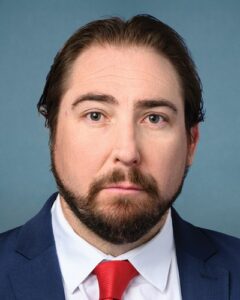
Tenure: 118th–119th Congresses
Years of Service: 2023–Present
Rep. Eli Crane has quickly established himself as one of the most consistently conservative members of the House Republican Conference, and that ideological approach extends to issues affecting wildlife conservation and animal protection. While Crane has not made animal policy a major focus of his legislative agenda, his voting record reflects a pattern of support for measures that animal-protection advocates generally oppose, particularly those involving endangered species, wildlife management, and agricultural regulation.
Unlike some lawmakers who maintain a mixed record through selective support for animal welfare legislation, Crane has shown little interest in advancing bipartisan animal-protection priorities. He is not known to have sponsored major legislation addressing animal cruelty, commercial breeding standards, wildlife trafficking, horse slaughter, animal fighting, or companion animal welfare. Nor has he emerged as an active participant in congressional caucuses or coalitions dedicated to animal protection.
Crane’s record is most clearly defined by a series of votes that align him with efforts to reduce federal wildlife protections. He voted in favor of H.R. 845, the Pet and Livestock Protection Act, legislation removing Endangered Species Act protections for gray wolves and transferring management authority to the states. Animal-protection and conservation organizations strongly opposed the legislation, arguing that it weakened federal safeguards for a recovering species.
He also supported H.R. 556, the Protecting Access for Hunters and Anglers Act, legislation designed to limit the ability of federal agencies to restrict lead ammunition and lead fishing tackle on federal lands. Conservation groups opposed the measure because lead poisoning remains a significant threat to eagles, condors, and other scavenging wildlife. Supporters characterized the legislation as protecting hunting traditions and public access, while critics viewed it as prioritizing recreational interests over wildlife health.
Crane likewise voted for the Moore Amendment (House Roll Call Vote 149), which sought to exempt West Virginia’s remaining commercial greyhound racing facilities from the greyhound-racing prohibition contained in the House Farm Bill. Animal-protection organizations supported the underlying greyhound-racing ban and opposed the Moore Amendment, arguing that it would have prolonged a practice they consider inherently cruel. Although the amendment failed, Crane’s vote placed him on the side of preserving commercial greyhound racing.
His Farm Bill vote similarly aligned him with a package that drew substantial criticism from animal-protection advocates. While the bill contained a national prohibition on commercial greyhound racing, it also included provisions designed to preempt certain state agricultural production standards, including laws affecting farm-animal confinement. Many national animal welfare organizations opposed those provisions, arguing they would undermine state-level animal protection laws.
Beyond these votes, Crane has not developed a record of affirmative engagement with animal welfare issues. He has not been a visible supporter of measures such as the Puppy Protection Act, the SAFE Act, the FIGHT Act, or other bipartisan efforts aimed at strengthening protections for animals. The absence of positive engagement, combined with a voting record that consistently favors reduced federal wildlife protections, places him among the more challenging members for animal advocates to engage.
Taken together, Crane’s record reflects more than simple disengagement. While animal welfare is not a central issue for his office, the positions he has taken when animal-related questions arise have generally aligned against the priorities of major animal-protection organizations. As a result, he is best classified as an Animal Opponent.
Notable Actions
119th Congress
✅ Supported House passage of the FDA Modernization Act 3.0, H.R. 2821, which passed by voice vote under suspension of the rules on July 20, 2026. The bipartisan legislation directs the FDA to update its regulations to fully implement the 2022 law allowing scientifically valid non-animal methods to be used instead of animal testing in drug development.
❌ Voted “Aye” on H.R. 556, the Protecting Access for Hunters and Anglers Act (House Roll Call Vote 93), to prohibit federal land management agencies from restricting the use of toxic lead ammunition and fishing tackle on public lands and waters to protect wildlife from poisoning. The bill passed the House 215–202. An “Aye” vote is the anti-animal position because it limited the federal government’s ability to restrict toxic lead ammunition and fishing tackle that poison wildlife and contaminate the environment.
❌ Voted “Aye” on H.R. 845, the Pet and Livestock Protection Act (House Roll Call Vote 360), to remove federal Endangered Species Act protections for gray wolves across much of the United States and restricted judicial review of future wolf management decisions. The bill passed the House 211–204. An “Aye” vote is the anti-animal position because it removed Endangered Species Act protections for gray wolves and limited judicial review of future wolf management decisions.
❌ Voted “Aye” on the Riley Moore Amendment (House Roll Call Vote 149), to weaken the Farm Bill’s Greyhound Protection Act provisions by creating a special exemption allowing commercial greyhound racing to continue in West Virginia indefinitely. The House rejected the amendment 187–237. An “Aye” vote is the anti-animal position because it sought to weaken greyhound protections by allowing commercial greyhound racing to continue indefinitely in West Virginia.
❌ Voted “Aye” on H.R. 7567, the Farm, Food, and National Security Act (House Roll Call Vote 154), to pass the Farm Bill, which included a provision to overturn state laws in California and Massachusetts restricting in-state sales of fresh pork sourced from farms that do not provide minimum space requirements for the housing of pregnant pigs. The bill passed the House 224–200. An “Aye” vote is the anti-animal position because it supported overturning state farm animal welfare laws that require more humane housing standards for pregnant pigs.
❌ Voted “Aye” on the Biggs Amendment to H.R. 3838 (House Roll Call Vote 259), to exempt defense-related activities from the requirements of the Endangered Species Act, eliminating protections for endangered and threatened species and their critical habitat on military lands and during defense operations. The House rejected the amendment 200–228. An “Aye” vote is the anti-animal position because it sought to weaken Endangered Species Act protections for threatened and endangered wildlife on military lands.
❌ Voted “Aye” on the Greene Amendment to H.R. 3838 (House Roll Call Vote 254), to prohibit the Department of Defense from using FY2026 funds for the research, development, procurement, or promotion of cell-cultured meat, an emerging alternative to conventional slaughter-based meat production. The House rejected the amendment 194–236, with 1 voting present. An “Aye” vote is the anti-animal position because it sought to block federal support for the development of slaughter-free, cell-cultured meat alternatives that could reduce the number of animals raised and killed for food.
❌ Voted “Aye” on the Northeast Lobster Protection Act, H.R. 9436 (House Roll Call Vote 291), which would extend a pause on new federal fishing gear regulations intended to protect critically endangered North Atlantic right whales from 2028 to 2035, delaying potential protections for an additional seven years. An “Aye” is an anti-animal position because it supports extending the delay in fishing rope, a leading cause of injury and death.
118th Congress
❌ Voted “Aye” on H.R. 764 (House Roll Call Vote 169), legislation to remove federal protections for gray wolves under the Endangered Species Act across most of the United States and return management authority to the states. Wildlife advocates warned that the bill would undermine science-based wildlife management and threaten the long-term recovery of gray wolf populations. The House passed the bill 209–205. An “Aye” vote is the anti-animal position because it removed Endangered Species Act protections for gray wolves across much of the United States, despite concerns that doing so would undermine their long-term recovery and science-based wildlife management.
❌ Voted “Aye” on H.R. 615 (House Roll Call Vote 167), legislation to bar the Department of the Interior and the Department of Agriculture from prohibiting or regulating the use of toxic lead ammunition and fishing tackle on federal lands and waters made available for hunting or fishing. Lead ammunition and tackle poison wildlife, including eagles, loons, condors, and other animals that ingest spent lead fragments or lost fishing gear. The House passed the bill 214–201. An “Aye” vote is the anti-animal position because it blocked federal agencies from restricting toxic lead ammunition and fishing tackle that poison eagles, loons, condors, and other wildlife.