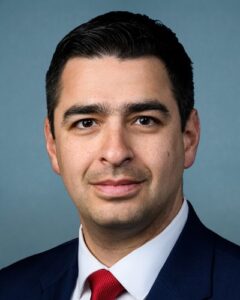
Tenure: 119th Congress
Years of Service: 2025–Present
Rep. Gabe Evans, a former Army helicopter pilot, police officer, and Colorado state legislator, represents a politically competitive district that includes portions of Adams, Larimer, and Weld counties. He and his wife operate a family farm in southern Weld County, giving him a direct connection to the agricultural and livestock interests that play a prominent role in his district.
During his first term in Congress, Evans has supported several meaningful animal-protection initiatives, particularly those connected to law enforcement and public safety. He is a cosponsor of the Fighting Inhumane Gambling and High-Risk Trafficking (FIGHT) Act, H.R. 3946, to strengthen federal enforcement against organized dogfighting and cockfighting. He joined as a cosponsor of the Captive Primate Safety Act, H.R. 3199, to end the private possession and commercial trade of nonhuman primates, and the Law Enforcement Animal Safety and Harm Reporting (LEASH) Act, H.R. 9078, to improve the reporting of felony animal-cruelty convictions and establish a national database of convicted offenders. Evans supported House passage of the FDA Modernization Act 3.0, H.R. 2821, which directs the Food and Drug Administration to update its regulations to advance the use of scientifically valid non-animal testing methods in drug development.
Evans serves on the influential House Energy and Commerce Committee. The Environment Subcommittee oversees the Environmental Protection Agency and federal laws governing air and water pollution, toxic substances, hazardous waste, and drinking water. Although it does not have primary jurisdiction over the Endangered Species Act or most stand-alone animal-welfare legislation, his position gives him an important platform to address toxic lead, pesticides, water contamination, and other environmental threats affecting wildlife, aquatic species, and public health. To date, however, he has not emerged as a leader on animal protection or used his committee position to advance a significant animal-protection initiative.
Evans’s positive actions on animal fighting, captive primates, cruelty enforcement, and non-animal testing are offset by a series of votes adverse to wildlife and animal protection. He voted for H.R. 556, legislation restricting the ability of federal land-management agencies to limit toxic lead ammunition and fishing tackle on public lands and waters. He voted for H.R. 845 to remove federal Endangered Species Act protections for gray wolves across much of the country and limit judicial review of the delisting decision. He had previously joined other Colorado Republicans in calling for an end to further wolf releases in Colorado and supporting legislation to transfer wolf management from the federal government to the states.
Evans voted for an amendment to the National Defense Authorization Act that would have exempted defense-related activities and military lands from important Endangered Species Act protections. He supported a separate amendment that would have prohibited the Department of Defense from funding or promoting cell-cultured meat, an emerging alternative to conventional slaughter-based production. Both amendments were rejected by the House.
On the 2026 Farm Bill, Evans voted for an unsuccessful amendment creating a special exemption that would have allowed commercial greyhound racing to continue indefinitely in West Virginia. He then supported final passage of the Farm Bill despite its inclusion of language overriding California and Massachusetts laws requiring pork sold in those states to come from operations that provide breeding pigs with minimum housing space. He took that adverse action even though Colorado bans gestation crates and battery cages; in short, no farmers in his state are allowed to use the confinement methods proscribed in Prop 12 or Question 3. These votes placed him on the side of greyhound-racing and industrial livestock interests and against the authority of states to establish more humane standards for agricultural products sold within their borders.
His record in the Colorado House was similarly mixed. In 2023, Evans supported the Colorado Wild Horse Project, stronger penalties for aggravated animal cruelty, and restitution for injuries to law-enforcement animals. However, he opposed a voluntary nonlead-ammunition voucher program, legislation ending wagering on simulcast greyhound races, protections for people keeping pets in rental housing, a wolf license plate supporting nonlethal conflict prevention, and the timely implementation of voter-approved wolf restoration. Colorado Voters for Animals gave him a 44 percent voting score and a D+ grade that year.
Evans improved to a 71 percent score and a B− grade in 2024. He supported emergency planning for people with animals, expanded veterinary-technician services, stronger protections for police animals, infectious-disease notification requirements for pet-care facilities, and sterilization requirements for dogs and cats adopted from shelters and rescues. At the same time, he opposed establishing a dedicated Division of Animal Welfare within the Colorado Department of Agriculture and voted against legislation authorizing the restoration of threatened wolverines to suitable Colorado habitat.
Evans has demonstrated that he can be a constructive Republican partner when animal protection is connected to criminal enforcement, public safety, or scientific innovation. His cosponsoring of the FIGHT, Captive Primate Safety, and LEASH Acts provides a foundation for further collaboration, but these are subject where there is no animal-use industry pushing back. Where there is pushback, he typically defaults to a pro-animal-use-industry voting pattern. That’s where he’s fallen short when it comes to core wildlife protection efforts (including endangered species defense), blocking efforts to restrict the use of toxic lead ammunition on federal lands, winding down greyhound racing, and voting to repeal of state farm animal welfare laws (even though his own state farmers live by standards forbidding extreme confinement).
Notable Actions
119th Congress
✅ Cosponsor of the Fighting Inhumane Gambling and High-Risk Trafficking (FIGHT) Act, H.R. 3946, to strengthen federal enforcement against animal fighting and related criminal activity.
✅ Cosponsor of the Captive Primate Safety Act, H.R. 3199, to prohibit the private ownership, breeding, sale, transport, and other commercial activities involving nonhuman primates by amending the Lacey Act, while exempting accredited zoos, sanctuaries, research facilities, and certain other qualified entities. The legislation is designed to protect both public safety and the welfare of highly intelligent primates by ending the commercial pet trade in these animals.
✅ Supported House passage of the FDA Modernization Act 3.0, H.R. 2821, which passed by voice vote under suspension of the rules on July 20, 2026. The bipartisan legislation directs the FDA to update its regulations to fully implement the 2022 law allowing scientifically valid non-animal methods to be used instead of animal testing in drug development.
❌ Voted “Aye” on H.R. 556, the Protecting Access for Hunters and Anglers Act (House Roll Call Vote 93), to prohibit federal land management agencies from restricting the use of toxic lead ammunition and fishing tackle on public lands and waters to protect wildlife from poisoning. The bill passed the House 215–202. An “Aye” vote is the anti-animal position because it limited the federal government’s ability to restrict toxic lead ammunition and fishing tackle that poison wildlife and contaminate the environment.
❌ Voted “Aye” on H.R. 845, the Pet and Livestock Protection Act (House Roll Call Vote 360), to remove federal Endangered Species Act protections for gray wolves across much of the United States and restricted judicial review of future wolf management decisions. The bill passed the House 211–204. An “Aye” vote is the anti-animal position because it removed Endangered Species Act protections for gray wolves and limited judicial review of future wolf management decisions.
❌ Voted “Aye” on the Riley Moore Amendment (House Roll Call Vote 149), to weaken the Farm Bill’s Greyhound Protection Act provisions by creating a special exemption allowing commercial greyhound racing to continue in West Virginia indefinitely. The House rejected the amendment 187–237. An “Aye” vote is the anti-animal position because it sought to weaken greyhound protections by allowing commercial greyhound racing to continue indefinitely in West Virginia.
❌ Voted “Aye” on H.R. 7567, the Farm, Food, and National Security Act (House Roll Call Vote 154), to pass the Farm Bill, which included a provision to overturn state laws in California and Massachusetts restricting in-state sales of fresh pork sourced from farms that do not provide minimum space requirements for the housing of pregnant pigs. The bill passed the House 224–200. An “Aye” vote is the anti-animal position because it supported overturning state farm animal welfare laws that require more humane housing standards for pregnant pigs.
❌ Voted “Aye” on the Biggs Amendment to H.R. 3838 (House Roll Call Vote 259), to exempt defense-related activities from the requirements of the Endangered Species Act, eliminating protections for endangered and threatened species and their critical habitat on military lands and during defense operations. The House rejected the amendment 200–228. An “Aye” vote is the anti-animal position because it sought to weaken Endangered Species Act protections for threatened and endangered wildlife on military lands.
❌ Voted “Aye” on the Greene Amendment to H.R. 3838 (House Roll Call Vote 254), to prohibit the Department of Defense from using FY2026 funds for the research, development, procurement, or promotion of cell-cultured meat, an emerging alternative to conventional slaughter-based meat production. The House rejected the amendment 194–236, with 1 voting present. An “Aye” vote is the anti-animal position because it sought to block federal support for the development of slaughter-free, cell-cultured meat alternatives that could reduce the number of animals raised and killed for food.
❌ Voted “Aye” on the Northeast Lobster Protection Act, H.R. 9436 (House Roll Call Vote 291), which would extend a pause on new federal fishing gear regulations intended to protect critically endangered North Atlantic right whales from 2028 to 2035, delaying potential protections for an additional seven years. An “Aye” is an anti-animal position because it supports extending the delay in fishing rope, a leading cause of injury and death.