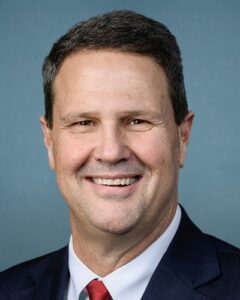
Tenure: 119th Congress
Years of Service: 2025–Present
Jeff Crank was born in Pueblo, Colorado, and earned a BA from Colorado State University. He hosted a talk radio show and worked as a congressional staffer for most of the 1990s. He subsequently worked for the Colorado Springs Chamber of Commerce, Americans for Prosperity and then created his own political consulting firm. He was elected to Congress in 2024.
Congressman Jeff Crank’s first two years in Congress have been quite a significant disappointment from an animal-welfare policy perspective. As a new member of the House with ample opportunity to establish himself as a strong advocate for animal wellness and sensible wildlife policies, Crank instead has quickly compiled a record that reflects contempt for animal welfare, voting to weaken protections for wildlife, farm animals, and endangered species.
The sole exception to this alarming trend was Crank’s support for the FDA Modernization Act 3.0, H.R. 2821, which passed unanimously in the House. The bipartisan legislation directs the FDA to update its regulations to fully implement the 2022 law allowing scientifically valid non-animal methods to be used instead of animal testing in drug development.
Unfortunately, his support for that measure has been overshadowed by a much deeper and broader pattern of positions at odds with mainstream animal-welfare and wildlife-conservation principles. In the 119th Congress, Crank voted for H.R. 556, the Protecting Access for Hunters and Anglers Act, which restricted federal land-management agencies from limiting the use of toxic lead ammunition and fishing tackle despite the well-documented threat that lead poisoning poses to wildlife. He also voted for H.R. 845, the Pet and Livestock Protection Act, to strip federal Endangered Species Act protections from gray wolves across much of the United States while restricting judicial review of future wolf-management decisions.
Crank’s voting record also includes support for weakening protections for animals exploited for entertainment. He voted for the Riley Moore Amendment, which sought to create an exemption allowing commercial greyhound racing in West Virginia and to cut the heart out of the Greyhound Protection Act. His vote placed him on the side of weakening rather than strengthening federal protections for racing greyhounds.
His vote on the 2026 Farm Bill was similarly at odds with core animal protection values. Crank supported H.R. 7567, the Farm, Food, and National Security Act, which included provisions overturning state laws in California (Prop 12) and Massachusetts (Question 3) requiring minimum space standards for pregnant pigs. From an animal-welfare perspective, this represented support for federal preemption of state laws that provide more humane housing standards for farm animals.
Crank likewise voted for the Biggs Amendment to H.R. 3838, which sought to exempt defense-related activities from Endangered Species Act requirements and thereby weaken protections for threatened and endangered species and their critical habitat on military lands. At the same time, however, he voted against the Greene Amendment, which would have prohibited the Department of Defense from using federal funds to research, develop, procure, or promote cell-cultured meat. That vote was a positive one because cell-cultured meat represents an emerging alternative to conventional slaughter-based meat production and could ultimately reduce the number of animals raised and slaughtered for food.
His vote on the Northeast Lobster Protection Act further illustrates the problem. Crank supported H.R. 9436, legislation extending from 2028 to 2035 a pause on new federal fishing-gear regulations intended to protect critically endangered North Atlantic right whales from entanglement. From an animal-protection perspective, extending the delay places the interests of a commercial fishery ahead of timely implementation of measures intended to reduce serious injury and death to one of the world’s most endangered whale species.
Taken together, this string of votes demonstrates why Crank’s first two years in Congress have been so terribly disappointing. He has shown that he can support meaningful animal-welfare reform when he chooses to do so, most notably through FDA Modernization Act 3.0 and his opposition to the Greene Amendment. But those two positive steps have been vastly outweighed by numerous votes supporting toxic lead ammunition and fishing tackle, weakening Endangered Species Act protections, allowing commercial greyhound racing to continue indefinitely, overriding state farm-animal welfare standards, and delaying protections for critically endangered North Atlantic right whales.
For a new member of Congress, these first two years represented an important opportunity to establish a record as a strong advocate for animal wellness and responsible wildlife policies. Instead, Crank has largely failed to seize that golden opportunity. His record is especially frustrating because his votes demonstrate that he is capable of recognizing sound, modern approaches to animal welfare, yet he has repeatedly sided with interests seeking to weaken established protections for animals and wildlife. After two years in Congress, there is considerable room for Congressman Crank to become a much stronger and more consistent advocate for animal wellness.
Notable Actions
119th Congress
✅ Supported House passage of the FDA Modernization Act 3.0, H.R. 2821, which passed by voice vote under suspension of the rules on July 20, 2026. The bipartisan legislation directs the FDA to update its regulations to fully implement the 2022 law allowing scientifically valid non-animal methods to be used instead of animal testing in drug development.
❌ Voted “Aye” on H.R. 556, the Protecting Access for Hunters and Anglers Act (House Roll Call Vote 93), to prohibit federal land management agencies from restricting the use of toxic lead ammunition and fishing tackle on public lands and waters to protect wildlife from poisoning. The bill passed the House 215–202. An “Aye” vote is the anti-animal position because it limited the federal government’s ability to restrict toxic lead ammunition and fishing tackle that poison wildlife and contaminate the environment.
❌ Voted “Aye” on H.R. 845, the Pet and Livestock Protection Act (House Roll Call Vote 360), to remove federal Endangered Species Act protections for gray wolves across much of the United States and restricted judicial review of future wolf management decisions. The bill passed the House 211–204. An “Aye” vote is the anti-animal position because it removed Endangered Species Act protections for gray wolves and limited judicial review of future wolf management decisions.
❌ Voted “Aye” on the Riley Moore Amendment (House Roll Call Vote 149), to weaken the Farm Bill’s Greyhound Protection Act provisions by creating a special exemption allowing commercial greyhound racing to continue in West Virginia indefinitely. The House rejected the amendment 187–237. An “Aye” vote is the anti-animal position because it sought to weaken greyhound protections by allowing commercial greyhound racing to continue indefinitely in West Virginia.
❌ Voted “Aye” on H.R. 7567, the Farm, Food, and National Security Act (House Roll Call Vote 154), to pass the Farm Bill, which included a provision to overturn state laws in California and Massachusetts restricting in-state sales of fresh pork sourced from farms that do not provide minimum space requirements for the housing of pregnant pigs. The bill passed the House 224–200. An “Aye” vote is the anti-animal position because it supported overturning state farm animal welfare laws that require more humane housing standards for pregnant pigs.
❌ Voted “Aye” on the Biggs Amendment to H.R. 3838 (House Roll Call Vote 259), to exempt defense-related activities from the requirements of the Endangered Species Act, eliminating protections for endangered and threatened species and their critical habitat on military lands and during defense operations. The House rejected the amendment 200–228. An “Aye” vote is the anti-animal position because it sought to weaken Endangered Species Act protections for threatened and endangered wildlife on military lands.
✅ Voted “Nay” on the Greene Amendment to H.R. 3838 (House Roll Call Vote 254), to prohibit the Department of Defense from using FY2026 funds for the research, development, procurement, or promotion of cell-cultured meat, an emerging alternative to conventional slaughter-based meat production. The House rejected the amendment 194–236, with 1 voting present. A “Nay” vote is the pro-animal position.
❌ Voted “Aye” on the Northeast Lobster Protection Act, H.R. 9436 (House Roll Call Vote 291), which would extend a pause on new federal fishing gear regulations intended to protect critically endangered North Atlantic right whales from 2028 to 2035, delaying potential protections for an additional seven years. An “Aye” is an anti-animal position because it supports extending the delay in fishing rope, a leading cause of injury and death.