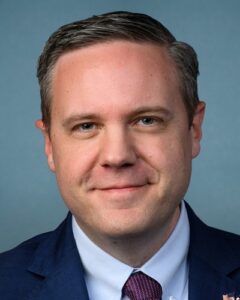
Tenure: 119th Congress
Years of Service: 2025–Present
Although still early in his congressional career, Rep. Jeff Hurd has quickly developed a record that places him at odds with many major animal protection priorities. Unlike some freshman lawmakers whose records are characterized primarily by limited engagement, Hurd has repeatedly aligned himself with positions favored by livestock, agricultural, and hunting interests when those interests have come into conflict with animal welfare and wildlife protection concerns.
The clearest example is his opposition to federal anti-horse-slaughter efforts. Hurd opposed legislation that would have prohibited the slaughter of American horses for human consumption and prevented the export of horses for slaughter abroad. Horse protection advocates have long regarded these measures as among the movement’s highest federal priorities, and Hurd’s opposition placed him squarely against one of the most prominent animal welfare initiatives before Congress.
His voting record has followed a similar pattern. Hurd voted for H.R. 845, legislation that would remove federal Endangered Species Act protections for gray wolves. He voted for H.R. 556, restricting federal agencies’ ability to regulate lead ammunition and lead fishing tackle on federal lands and waters. He supported the Moore Amendment, which sought to create an exemption from the federal prohibition on commercial greyhound racing, and he voted for the Greene Amendment restricting federal support for cultivated meat and alternative protein technologies.
Hurd also voted for the Farm, Food, and National Security Act, including provisions that would have preempted state farm-animal welfare laws such as California’s Proposition 12 and Massachusetts’ Question 3. Animal protection organizations viewed those provisions as one of the most significant federal threats to state animal welfare laws in recent years.
Beyond these votes, Hurd’s legislative work has generally reflected close alignment with traditional livestock and agricultural interests. His sponsorship of the Hauling Exemptions for Livestock Protection (HELP) Act further illustrates a policy approach centered on the concerns of livestock producers rather than animal welfare advocates.
Unlike many members who maintain mixed records, there is little evidence thus far of offsetting support for major animal protection legislation. Based on currently available information, Hurd is not a current cosponsor of significant animal welfare measures such as the SAFE Act, FIGHT Act, ACE Act, LEAD Act, or FDA Modernization Act 3.0.
Taken as a whole, Hurd’s record places him in the Animal Opponent category. While still a freshman member of Congress, he has already established a pattern of opposing many of the movement’s most significant priorities, particularly on horse protection, wildlife conservation, and farm-animal welfare issues.
Notable Actions
119th Congress
❌ Voted “Nay” on the Van Drew–Titus Amendment (Recorded Vote No. 98-pg. 46) to H.R. 8870 (Transportation and Infrastructure Committee Vote), which would have incorporated key provisions of the Save America’s Forgotten Equines (SAFE) Act into the Build America 250 Act. The bipartisan amendment would permanently prohibit the export of American horses to Canada, Mexico, or other countries for slaughter for human consumption and ban the use of dangerous double-decker trailers to transport horses. The amendment was adopted by a 34–30 vote. A “Nay” vote is the anti-animal position because it opposed ending the export of American horses for slaughter.
✅ Supported House passage of the FDA Modernization Act 3.0, H.R. 2821, which passed by voice vote under suspension of the rules on July 20, 2026. The bipartisan legislation directs the FDA to update its regulations to fully implement the 2022 law allowing scientifically valid non-animal methods to be used instead of animal testing in drug development.
❌ Voted “Aye” on H.R. 556, the Protecting Access for Hunters and Anglers Act (House Roll Call Vote 93), to prohibit federal land management agencies from restricting the use of toxic lead ammunition and fishing tackle on public lands and waters to protect wildlife from poisoning. The bill passed the House 215–202. An “Aye” vote is the anti-animal position because it limited the federal government’s ability to restrict toxic lead ammunition and fishing tackle that poison wildlife and contaminate the environment.
❌ Voted “Aye” on H.R. 845, the Pet and Livestock Protection Act (House Roll Call Vote 360), to remove federal Endangered Species Act protections for gray wolves across much of the United States and restricted judicial review of future wolf management decisions. The bill passed the House 211–204. An “Aye” vote is the anti-animal position because it removed Endangered Species Act protections for gray wolves and limited judicial review of future wolf management decisions.
❌ Voted “Aye” on the Riley Moore Amendment (House Roll Call Vote 149), to weaken the Farm Bill’s Greyhound Protection Act provisions by creating a special exemption allowing commercial greyhound racing to continue in West Virginia indefinitely. The House rejected the amendment 187–237. An “Aye” vote is the anti-animal position because it sought to weaken greyhound protections by allowing commercial greyhound racing to continue indefinitely in West Virginia.
❌ Voted “Aye” on H.R. 7567, the Farm, Food, and National Security Act (House Roll Call Vote 154), to pass the Farm Bill, which included a provision to overturn state laws in California and Massachusetts restricting in-state sales of fresh pork sourced from farms that do not provide minimum space requirements for the housing of pregnant pigs. The bill passed the House 224–200. An “Aye” vote is the anti-animal position because it supported overturning state farm animal welfare laws that require more humane housing standards for pregnant pigs.
❌ Voted “Aye” on the Biggs Amendment to H.R. 3838 (House Roll Call Vote 259), to exempt defense-related activities from the requirements of the Endangered Species Act, eliminating protections for endangered and threatened species and their critical habitat on military lands and during defense operations. The House rejected the amendment 200–228. An “Aye” vote is the anti-animal position because it sought to weaken Endangered Species Act protections for threatened and endangered wildlife on military lands.
❌ Voted “Aye” on the Greene Amendment to H.R. 3838 (House Roll Call Vote 254), to prohibit the Department of Defense from using FY2026 funds for the research, development, procurement, or promotion of cell-cultured meat, an emerging alternative to conventional slaughter-based meat production. The House rejected the amendment 194–236, with 1 voting present. An “Aye” vote is the anti-animal position because it sought to block federal support for the development of slaughter-free, cell-cultured meat alternatives that could reduce the number of animals raised and killed for food.