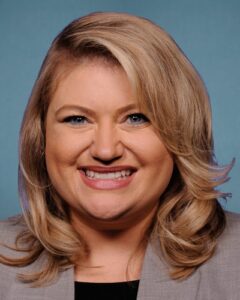
Tenure: 117th–119th Congresses
Years of Service: 2021–Present
Notable Actions
119th Congress
✅ Cosponsor of the Stop Billion-Dollar FWS Plan to Kill Half a Million Owls, H.J. Res. 111, a Congressional Review Act resolution to nullify the U.S. Fish and Wildlife Service plan to kill approximately 450,000 barred owls to reduce competition with northern spotted owls.
❌ Voted “Aye” on House Agriculture Committee Record Vote No. 24, approving Rep. Tracey Mann’s second-degree amendment to Rep. Shri Thanedar’s Amendment No. 119 during markup of the 2026 Farm Bill. The Mann amendment stripped away nearly all of the bipartisan FIGHT Act’s enforcement provisions—including measures targeting the trafficking and shipment of fighting birds, expanded civil enforcement authority, and other tools to combat organized animal fighting—leaving primarily language related to gambling on animal fighting. The committee adopted the amendment by a 29–22 vote. An “Aye” vote is the anti-animal position because it substantially weakened the FIGHT Act before the committee unanimously adopted the amended Thanedar amendment.
✅ Supported House passage of the FDA Modernization Act 3.0, H.R. 2821, which passed by voice vote under suspension of the rules on July 20, 2026. The bipartisan legislation directs the FDA to update its regulations to fully implement the 2022 law allowing scientifically valid non-animal methods to be used instead of animal testing in drug development.
❌ Voted “Aye” on H.R. 556, the Protecting Access for Hunters and Anglers Act (House Roll Call Vote 93), to prohibit federal land management agencies from restricting the use of toxic lead ammunition and fishing tackle on public lands and waters to protect wildlife from poisoning. The bill passed the House 215–202. An “Aye” vote is the anti-animal position because it limited the federal government’s ability to restrict toxic lead ammunition and fishing tackle that poison wildlife and contaminate the environment.
❌ Voted “Aye” on H.R. 845, the Pet and Livestock Protection Act (House Roll Call Vote 360), to remove federal Endangered Species Act protections for gray wolves across much of the United States and restricted judicial review of future wolf management decisions. The bill passed the House 211–204. An “Aye” vote is the anti-animal position because it removed Endangered Species Act protections for gray wolves and limited judicial review of future wolf management decisions.
✅ Voted “Nay” on the Riley Moore Amendment to H.R. 7567 (House Roll Call Vote 149), to weaken the Farm Bill’s Greyhound Protection Act provisions by creating a special exemption allowing commercial greyhound racing to continue in West Virginia indefinitely. The House rejected the amendment 187–237. A “Nay” vote is the pro-animal position.
❌ Voted “Aye” on H.R. 7567, the Farm, Food, and National Security Act (House Roll Call Vote 154), to pass the Farm Bill, which included a provision to overturn state laws in California and Massachusetts restricting in-state sales of fresh pork sourced from farms that do not provide minimum space requirements for the housing of pregnant pigs. The bill passed the House 224–200. An “Aye” vote is the anti-animal position because it supported overturning state farm animal welfare laws that require more humane housing standards for pregnant pigs.
❌ Voted “Aye” on the Biggs Amendment to H.R. 3838 (House Roll Call Vote 259), to exempt defense-related activities from the requirements of the Endangered Species Act, eliminating protections for endangered and threatened species and their critical habitat on military lands and during defense operations. The House rejected the amendment 200–228. An “Aye” vote is the anti-animal position because it sought to weaken Endangered Species Act protections for threatened and endangered wildlife on military lands.
❌ Voted “Aye” on the Greene Amendment to H.R. 3838 (House Roll Call Vote 254), to prohibit the Department of Defense from using FY2026 funds for the research, development, procurement, or promotion of cell-cultured meat, an emerging alternative to conventional slaughter-based meat production. The House rejected the amendment 194–236, with 1 voting present. An “Aye” vote is the anti-animal position because it sought to block federal support for the development of slaughter-free, cell-cultured meat alternatives that could reduce the number of animals raised and killed for food.
118th Congress
❌ Voted “Aye” on H.R. 764 (House Roll Call Vote 169), legislation to remove federal protections for gray wolves under the Endangered Species Act across most of the United States and return management authority to the states. Wildlife advocates warned that the bill would undermine science-based wildlife management and threaten the long-term recovery of gray wolf populations. The House passed the bill 209–205. An “Aye” vote is the anti-animal position because it removed Endangered Species Act protections for gray wolves across much of the United States, despite concerns that doing so would undermine their long-term recovery and science-based wildlife management.
❌ Voted “Aye” on H.R. 615 (House Roll Call Vote 167), legislation to bar the Department of the Interior and the Department of Agriculture from prohibiting or regulating the use of toxic lead ammunition and fishing tackle on federal lands and waters made available for hunting or fishing. Lead ammunition and tackle poison wildlife, including eagles, loons, condors, and other animals that ingest spent lead fragments or lost fishing gear. The House passed the bill 214–201. An “Aye” vote is the anti-animal position because it blocked federal agencies from restricting toxic lead ammunition and fishing tackle that poison eagles, loons, condors, and other wildlife.
117th Congress
❌ Voted “Nay” on the motion to suspend the rules and pass Prevent All Soring Tactics (PAST) Act, H.R. 5441 (House Roll Call Vote 478). The bill would strengthen enforcement of the Horse Protection Act and help end the cruel practice of “soring” Tennessee Walking Horses, Racking Horses, and Spotted Saddle Horses. Soring involves intentionally inflicting severe pain on horses’ legs and hooves through caustic chemicals, chains, pressure devices, or other abusive methods to force an exaggerated, high-stepping gait known as the “Big Lick.” The motion was agreed to by a vote of 304–111, exceeding the two-thirds majority required under the suspension of the rules procedure. A “Nay” vote is the anti-animal position because it opposed stronger enforcement against the deliberate infliction of pain on horses to produce an exaggerated gait for competition.
❌ Voted “Nay” on Big Cat Public Safety Act, H.R. 263 (House Roll Call Vote 415), legislation to end the private possession and commercial breeding of lions, tigers, leopards, cheetahs, jaguars, cougars, and other big cats while prohibiting public contact with these animals. The bill targeted the exploitative cub-petting industry and roadside zoos, where big cats are repeatedly bred, handled, and discarded, while strengthening protections for both animals and public safety. A “Nay” vote is the anti-animal position because it opposed ending the commercial exploitation and private ownership of big cats.