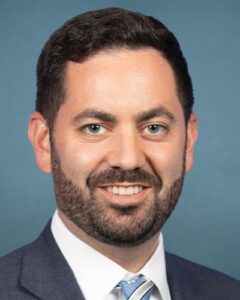
Tenure: 118th–119th Congresses
Years of Service: 2023–Present
Congressman Mike Lawler graduated from Manhattan College with a degree in accounting in 2009. From 2009 through 2018, he worked for the New York Republican State Committee and ran a political consulting firm. From 2018 through 2020, he worked in local government and was elected to the New York State Assembly in 2020. He was elected to the U.S. Congress in 2022 as a Republican and is completing his third term, showing off a commanding presence on television and winning a seat with a strong Democrat registration advantage and successfully defending it with his impressive political skills.
Lawler has been an advocate on a wide range of animal welfare policies and has even led on one priority policy reform on animal protection– joining Congresswoman Val Hoyle, D-Oregon, as the co-leader of the Snowmobiles Aren’t Weapons (SAW) Act. That measure seeks to halt running down and ramming wolves and other animals with snowmobiles or other motorized vehicles, and it came in the wake of a grisly incident in Wyoming where a man intentionally crushed an adolescent wolf with a snowmobile, grievously wounded the animal, and then took her captive and tormented the debilitated animal after taking pictures of the battered animal at a bar in the western part of the state.
But Lawler’s support for animal welfare has been far from consistent and he’s rejected recommendations from animal welfare groups on a set of important policies. Lawler voted for H.R. 556, the Protecting Access for Hunters and Anglers Act, which would restrict federal land-management agencies from prohibiting or regulating toxic lead ammunition and fishing tackle on federal lands and waters. Lead ammunition and fishing tackle can poison wildlife, including eagles, loons, condors, and other species that ingest spent ammunition fragments or lost fishing gear. Likewise, Lawler also voted for H.R. 845, the Pet and Livestock Protection Act promoted by Rep. Tom Tiffany, an anti-wolf zealot, to remove Endangered Species Act protections for gray wolves across much of the United States while restricting judicial review of future wolf-management decisions. In the 118th Congress, he similarly voted for H.R. 764 to remove federal protections for gray wolves and H.R. 615 to restrict federal authority to regulate toxic lead ammunition and fishing tackle.
In the 119th Congress, he supported the efforts of Agriculture Committee Chairman Glenn Thompson, R-Pa., to push a Farm bill with a provision to overturn the nation’s most important animal protection laws, including Prop 12 in California and Question 3 in Massachusetts. He voted for the Farm bill even though he had signed a letter to Thompson urging him not to include the so-called Save Our Bacon (SOB) Act in any Farm bill. More recently, he jolted animal advocates by serving as the lead author of a bill to delay federal protections for the critically endangered North Atlantic right whale, who face mortality from entanglement from lobster traps. His support for this set of anti-animal policies undercuts what’s generally been a very strong set of other actions that have demonstrated broad-based support for animal welfare policies.
On the positive side – and there’s much to Lawler’s positive side – Congressman Lawler has been an active supporter of animal welfare legislation in the 119th Congress. He is a cosponsor of the Save America’s Forgotten Equines (SAFE) Act, which would prohibit horse slaughter in the United States and the export of American horses for slaughter abroad. While he hasn’t cosponsored the FIGHT Act—which has been endorsed by nearly all of American law enforcement—he has cosponsored the No Flight, No Fight Act to bar transports of fighting roosters on commercial airlines. He has also cosponsored the Animal Cruelty Enforcement (ACE) Act and the FBI Animal Cruelty Task Force Act, both of which would strengthen federal investigation and prosecution of animal cruelty crimes, particularly animal-fighting crimes. These measures would give federal law-enforcement agencies substantially greater capacity to address organized animal fighting and other serious animal-abuse offenses.
He has likewise supported a broad range of measures addressing specific forms of animal exploitation. Lawler is a cosponsor of the Greyhound Protection Act, which would phase out commercial greyhound racing in the United States, where the industry has declined to just two operating tracks. He also cosponsored the PAST Act, legislation to strengthen enforcement against the deliberate abuse of horses through soring; the Puppy Protection Act, which would strengthen federal standards of care for dogs kept by commercial breeders; Goldie’s Act and the Better CARE for Animals Act, which would strengthen enforcement of the Animal Welfare Act; and Violet’s Law, which would require federally funded research facilities to pursue adoption or sanctuary placement for dogs, cats, rabbits, guinea pigs, hamsters, and nonhuman primates when feasible.
Lawler’s support for animal welfare extends to farm-animal and emerging-technology issues. He is a cosponsor of the EGG SAVE Act, which would encourage the voluntary adoption of in-ovo sexing technology to reduce the routine killing of unwanted male chicks in the egg industry. He also cosponsored the FDA Modernization Act 3.0, which directs the FDA to implement its existing authority allowing scientifically valid non-animal methods to be used as alternatives to animal testing in drug development. He subsequently supported House passage of the legislation, which passed by voice vote in July 2026. His support for the measure represents an important commitment to reducing the use of animals in biomedical research where scientifically valid alternatives are available.
Joining just 27 GOP colleagues, Lawler bucked Thompson’s wishes on a separate animal welfare issue on the Farm bill, opposing Rep. Riley Moore’s amendment to the 2026 Farm Bill to hollow out the Greyhound Protection Act and allow greyhound racing in the last state where the events are staged. He also voted against the Biggs Amendment to exempt defense-related activities from Endangered Species Act requirements on military lands and against the Greene Amendment to prohibit federal funding for research, development, procurement, or promotion of cell-cultured meat. These votes demonstrate that Lawler has been very active in supporting animal welfare policies, and it makes his votes on repealing Prop 12, removing federal protections for wolves, delaying urgent protections for right whales, and blocking efforts to limit lead ammunition use perplexing and inconsistent with his larger body of work.
Lawler’s sponsorship of H.R. 9436, the Northeast Lobsterman Protection Act of 2026, represents perhaps his boldest and most confusing acts as a lawmaker, given that his district has no coastal connection and there is no lobster industry connected to his constituency. The legislation extends from 2028 to 2035 a congressional moratorium on certain new federal regulations addressing North Atlantic right whale interactions with the lobster and Jonah crab fisheries, including potential fishery closures. The House passed the bill on September 1, 2026, and it is pending in the Senate.
From an animal welfare perspective, the concern is an additional seven-year delay in implementing life-saving protections for one of the world’s most endangered large whales. NOAA estimates that only approximately 380 North Atlantic right whales remain, including only about 70 reproductively active females, and identifies fishing-gear entanglement as one of the species’ primary threats. More than 85 percent of right whales are estimated to have experienced entanglement at least once, and NOAA reports that at least 46 right whales have been confirmed dead or seriously injured from entanglement since the current Unusual Mortality Event began in 2017, with the actual number likely substantially higher because many deaths go undetected. NOAA is continuing to work with fishermen and gear manufacturers on innovations such as ropeless fishing gear, demonstrating that the policy choice need not be between protecting whales and sustaining fisheries; the goal can be to develop fishing practices that allow both to coexist.
Taken as a whole, Lawler’s record is considerably more supportive of mainstream animal-welfare policies than three-quarters of his Republican colleagues in Congress. He has repeatedly cosponsored major bipartisan animal-protection measures and has supported efforts to strengthen enforcement of federal animal-cruelty laws, protect horses and dogs, phase out greyhound racing, reduce animal testing, and provide alternatives to laboratory research animals. While his actions on the wildlife front, and his flip flop on Prop 12 defense, are unmistakably bad for animal welfare, he is the co-lead of an effort to stop egregious abuses of wolves through the SAW Act. His record is one of the most complicated and confounding ones in the entire U.S. House of Representatives on animal welfare.
Notable Actions
119th Congress
✅ Cosponsor of the Save America’s Forgotten Equines (SAFE) Act, H.R. 1661, to ban U.S.-based horse slaughter and the export of horses for slaughter for human consumption.
✅ Cosponsor of the Animal Cruelty Enforcement (ACE) Act, H.R. 1477, to establish a dedicated DOJ unit to investigate and prosecute animal cruelty crimes.
✅ Cosponsor of the FBI Animal Cruelty Task Force (FBI ACT) Act, H.R. 3683, to establish an Animal Cruelty Crimes Task Force within the Federal Bureau of Investigation to investigate and enforce federal animal cruelty laws, including those involving dogfighting, cockfighting, crush videos, and related offenses.
✅ Cosponsor of the Greyhound Protection Act, H.R. 5017, to phase out U.S. greyhound racing, a practice long in decline and operational at just two tracks.
✅ Cosponsor of the FDA Modernization Act 3.0, H.R. 2821, to direct the FDA to update its regulations consistent with a law passed by Congress in 2022 that made animal testing optional in new drug development.
✅ Cosponsor of the EGG SAVE Act, H.R. 5776, to modernize egg production by accelerating the voluntary adoption of in-ovo sexing technology to end the wasteful and inhumane culling of male chicks in hatcheries.
✅ Cosponsor of the Snowmobiles Aren’t Weapons (SAW) Act, H.R. 6864, to prohibit any person from intentionally using a motor vehicle to run over or kill wolves and other mammals on federal lands.
✅ Cosponsor of Violet’s Law, H.R. 3246, to provide a second chance for dogs, cats, rabbits, guinea pigs, hamsters, and nonhuman primates used in federally funded research by requiring facilities to pursue adoption or sanctuary placement whenever feasible. The measure was later incorporated into the House-passed Farm, Food, and National Security Act.
✅ Cosponsor of the Prevent All Soring Tactics (PAST) Act, H.R. 1684, to strengthen enforcement against the cruel practice of soring horses. The bill would ban devices associated with soring, require independent USDA-trained inspectors, increase penalties for violations, and strengthen the Horse Protection Act to better protect Tennessee Walking Horses and other affected breeds from intentional abuse.
✅ Cosponsor of the Puppy Protection Act, H.R. 2253, bipartisan legislation to strengthen federal standards of care for dogs kept by commercial breeders by improving requirements for housing, veterinary care, exercise, socialization, and humane breeding practices.
✅ Cosponsor of the Better CARE for Animals Act, H.R. 3112, to strengthen enforcement of the Animal Welfare Act by expanding federal authority to investigate and prosecute animal cruelty violations and improve coordination between the U.S. Department of Agriculture and the Department of Justice.
✅ Cosponsor of Goldie’s Act, H.R. 349, bipartisan legislation to strengthen enforcement of the Animal Welfare Act by requiring more frequent inspections, faster reporting of violations, and improved protections for animals suffering abuse or neglect.
✅ Signed a congressional letter opposing the EATS/SOB Act that would erode states’ rights, undermine family farmers, and expand foreign influence over U.S. food production.
✅ Signed a congressional letter to President Donald J. Trump urging him to permanently prohibit the export of American horses to Mexico for slaughter.
✅ Supported House passage of the FDA Modernization Act 3.0, H.R. 2821, which passed by voice vote under suspension of the rules on July 20, 2026. The bipartisan legislation directs the FDA to update its regulations to fully implement the 2022 law allowing scientifically valid non-animal methods to be used instead of animal testing in drug development.
❌ Voted “Aye” on H.R. 556, the Protecting Access for Hunters and Anglers Act (House Roll Call Vote 93), to prohibit federal land management agencies from restricting the use of toxic lead ammunition and fishing tackle on public lands and waters to protect wildlife from poisoning. The bill passed the House 215–202. An “Aye” vote is the anti-animal position because it limited the federal government’s ability to restrict toxic lead ammunition and fishing tackle that poison wildlife and contaminate the environment.
❌ Voted “Aye” on H.R. 845, the Pet and Livestock Protection Act (House Roll Call Vote 360), to remove federal Endangered Species Act protections for gray wolves across much of the United States and restricted judicial review of future wolf management decisions. The bill passed the House 211–204. An “Aye” vote is the anti-animal position because it removed Endangered Species Act protections for gray wolves and limited judicial review of future wolf management decisions.
✅ Voted “Nay” on the Riley Moore Amendment to H.R. 7567 (House Roll Call Vote 149), to weaken the Farm Bill’s Greyhound Protection Act provisions by creating a special exemption allowing commercial greyhound racing to continue in West Virginia indefinitely. The House rejected the amendment 187–237. A “Nay” vote is the pro-animal position.
❌ Voted “Aye” on H.R. 7567, the Farm, Food, and National Security Act (House Roll Call Vote 154), to pass the Farm Bill, which included a provision to overturn state laws in California and Massachusetts restricting in-state sales of fresh pork sourced from farms that do not provide minimum space requirements for the housing of pregnant pigs. The bill passed the House 224–200. An “Aye” vote is the anti-animal position because it supported overturning state farm animal welfare laws that require more humane housing standards for pregnant pigs.
✅ Voted “Nay” on the Biggs Amendment to H.R. 3838 (House Roll Call Vote 259), to exempt defense-related activities from the requirements of the Endangered Species Act, eliminating protections for endangered and threatened species and their critical habitat on military lands and during defense operations. The House rejected the amendment 200–228. A “Nay” vote is the pro-animal position.
✅ Voted “Nay” on the Greene Amendment to H.R. 3838 (House Roll Call Vote 254), to prohibit the Department of Defense from using FY2026 funds for the research, development, procurement, or promotion of cell-cultured meat, an emerging alternative to conventional slaughter-based meat production. The House rejected the amendment 194–236, with 1 voting present. A “Nay” vote is the pro-animal position.
118th Congress
✅ Cosponsor of the Fighting Inhumane Gambling and High-Risk Trafficking (FIGHT) Act, H.R. 2742, to strengthen federal enforcement against animal fighting and related criminal activity.
✅ Cosponsor of the Save America’s Forgotten Equines (SAFE) Act, H.R. 3475, to ban U.S.-based horse slaughter and the export of horses for slaughter for human consumption.
✅ Cosponsor of Greyhound Protection Act, H.R. 3894, to phase out U.S. greyhound racing, a practice long in decline and operational at just two tracks.
✅ Cosponsor of the FDA Modernization Act 3.0, H.R. 7248, to direct the FDA to update its regulations consistent with a law passed by Congress in 2022 that made animal testing optional in new drug development.
✅ Cosponsor of Violet’s Law, H.R. 1465, to provide a second chance for dogs, cats, rabbits, guinea pigs, hamsters, and nonhuman primates used in federally funded research by requiring facilities to pursue adoption or sanctuary placement whenever feasible.
✅ Cosponsor of Goldie’s Act, H.R. 1788, bipartisan legislation to strengthen enforcement of the Animal Welfare Act by requiring more frequent inspections, faster reporting of violations, and improved protections for animals suffering abuse or neglect.
✅ Cosponsor of the Puppy Protection Act, H.R. 1624, bipartisan legislation to strengthen federal standards of care for dogs kept by commercial breeders by improving requirements for housing, veterinary care, exercise, socialization, and humane breeding practices.
✅ Cosponsor of the Prevent All Soring Tactics (PAST) Act, H.R. 3090, bipartisan legislation to strengthen enforcement against the cruel practice of soring horses. The bill would ban devices associated with soring, require independent USDA-trained inspectors, increase penalties for violations, and strengthen the Horse Protection Act to better protect Tennessee Walking Horses and other affected breeds from intentional abuse.
✅ Cosponsor of the Better CARE for Animals Act, H.R. 5041, to strengthen enforcement of the Animal Welfare Act by expanding federal authority to investigate and prosecute animal cruelty violations and improve coordination between the U.S. Department of Agriculture and the Department of Justice.
✅ Signed a bipartisan letter opposing the Ending Agricultural Trade Suppression (EATS) Act, H.R. 4417. The lawmakers warned that the bill would nullify state agriculture and animal-welfare laws, including California’s Prop 12 and Massachusetts’ Question 3, and could broadly undermine more than 1,000 state laws while targeting modest consumer demand for more humanely raised pork.
❌ Voted “Aye” on H.R. 764 (House Roll Call Vote 169), legislation to remove federal protections for gray wolves under the Endangered Species Act across most of the United States and return management authority to the states. Wildlife advocates warned that the bill would undermine science-based wildlife management and threaten the long-term recovery of gray wolf populations. The House passed the bill 209–205. An “Aye” vote is the anti-animal position because it removed Endangered Species Act protections for gray wolves across much of the United States, despite concerns that doing so would undermine their long-term recovery and science-based wildlife management.
❌ Voted “Aye” on H.R. 615 (House Roll Call Vote 167), legislation to bar the Department of the Interior and the Department of Agriculture from prohibiting or regulating the use of toxic lead ammunition and fishing tackle on federal lands and waters made available for hunting or fishing. Lead ammunition and tackle poison wildlife, including eagles, loons, condors, and other animals that ingest spent lead fragments or lost fishing gear. The House passed the bill 214–201. An “Aye” vote is the anti-animal position because it blocked federal agencies from restricting toxic lead ammunition and fishing tackle that poison eagles, loons, condors, and other wildlife.