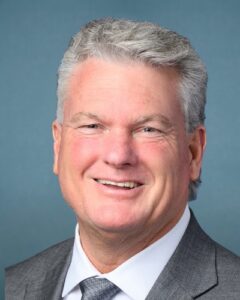
Tenure: 118th–119th Congresses
Years of Service: 2023–Present
Rep. Mike Collins has not made animal protection a visible priority during his time in Congress. While some members on both sides of the aisle have built records around modest engagement with animal-welfare issues, Collins’ approach has largely been defined by a lack of positive engagement and a consistent alignment with votes enabling bad outcomes for animals and people.
Collins has not sponsored or taken a leading role on any major federal animal-protection bills, nor has he cosponsored a single bill (out of 70 animal welfare measures) addressing issues including staged animal fighting, wildlife trafficking, or the mistreatment of dogs. In a Congress where even occasional cosponsorship can signal baseline engagement, his record reflects no constructive engagement in this policy area.
He has also supported broader legislative efforts to narrow the reach of the Endangered Species Act. These proposals – including measures to increase political oversight of species listings and reduce habitat protections – make it more difficult to protect vulnerable species. Collins’ support for these initiatives places him squarely within a bloc of lawmakers seeking to recalibrate or diminish a federal role in wildlife protection.
In addition, Collins failed to cosponsor H.R. 2253, the Puppy Protection Act, which would expand minimum standards for the humane treatment of dogs in commercial settings; H.R. 1661, the Save America’s Forgotten Equines (SAFE) Act; or the FIGHT Act, H.R. 3946, or the No Flight, No Fight Act, H.R. 7371, to combat the scourges of dogfighting and cockfighting. The Georgia Sheriffs’ Association has unanimously endorsed the GOP-led FIGHT Act, but that was not enough to convince Rep. Collins to add his name to the legislation.
Collins is not known to have participated in congressional caucuses focused on animal welfare, led oversight efforts tied to enforcement of animal-cruelty laws, or joined high-profile bipartisan letters supporting animal-protection initiatives. This absence is notable given the number of opportunities members have to signal engagement without taking politically difficult votes. He likewise failed to support efforts to curb a U.S. Fish and Wildlife proposal to allow the killing of half a million North American barred owls, a plan which garnered widespread opposition among both political parties.
Taken together, Collins’ record reflects more than simple disengagement. His voting history – including support for appropriations riders and regulatory reforms that weaken enforcement, and his lack of support for bipartisan animal-protection bills – places him firmly in the “Active Opponent / Low Engagement” category. Within the Republican conference, Rep. Collins has not supported a single bill among more than five dozen measures reflecting the widespread desire of Americans to stop random, calculated cruelty and mistreatment of animals while also reducing wasteful government spending associated with animal harms.
Notable Actions
119th Congress
❌ Voted “Nay” on the Van Drew–Titus Amendment (Recorded Vote No. 98-pg. 46) to H.R. 8870 (Transportation and Infrastructure Committee Vote), which would have incorporated key provisions of the Save America’s Forgotten Equines (SAFE) Act into the Build America 250 Act. The bipartisan amendment would permanently prohibit the export of American horses to Canada, Mexico, or other countries for slaughter for human consumption and ban the use of dangerous double-decker trailers to transport horses. The amendment was adopted by a 34–30 vote. A “Nay” vote is the anti-animal position because it opposed ending the export of American horses for slaughter.
✅ Supported House passage of the FDA Modernization Act 3.0, H.R. 2821, which passed by voice vote under suspension of the rules on July 20, 2026. The bipartisan legislation directs the FDA to update its regulations to fully implement the 2022 law allowing scientifically valid non-animal methods to be used instead of animal testing in drug development.
❌ Voted “Aye” on H.R. 556, the Protecting Access for Hunters and Anglers Act (House Roll Call Vote 93), to prohibit federal land management agencies from restricting the use of toxic lead ammunition and fishing tackle on public lands and waters to protect wildlife from poisoning. The bill passed the House 215–202. An “Aye” vote is the anti-animal position because it limited the federal government’s ability to restrict toxic lead ammunition and fishing tackle that poison wildlife and contaminate the environment.
❌ Voted “Aye” on H.R. 845, the Pet and Livestock Protection Act (House Roll Call Vote 360), to remove federal Endangered Species Act protections for gray wolves across much of the United States and restricted judicial review of future wolf management decisions. The bill passed the House 211–204. An “Aye” vote is the anti-animal position because it removed Endangered Species Act protections for gray wolves and limited judicial review of future wolf management decisions.
❌ Voted “Aye” on the Riley Moore Amendment (House Roll Call Vote 149), to weaken the Farm Bill’s Greyhound Protection Act provisions by creating a special exemption allowing commercial greyhound racing to continue in West Virginia indefinitely. The House rejected the amendment 187–237. An “Aye” vote is the anti-animal position because it sought to weaken greyhound protections by allowing commercial greyhound racing to continue indefinitely in West Virginia.
❌ Voted “Aye” on H.R. 7567, the Farm, Food, and National Security Act (House Roll Call Vote 154), to pass the Farm Bill, which included a provision to overturn state laws in California and Massachusetts restricting in-state sales of fresh pork sourced from farms that do not provide minimum space requirements for the housing of pregnant pigs. The bill passed the House 224–200. An “Aye” vote is the anti-animal position because it supported overturning state farm animal welfare laws that require more humane housing standards for pregnant pigs.
❌ Voted “Aye” on the Biggs Amendment to H.R. 3838 (House Roll Call Vote 259), to exempt defense-related activities from the requirements of the Endangered Species Act, eliminating protections for endangered and threatened species and their critical habitat on military lands and during defense operations. The House rejected the amendment 200–228. An “Aye” vote is the anti-animal position because it sought to weaken Endangered Species Act protections for threatened and endangered wildlife on military lands.
❌ Voted “Aye” on the Greene Amendment to H.R. 3838 (House Roll Call Vote 254), to prohibit the Department of Defense from using FY2026 funds for the research, development, procurement, or promotion of cell-cultured meat, an emerging alternative to conventional slaughter-based meat production. The House rejected the amendment 194–236, with 1 voting present. An “Aye” vote is the anti-animal position because it sought to block federal support for the development of slaughter-free, cell-cultured meat alternatives that could reduce the number of animals raised and killed for food.
❌ Voted “Aye” on the Northeast Lobster Protection Act, H.R. 9436 (House Roll Call Vote 291), which would extend a pause on new federal fishing gear regulations intended to protect critically endangered North Atlantic right whales from 2028 to 2035, delaying potential protections for an additional seven years. An “Aye” is an anti-animal position because it supports extending the delay in fishing rope, a leading cause of injury and death.
118th Congress
❌ Voted “Aye” on H.R. 764 (House Roll Call Vote 169), legislation to remove federal protections for gray wolves under the Endangered Species Act across most of the United States and return management authority to the states. Wildlife advocates warned that the bill would undermine science-based wildlife management and threaten the long-term recovery of gray wolf populations. The House passed the bill 209–205. An “Aye” vote is the anti-animal position because it removed Endangered Species Act protections for gray wolves across much of the United States, despite concerns that doing so would undermine their long-term recovery and science-based wildlife management.
❌ Voted “Aye” on H.R. 615 (House Roll Call Vote 167), legislation to bar the Department of the Interior and the Department of Agriculture from prohibiting or regulating the use of toxic lead ammunition and fishing tackle on federal lands and waters made available for hunting or fishing. Lead ammunition and tackle poison wildlife, including eagles, loons, condors, and other animals that ingest spent lead fragments or lost fishing gear. The House passed the bill 214–201. An “Aye” vote is the anti-animal position because it blocked federal agencies from restricting toxic lead ammunition and fishing tackle that poison eagles, loons, condors, and other wildlife.