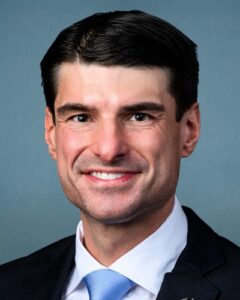
Tenure: 119th Congress
Years of Service: 2025–Present
At 19, Rob Bresnahan became the CFO of his grandfather’s highway electrical business in Exeter, Pa. He subsequently graduated from the University of Scranton in 2013 and became CEO of that family business. In later years, he founded a real estate development business, with work centered in Pittston. As part of his charitable work, Bresnahan served as interim president of the Luzerne County SPCAs board of directors. He was elected to Congress in 2024.
Given that important touch with animal welfare, there were high expectations about Congressman Bresnahan as a reliable supporter on animal welfare policy and perhaps even a leader. While Bresnahan has shown support on a couple of issues in his first term, he showed a lack of concern about animals by voting to overturn state farm animal welfare laws and by reneging on his original public support for the Fighting Inhumane Gambling and High-Risk Trafficking Act and working to gut the legislation.
On the positive side, Bresnahan voted for the bipartisan Van Drew–Titus amendment, incorporated into a bill related to surface transportation reauthorization measure, to stop the transport of American horses sent to Mexico or Canada for slaughter for human consumption. The vote was close, 34-30, and Bresnahan’s vote was critical in passing the measure. That measure is still pending in the House, and there’s an outside chance the Congress will take up the underlying bill in the lame-duck session of congress.
He also cast a very important vote to protect greyhounds. Bresnahan was one of 28 Republicans to vote against an amendment from Rep. Riley Moore, R-W.V., gut the Greyhound Protection Act. The GPA was included as an amendment to the Farm bill, but Rep. Moore tried to hollow it out with his amendment. Bresnahan and 27 other Republicans joined all but three Democrats in defeating the Moore amendment. The Greyhound Protection Act, however, is stalled, with a remote chance that the House and Senate will take up the Farm bill and the greyhound protection issue in the lame duck session of the 119th Congress.
But Bresnahan took other actions on the Farm bill that decidedly harmful to animal protection. The first one was particularly telling and damaging.
Bresnahan cosponsored the Fighting Inhumane Gambling and High-Risk Trafficking (FIGHT) Act, H.R. 3946, to combat the scourges of dogfighting and cockfighting. In doing so, he was getting into alignment with the Pennsylvania Sheriffs’ Association, the Pennsylvania Chiefs of Police, and the Pennsylvania District Attorneys’ Association that asked him to cosponsor this anti-crime, pro-agriculture, and pro-animal bill.
But in committee, and apparently taking marching orders from Agriculture Committee Chairman Glenn Thompson, R-Pa., Bresnahan reneged on his support for the FIGHT Act and voted to gut the measure. A 2nd degree amendment from Rep. Tracy Mann, R-Kansas, removed three of the four provisions of the policy reform, including striking a provision to make it plain that the U.S. Postal Service should stop shipping tens of thousands of fighting birds a year. The hostile amendment that Bresnahan supported also eliminated a provision coveted by law enforcement – a provision to seize animal fighting equipment and fighting pits once an animal fighter was criminally convicted for staged animal fighting or related activities. Law enforcement was worried that once a convicted animal fighter was released from prison, or simply stuck with a fine, he would just pick up where he left off and resume animal fighting if the equipment and the entire set-up was left intact.
Bresnahan also sided with Thompson and voted to override state farm animal protection laws, even though the vast majority of Pennsylvania pig and egg producers no longer use extreme confinement methods. Bresnahan supported the notorious Save Our Bacon (SOB) Act, which is being pushed by China’s Smithfield Foods and the National Pork Producers Council to override Prop 12 in California and Question 3 in Massachusetts. These state laws, upheld as proper exercise of authority by the U.S. Supreme Court in NPPC v. Ross, restrict the extreme confinement of animals kept in cages and crates barely larger than their bodies. Pennsylvania agricultural producers lobbied fiercely against the SOB Act and told Bresnahan and other lawmakers that they needed markets for their products provided by Prop 12 and Question 3. Bresnahan and Thompson discounted the views of Pennsylvania farmers and sided with the Chinese-controlled interests.
Bresnahan voted for the Protecting Access for Hunters and Anglers Act, which would prohibit federal land-management agencies from restricting toxic lead ammunition and fishing tackle on public lands and waters. Lead is a potent toxin that can poison wildlife and contaminate ecosystems, and the legislation would restrict the federal government’s ability to respond to those risks. Lead ammunition use is an acute threat to hunting families, as well as to scavenging wildlife.
And even though there are no wolves in Pennsylvania, he voted to remove federal protections for endangered wolves across vast areas in the Upper Midwest and the West. Wolves number only 7,000 in the lower 48 states and they keep balance in ecosystems. Where they live, they cleanse deer and elk populations of the always fatal Chronic Wasting Disease, a brain-wasting disease that menaces cervid populations in 34 states, including Pennsylvania. Wolves also reduce excessive deer and elk densities, reducing automobile collisions with these large animals that result in 200 motorist deaths every year and causes billions in damage to vehicles.
Rep. Bresnahan also voted against an amendment to exempt defense-related activities from the Endangered Species Act and against an amendment barring the Department of Defense from funding research, development, procurement, or promotion of cell-cultured meat.
Rather than becoming a leading Republican advocate for animal wellness, Bresnahan took a couple of positive actions, but worked against several of the most important animal welfare priorities. He failed to stand up to an aggressive, anti-animal committee chairman when his independence and animal-welfare value system should have won the day.
Notable Actions
119th Congress
✅ Cosponsor of the Fighting Inhumane Gambling and High-Risk Trafficking (FIGHT) Act, H.R. 3946, to strengthen federal enforcement against animal fighting and related criminal activity.
✅ Voted “Aye” on the Van Drew–Titus Amendment (Recorded Vote No. 98-pg. 46) to H.R. 8870 (Transportation and Infrastructure Committee Vote), to incorporate key provisions of the Save America’s Forgotten Equines (SAFE) Act into the Build America 250 Act. The bipartisan amendment would permanently prohibit the export of American horses to Canada, Mexico, or other countries for slaughter for human consumption and ban the use of dangerous double-decker trailers to transport horses. The amendment was adopted by a 34–30 vote. An “Aye” vote is the pro-animal position because it advanced legislation to end the slaughter pipeline for American horses.
❌ Voted “Aye” on House Agriculture Committee Record Vote No. 24, approving Rep. Tracey Mann’s second-degree amendment to Rep. Shri Thanedar’s Amendment No. 119 during markup of the 2026 Farm Bill. The Mann amendment stripped away nearly all of the bipartisan FIGHT Act’s enforcement provisions—including measures targeting the trafficking and shipment of fighting birds, expanded civil enforcement authority, and other tools to combat organized animal fighting—leaving primarily language related to gambling on animal fighting. The committee adopted the amendment by a 29–22 vote. An “Aye” vote is the anti-animal position because it substantially weakened the FIGHT Act before the committee unanimously adopted the amended Thanedar amendment.
✅ Supported House passage of the FDA Modernization Act 3.0, H.R. 2821, which passed by voice vote under suspension of the rules on July 20, 2026. The bipartisan legislation directs the FDA to update its regulations to fully implement the 2022 law allowing scientifically valid non-animal methods to be used instead of animal testing in drug development.
❌ Voted “Aye” on H.R. 556, the Protecting Access for Hunters and Anglers Act (House Roll Call Vote 93), to prohibit federal land management agencies from restricting the use of toxic lead ammunition and fishing tackle on public lands and waters to protect wildlife from poisoning. The bill passed the House 215–202. An “Aye” vote is the anti-animal position because it limited the federal government’s ability to restrict toxic lead ammunition and fishing tackle that poison wildlife and contaminate the environment.
❌ Voted “Aye” on H.R. 845, the Pet and Livestock Protection Act (House Roll Call Vote 360), to remove federal Endangered Species Act protections for gray wolves across much of the United States and restricted judicial review of future wolf management decisions. The bill passed the House 211–204. An “Aye” vote is the anti-animal position because it removed Endangered Species Act protections for gray wolves and limited judicial review of future wolf management decisions.
✅ Voted “Nay” on the Riley Moore Amendment to H.R. 7567 (House Roll Call Vote 149), to weaken the Farm Bill’s Greyhound Protection Act provisions by creating a special exemption allowing commercial greyhound racing to continue in West Virginia indefinitely. The House rejected the amendment 187–237. A “Nay” vote is the pro-animal position.
❌ Voted “Aye” on H.R. 7567, the Farm, Food, and National Security Act (House Roll Call Vote 154), to pass the Farm Bill, which included a provision to overturn state laws in California and Massachusetts restricting in-state sales of fresh pork sourced from farms that do not provide minimum space requirements for the housing of pregnant pigs. The bill passed the House 224–200. An “Aye” vote is the anti-animal position because it supported overturning state farm animal welfare laws that require more humane housing standards for pregnant pigs.
✅ Voted “Nay” on the Biggs Amendment to H.R. 3838 (House Roll Call Vote 259), to exempt defense-related activities from the requirements of the Endangered Species Act, eliminating protections for endangered and threatened species and their critical habitat on military lands and during defense operations. The House rejected the amendment 200–228. A “Nay” vote is the pro-animal position.
✅ Voted “Nay” on the Greene Amendment to H.R. 3838 (House Roll Call Vote 254), to prohibit the Department of Defense from using FY2026 funds for the research, development, procurement, or promotion of cell-cultured meat, an emerging alternative to conventional slaughter-based meat production. The House rejected the amendment 194–236, with 1 voting present. A “Nay” vote is the pro-animal position.
❌ Voted “Aye” on the Northeast Lobster Protection Act, H.R. 9436 (House Roll Call Vote 291), which would extend a pause on new federal fishing gear regulations intended to protect critically endangered North Atlantic right whales from 2028 to 2035, delaying potential protections for an additional seven years. An “Aye” is an anti-animal position because it supports extending the delay in fishing rope, a leading cause of injury and death.