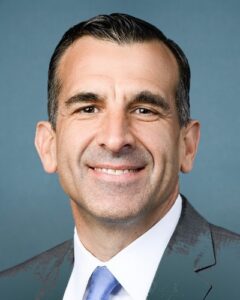
Tenure: 119th Congress
Years of Service: 2025–Present
Rep. Sam Liccardo entered Congress in 2025, but he has already begun assembling a noteworthy record on animal protection issues. Although still in his first term, Liccardo has combined favorable votes on major animal welfare priorities with affirmative legislative leadership on wildlife protection and support for legislation aimed at reducing the commercial exploitation of animals. His early record reflects a willingness to engage directly on animal protection issues rather than simply support them when they reach the House floor.
One of the clearest examples of Liccardo’s engagement is his leadership on marine wildlife conservation. Shortly after arriving in Congress, he introduced the Save Willy Act, legislation designed to reduce whale deaths in the San Francisco Bay region. The bill was developed in response to growing concerns about whale strikes and other human-caused threats to marine mammals and reflects a proactive approach to wildlife protection. Rather than waiting for animal welfare issues to emerge through committee action or floor votes, Liccardo has demonstrated a willingness to lead on conservation measures affecting vulnerable species.
Liccardo has also engaged on international wildlife protection issues. He is a cosponsor of the Kangaroo Protection Act, legislation that would prohibit the commercial sale of kangaroo products in the United States. The bill seeks to reduce demand for products derived from commercial kangaroo hunting and reflects growing concern about the treatment and conservation of kangaroos harvested for meat and leather. His support for the legislation demonstrates an interest in animal protection issues that extend beyond California and encompass broader wildlife conservation concerns.
His voting record has been consistently favorable across the major animal protection debates of the 119th Congress. Liccardo voted against H.R. 845, the Pet and Livestock Protection Act, which would remove federal Endangered Species Act protections for gray wolves. He also voted against H.R. 556, the Protecting Access for Hunters and Anglers Act, preserving federal authority to regulate lead ammunition and lead fishing tackle on federal lands and waters. Lead poisoning remains a significant source of mortality for condors, eagles, loons, swans, and other wildlife species, making the vote an important indicator of support for wildlife conservation.
Liccardo also voted against the Moore Amendment, which sought to create an exemption from the federal prohibition on commercial greyhound racing. His vote aligned with efforts to preserve protections that have helped bring commercial greyhound racing to an end across most of the country.
On farm-animal welfare and food-system issues, Liccardo has likewise taken positions aligned with animal protection priorities. He voted against the Greene Amendment, which sought to prohibit federal support for cultivated meat and related technologies. Cultivated meat has the potential to reduce reliance on conventional animal agriculture and significantly decrease the number of animals raised and slaughtered for food. He also voted against the Farm, Food, and National Security Act, which included provisions that would preempt state farm-animal welfare laws such as California’s Proposition 12 and Massachusetts’ Question 3. Those provisions threatened some of the strongest animal welfare standards enacted anywhere in the United States.
What distinguishes Liccardo’s early record is the combination of legislative leadership and favorable voting. Many freshman lawmakers compile positive voting records, but fewer take the additional step of introducing wildlife-protection legislation or cosponsoring animal-specific bills. Liccardo has already demonstrated engagement on marine mammal conservation, international wildlife protection, farm-animal welfare, and wildlife conservation issues.
Given the breadth of his involvement during his first term, Liccardo has quickly established himself as a promising ally for animal protection. While his congressional career is still in its early stages, his actions suggest a lawmaker willing to engage substantively on behalf of animals and wildlife.
Notable Actions
119th Congress
✅ Cosponsor of the Kangaroo Protection Act, H.R. 1992, to stop the U.S. sale of commercial products made with kangaroo skins and other kangaroo parts.
✅ Cosponsor of the Puppy Protection Act, H.R. 2253, bipartisan legislation to strengthen federal standards of care for dogs kept by commercial breeders by improving requirements for housing, veterinary care, exercise, socialization, and humane breeding practices.
✅ Signed congressional letter opposing the SOB Act that would erode states’ rights, undermine family farmers, and expand foreign influence over U.S. food production.
✅ Supported House passage of the FDA Modernization Act 3.0, H.R. 2821, which passed by voice vote under suspension of the rules on July 20, 2026. The bipartisan legislation directs the FDA to update its regulations to fully implement the 2022 law allowing scientifically valid non-animal methods to be used instead of animal testing in drug development.
✅ Voted “Nay” on H.R. 556, the Protecting Access for Hunters and Anglers Act (House Roll Call Vote 93), to prohibit federal land management agencies from restricting the use of toxic lead ammunition and fishing tackle on public lands and waters to protect wildlife from poisoning. The bill passed the House 215–202. A “Nay” vote is the pro-animal vote.
✅ Voted “Nay” on H.R. 845, the Pet and Livestock Protection Act (House Roll Call Vote 360), to remove federal Endangered Species Act protections for gray wolves across much of the United States and restricted judicial review of future wolf management decisions. The bill passed the House 211–204. A “Nay” vote is the pro-animal position.
✅ Voted “Nay” on the Riley Moore Amendment to H.R. 7567 (House Roll Call Vote 149), to weaken the Farm Bill’s Greyhound Protection Act provisions by creating a special exemption allowing commercial greyhound racing to continue in West Virginia indefinitely. The House rejected the amendment 187–237. A “Nay” vote is the pro-animal position.
✅ Voted “Nay” on H.R. 7567, the Farm, Food, and National Security Act (House Roll Call Vote 154), to pass the Farm Bill, which included a provision to overturn state laws in California and Massachusetts restricting in-state sales of fresh pork sourced from farms that do not provide minimum space requirements for the housing of pregnant pigs. The bill passed the House 224–200. A “Nay” vote is the pro-animal position.
✅ Voted “Nay” on the Biggs Amendment to H.R. 3838 (House Roll Call Vote 259), to exempt defense-related activities from the requirements of the Endangered Species Act, eliminating protections for endangered and threatened species and their critical habitat on military lands and during defense operations. The House rejected the amendment 200–228. A “Nay” vote is the pro-animal position.
✅ Voted “Nay” on the Greene Amendment to H.R. 3838 (House Roll Call Vote 254), to prohibit the Department of Defense from using FY2026 funds for the research, development, procurement, or promotion of cell-cultured meat, an emerging alternative to conventional slaughter-based meat production. The House rejected the amendment 194–236, with 1 voting present. A “Nay” vote is the pro-animal position.
✅ Voted “Nay” on the Northeast Lobster Protection Act, H.R. 9436 (House Roll Call Vote 291), which would extend a pause on new federal fishing gear regulations intended to protect critically endangered North Atlantic right whales from 2028 to 2035, delaying potential protections for an additional seven years. A “Nay” is a pro-animal position because it opposes repealing a leading delay in measures intended to prevent right whales from becoming entangled in fishing rope, a leading cause of injury and death.