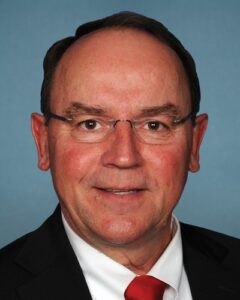
Tenure: 116th–119th Congresses
Years of Service: 2020–Present
Among all lawmakers serving in the Congress, Rep. Tom Tiffany, a Republican from northwest Wisconsin, has taken a rare, aggressive and hostile approach to animal welfare. That was also his ideological orientation during his nine-year run as a state lawmaker serving at the Wisconsin capitol in Madison. He’s not supported any animal welfare initiatives during his time as an elected public servant at the state or federal level, but his animus toward animals has been directed most stridently toward wolves. He’s promoted killing them in Wisconsin and in other parts of their native range, including by means generally considered unacceptable by the norms of hunting and fair-chase principles.
In the 119th Congress, he has not cosponsored a single animal welfare bill, even though his colleagues on the right and left have introduced more than 70 policy ideas related to animal welfare. That includes passing on the FIGHT Act to combat dogfighting and cockfighting even as fellow conservatives from Wisconsin – Republican Congressmen Scott Fitzgerald, Glenn Grothman, and Derrick Van Orden – have cosponsored that measure supported by the National Sheriffs’ Association and the Badger State Sheriffs’ Association. He’s declined to support efforts to address puppy mills, the slaughter of American horses, or the poaching of bears for their gallbladders and bile for use in Traditional Chinese Medicine.
He has devoted a large portion of his time in Congress toward advocating for legislation to strip federal Endangered Species Act protection for gray wolves, building on work he did at the state capitol in Madison to require trophy hunting and commercial trapping of wolves should gray wolves lose their protected status under the federal Endangered Species Act. In 2025, Tiffany and Rep. Lauren Boebert, R-Colorado, worked to narrowly pass H.R. 845, the Pet and Livestock Protection Act, in the House. That bill, H.R. 845, sought to remove gray wolves from federal Endangered Species Act protection and bar any legal actions by humane, tribal, or environmental groups from challenging the action in court, nullifying judicial review.
In December 2025, the House narrowly passed this bill by 211–204 roll call vote. His Wisconsin colleague, Senator Ron Johnson, attempted to pass that bill in the Senate on August 3, 2026 by unanimous consent, but Senator Cory Booker, D-N.J., objected and halted its progress.
“Wisconsinites know best when it comes to managing Wisconsin’s wolf population, and it’s long past time we empowered Wisconsinites to be able to manage the gray wolf population,” Tiffany said after passing the bill. But when he was a state lawmaker, he removed the discretion of the Wisconsin DNR to determine if hunting was appropriate. But his performance in the state legislature revealed that he never wanted to give latitude to the professional wildlife agency in Wisconsin DNR to determine whether hunting and trapping were proper. His state legislation in 2011 required hunting and trapping of wolves in the Badger State so long as the animals are not federally protected.
That legislation allowed hunters to use packs of dogs to hunt wolves, to allow baiting, night hunting, or the use of steel-jawed leghold traps or neck snares – again removing the authority of the DNR to limit such practices.
When he ascended to state senate, Tiffany was the chair of the key Senate Committee handling wildlife policy, and he derailed legislation to prohibit the use of dogs while hunting wolves. In 2017, he took the extraordinary step of sponsoring legislation prohibiting law enforcement personnel from enforcing federal and state laws governing wolf protection in 2017. That pro-wolf-poaching legislation failed.
In 2021, the first Trump Administration removed federal protections for wolves. But before there was time for a legal challenge to ripen, Wisconsin opened up a rare January wolf killing season, compelled by the state legislature, and set a kill limit for 119 wolves. Trophy hunters and trappers, enabled by the methods that Tiffany worked to permit, exceeded the total kill limit by nearly double – killing 218 wolves in about 48 hours. The DNR abruptly ordered hunters and trappers out of the woods given that the take far exceeded the limits imposed by the wildlife department. That incident showed that it was impossible to control the kill when trophy hunters had so many tools to readily track and kill wolves.
In 2021, not long after taking federal office, Rep. Tiffany introduced the Managing Predators Act, to throw wolf management authority to the states, but that measure did not advance. During the 118th Congress, he was a leading proponent of the Trust the Science Act to delist gray wolves. In April 2024, the House narrowly passed wolf-delisting legislation by a 209–205 vote. It subsequently died in the U.S. Senate.
While Tiffany has devoted an extraordinary amount of time, energy and attention to delisting wolves, there is virtually no evidence that puppy mills, animal-cruelty enforcement, farm-animal welfare, animal fighting, horse protection or stronger enforcement of the Animal Welfare Act are comparable congressional priorities for him at all.
In addition, he has consistently voted against animal protection efforts on the floor of the House in the 119th Congress. For example, he voted in support of the 2026 Farm Bill, which called for overturning state farm animal welfare laws that require more humane housing standards for pregnant pigs. In addition, he supported the Moore amendment to the Farm Bill, which sought to weaken greyhound protections by allowing commercial greyhound racing to continue indefinitely in West Virginia.
Furthermore, he voted for legislation prohibiting federal land management agencies from restricting the use of toxic lead ammunition and fishing tackle on public lands and waters to protect wildlife from poisoning. Of the six major animal protection floor votes to date in the 119th Congress, Tiffany has voted against animal wellness every single time.
Notable Actions
119th Congress
✅ Supported House passage of the FDA Modernization Act 3.0, H.R. 2821, which passed by voice vote under suspension of the rules on July 20, 2026. The bipartisan legislation directs the FDA to update its regulations to fully implement the 2022 law allowing scientifically valid non-animal methods to be used instead of animal testing in drug development.
❌ Voted “Aye” on H.R. 556, the Protecting Access for Hunters and Anglers Act (House Roll Call Vote 93), to prohibit federal land management agencies from restricting the use of toxic lead ammunition and fishing tackle on public lands and waters to protect wildlife from poisoning. The bill passed the House 215–202. An “Aye” vote is the anti-animal position because it limited the federal government’s ability to restrict toxic lead ammunition and fishing tackle that poison wildlife and contaminate the environment.
❌ Voted “Aye” on H.R. 845, the Pet and Livestock Protection Act (House Roll Call Vote 360), to remove federal Endangered Species Act protections for gray wolves across much of the United States and restricted judicial review of future wolf management decisions. The bill passed the House 211–204. An “Aye” vote is the anti-animal position because it removed Endangered Species Act protections for gray wolves and limited judicial review of future wolf management decisions.
❌ Voted “Aye” on the Riley Moore Amendment (House Roll Call Vote 149), to weaken the Farm Bill’s Greyhound Protection Act provisions by creating a special exemption allowing commercial greyhound racing to continue in West Virginia indefinitely. The House rejected the amendment 187–237. An “Aye” vote is the anti-animal position because it sought to weaken greyhound protections by allowing commercial greyhound racing to continue indefinitely in West Virginia.
❌ Voted “Aye” on H.R. 7567, the Farm, Food, and National Security Act (House Roll Call Vote 154), to pass the Farm Bill, which included a provision to overturn state laws in California and Massachusetts restricting in-state sales of fresh pork sourced from farms that do not provide minimum space requirements for the housing of pregnant pigs. The bill passed the House 224–200. An “Aye” vote is the anti-animal position because it supported overturning state farm animal welfare laws that require more humane housing standards for pregnant pigs.
❌ Voted “Aye” on the Biggs Amendment to H.R. 3838 (House Roll Call Vote 259), to exempt defense-related activities from the requirements of the Endangered Species Act, eliminating protections for endangered and threatened species and their critical habitat on military lands and during defense operations. The House rejected the amendment 200–228. An “Aye” vote is the anti-animal position because it sought to weaken Endangered Species Act protections for threatened and endangered wildlife on military lands.
❌ Voted “Aye” on the Greene Amendment to H.R. 3838 (House Roll Call Vote 254), to prohibit the Department of Defense from using FY2026 funds for the research, development, procurement, or promotion of cell-cultured meat, an emerging alternative to conventional slaughter-based meat production. The House rejected the amendment 194–236, with 1 voting present. An “Aye” vote is the anti-animal position because it sought to block federal support for the development of slaughter-free, cell-cultured meat alternatives that could reduce the number of animals raised and killed for food.
❌ Voted “Aye” on the Northeast Lobster Protection Act, H.R. 9436 (House Roll Call Vote 291), which would extend a pause on new federal fishing gear regulations intended to protect critically endangered North Atlantic right whales from 2028 to 2035, delaying potential protections for an additional seven years. An “Aye” is an anti-animal position because it supports extending the delay in fishing rope, a leading cause of injury and death.
118th Congress
❌ Voted “Aye” on H.R. 764 (House Roll Call Vote 169), legislation to remove federal protections for gray wolves under the Endangered Species Act across most of the United States and return management authority to the states. Wildlife advocates warned that the bill would undermine science-based wildlife management and threaten the long-term recovery of gray wolf populations. The House passed the bill 209–205. An “Aye” vote is the anti-animal position because it removed Endangered Species Act protections for gray wolves across much of the United States, despite concerns that doing so would undermine their long-term recovery and science-based wildlife management.
❌ Voted “Aye” on H.R. 615 (House Roll Call Vote 167), legislation to bar the Department of the Interior and the Department of Agriculture from prohibiting or regulating the use of toxic lead ammunition and fishing tackle on federal lands and waters made available for hunting or fishing. Lead ammunition and tackle poison wildlife, including eagles, loons, condors, and other animals that ingest spent lead fragments or lost fishing gear. The House passed the bill 214–201. An “Aye” vote is the anti-animal position because it blocked federal agencies from restricting toxic lead ammunition and fishing tackle that poison eagles, loons, condors, and other wildlife.
117th Congress
❌ Voted “Nay” on the motion to suspend the rules and pass Prevent All Soring Tactics (PAST) Act, H.R. 5441 (House Roll Call Vote 478). The bill would strengthen enforcement of the Horse Protection Act and help end the cruel practice of “soring” Tennessee Walking Horses, Racking Horses, and Spotted Saddle Horses. Soring involves intentionally inflicting severe pain on horses’ legs and hooves through caustic chemicals, chains, pressure devices, or other abusive methods to force an exaggerated, high-stepping gait known as the “Big Lick.” The motion was agreed to by a vote of 304–111, exceeding the two-thirds majority required under the suspension of the rules procedure. A “Nay” vote is the anti-animal position because it opposed stronger enforcement against the deliberate infliction of pain on horses to produce an exaggerated gait for competition.
❌ Voted “Nay” on Big Cat Public Safety Act, H.R. 263 (House Roll Call Vote 415), legislation to end the private possession and commercial breeding of lions, tigers, leopards, cheetahs, jaguars, cougars, and other big cats while prohibiting public contact with these animals. The bill targeted the exploitative cub-petting industry and roadside zoos, where big cats are repeatedly bred, handled, and discarded, while strengthening protections for both animals and public safety. A “Nay” vote is the anti-animal position because it opposed ending the commercial exploitation and private ownership of big cats.
116th Congress
❌ Voted “Nay” on the Big Cat Public Safety Act (House Roll Call Vote 232), legislation to prohibit private ownership and breeding of lions, tigers, and other big cats while restricting public contact with these dangerous wild animals. The bill was designed to curb the exploitation of big cats in roadside zoos and cub-petting operations, improve animal welfare, and enhance public safety by limiting private possession of these species. The House passed the bill 272–114. A “Nay” vote is the anti-animal position because it opposed ending the private ownership, breeding, and commercial exploitation of lions, tigers, and other big cats in roadside zoos and cub-petting operations.