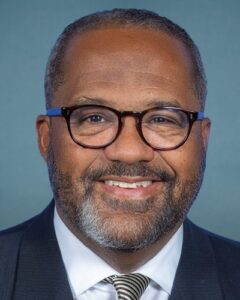
Tenure: 117th–119th Congresses
Years of Service: 2021–Present
Troy Carter was born and raised in New Orleans, Louisiana, later graduating from Xavier University of Louisiana with a degree in business administration and political science. He subsequently received a master’s degree in science from Holy Cross University and attended graduate level classes at Carnegie Mellon University and attended an executive training program the Kennedy School at Harvard.
In 1991, Carter was elected to the Louisiana State House of Representatives, where he served until 1994 when he was elected to the New Orleans City Council. He left the City Council in 2002 and was elected to the Louisiana State Senate in 2015. During his service in Baton Rouge, he emerged as one of the leading animal welfare advocates in the state legislature.
He was elected to the U.S. House of Representatives in May of 2021 in a special election to fill the seat of former Congressman Cedric Richmond, who left the House to work in the Biden White House. In short order, Congressman Carter has established himself as a strong and consistent advocate for animal wellness and protection in the U.S. House. Soon after arriving, he led an amendment to a major transportation bill to ban any slaughter of American horses for human consumption. That bill passed the committee and the House but was dropped in conference. But Carter immediately signaled he would be a forceful advocate to improve animal welfare policy.
Since that action, he’s built on that record very substantially during the subsequent five-and-a-half years. He’s supported a broad range of important animal-protection measures addressing animal cruelty, animal fighting, horse welfare, laboratory animal testing, commercial breeding, wildlife protection, and farm-animal welfare. He’s been a leader on animal protection issues and his record demonstrates a willingness to work across party lines and to support practical reforms that improve the treatment of animals and strengthen enforcement of laws designed to protect them.
A recent example of Carter’s efforts was his leadership, support and work to successfully enact the Freedom in School Cafeterias and Lunches (FISCAL) Act. This legislation gives children participating in the National School Lunch Program who are lactose intolerant access to a plant-based milk option for the very first time. The core of his legislation was attached to the Whole Milk for Healthy Kids Act, giving schools the option to stock soy milk and requiring that kids who are lactose intolerant can access that option. Carter’s support clearly reflected a willingness to work on practical food-policy reforms that give families and children greater choice, focusing on how cow’s milk makes nearly a third of children in the program ill. This problem is particularly acute for non-Europeans, and the rate of lactose intolerance among Black children is about 75 percent. Enacting this policy is one of the only major animal welfare achievements, intersecting as it does with sensible food policy, in the Republican-controlled 119th Congress.
In addition, Carter has continued with his crusade to halt horse slaughter, cosponsoring the SAFE Act and looking for opportunities to close out the enterprise of shipping live American horses to Mexico or Canada to be butchered.
He’s also one of the lead authors of the FIGHT Act, which would strengthen federal enforcement against animal fighting and related criminal activity; and the No Flight, No Fight Act, which would address the smuggling of fighting birds through commercial airlines. He has also backed the ACE Act and the FBI Animal Cruelty Task Force Act, both of which would strengthen the federal government’s ability to investigate and prosecute animal cruelty crimes. Together, these measures demonstrate a clear commitment to making federal animal-cruelty laws more effective and ensuring that those who abuse animal face serious legal consequences.
Carter has also emerged as a strong supporter of modernizing federal policy on the use of animals in scientific research. He’s also one of the leaders of the FDA Modernization Act 3.0 and subsequently supported House passage of the bipartisan measure, which directs the FDA to update its regulations to implement the 2022 law allowing scientifically valid non-animal methods to be used in drug development. His support for this effort builds on his earlier co-sponsorship of the FDA Modernization Act in the 117th Congress, whose core provisions ultimately became part of the FDA Modernization Act 2.0. This represents an important commitment to advancing more human-relevant scientific methods while reducing unnecessary reliance on animal testing in research, which is wildly inaccurate, very expensive and takes far too much time.
In the 119th Congress, he cosponsored the Violet’s Law, which would require federally funded research facilities to pursue adoption or sanctuary placement for dogs, cats, rabbits, guinea pigs, hamsters, and nonhuman primates when feasible. He also cosponsored the Puppy Protection Act to strengthen standards of care for dogs kept by commercial breeders, the PAST Act to strengthen enforcement against the cruel practice of horse soring, and the Better CARE for Animals Act to improve enforcement of the Animal Welfare Act and coordination between USDA and the Department of Justice. These actions reflect sustained support for both stronger standards of care and more effective federal enforcement.
His record also extends into wildlife protection and the defense of state animal-welfare laws. Carter signed bipartisan letters opposing the large-scale killing of barred owls and opposing legislation that would undermine state agricultural and animal-welfare laws, including California’s Proposition 12 and Massachusetts’ Question 3. He voted against legislation to remove federal protections for gray wolves, against legislation restricting federal agencies from addressing toxic lead ammunition and fishing tackle on federal lands, against an amendment creating an exemption for commercial greyhound racing, and against legislation that would delay federal protections intended to protect endangered North Atlantic right whales from fishing-gear entanglement. These votes reinforce the broader pattern of a lawmaker willing to take pro-animal positions on difficult but important wildlife, hunting, fishing, and agricultural issues.
Carter’s impressive body of work reaches back to the 117th Congress as well. He cosponsored the SAFE Act, FDA Modernization Act, PAST Act, and Shark Fin Sales Elimination Act, and he voted for the PAST Act and the Big Cat Public Safety Act. The latter measures addressed some of the most serious forms of animal exploitation, from the intentional infliction of pain on horses to the private possession and commercial breeding of dangerous big cats. His support for these bills demonstrates that his commitment to animal protection is not a recent development but has been sustained across multiple Congresses.
Taken together, Congressman Carter’s record shows a broad and steadily developing commitment to animal wellness and protection. He has supported efforts to strengthen federal animal-cruelty enforcement, combat animal fighting, improve the treatment of horses and commercially bred dogs, reduce unnecessary animal testing, protect wildlife, defend state animal-welfare standards, and expand practical alternatives to animal-based products.
Notable Actions
119th Congress
✅ Cosponsor of the Save America’s Forgotten Equines (SAFE) Act, H.R. 1661, to ban U.S.-based horse slaughter and the export of horses for slaughter for human consumption.
✅ Cosponsor of the Fighting Inhumane Gambling and High-Risk Trafficking (FIGHT) Act, H.R. 3946, to strengthen federal enforcement against animal fighting and related criminal activity.
✅ Cosponsor of the No Flight, No Fight Act, H.R. 7371, to stop the smuggling of fighting birds via commercial airlines—an illicit practice that has gone largely unenforced since Congress prohibited the interstate and foreign transport of fighting birds in 2002.
✅ Cosponsor of the Animal Cruelty Enforcement (ACE) Act, H.R. 1477, to establish a dedicated DOJ unit to investigate and prosecute animal cruelty crimes.
✅ Cosponsor of the FBI Animal Cruelty Task Force (FBI ACT) Act, H.R. 3683, to establish an Animal Cruelty Crimes Task Force within the Federal Bureau of Investigation to investigate and enforce federal animal cruelty laws, including those involving dogfighting, cockfighting, crush videos, and related offenses.
✅ Cosponsor of the FDA Modernization Act 3.0, H.R. 2821, to direct the FDA to update its regulations consistent with a law passed by Congress in 2022 that made animal testing optional in new drug development.
✅ Cosponsor of the Freedom in School Cafeterias and Lunches (FISCAL) Act, H.R. 2539, to give kids access to a plant-based milk option in the National School Lunch Program, in addition to the existing cow’s milk offerings.
✅ Cosponsor of Violet’s Law, H.R. 3246, to provide a second chance for dogs, cats, rabbits, guinea pigs, hamsters, and nonhuman primates used in federally funded research by requiring facilities to pursue adoption or sanctuary placement whenever feasible. The measure was later incorporated into the House-passed Farm, Food, and National Security Act.
✅ Cosponsor of the Prevent All Soring Tactics (PAST) Act, H.R. 1684, to strengthen enforcement against the cruel practice of soring horses. The bill would ban devices associated with soring, require independent USDA-trained inspectors, increase penalties for violations, and strengthen the Horse Protection Act to better protect Tennessee Walking Horses and other affected breeds from intentional abuse.
✅ Cosponsor of the Puppy Protection Act, H.R. 2253, bipartisan legislation to strengthen federal standards of care for dogs kept by commercial breeders by improving requirements for housing, veterinary care, exercise, socialization, and humane breeding practices.
✅ Cosponsor of the Better CARE for Animals Act, H.R. 3112, to strengthen enforcement of the Animal Welfare Act by expanding federal authority to investigate and prosecute animal cruelty violations and improve coordination between the U.S. Department of Agriculture and the Department of Justice.
✅ Signed the bipartisan congressional letter opposing the large-scale killing of barred owls.
✅ Signed congressional letter opposing the SOB Act that would erode states’ rights, undermine family farmers, and expand foreign influence over U.S. food production.
✅ Signed a congressional letter opposing the EATS/SOB Act that would erode states’ rights, undermine family farmers, and expand foreign influence over U.S. food production.
✅ Supported House passage of the FDA Modernization Act 3.0, H.R. 2821, which passed by voice vote under suspension of the rules on July 20, 2026. The bipartisan legislation directs the FDA to update its regulations to fully implement the 2022 law allowing scientifically valid non-animal methods to be used instead of animal testing in drug development.
✅ Voted “Nay” on H.R. 556, the Protecting Access for Hunters and Anglers Act (House Roll Call Vote 93), to prohibit federal land management agencies from restricting the use of toxic lead ammunition and fishing tackle on public lands and waters to protect wildlife from poisoning. The bill passed the House 215–202. A “Nay” vote is the pro-animal vote.
✅ Voted “Nay” on H.R. 845, the Pet and Livestock Protection Act (House Roll Call Vote 360), to remove federal Endangered Species Act protections for gray wolves across much of the United States and restricted judicial review of future wolf management decisions. The bill passed the House 211–204. A “Nay” vote is the pro-animal position.
✅ Voted “Nay” on the Riley Moore Amendment to H.R. 7567 (House Roll Call Vote 149), to weaken the Farm Bill’s Greyhound Protection Act provisions by creating a special exemption allowing commercial greyhound racing to continue in West Virginia indefinitely. The House rejected the amendment 187–237. A “Nay” vote is the pro-animal position.
✅ Voted “Nay” on H.R. 7567, the Farm, Food, and National Security Act (House Roll Call Vote 154), to pass the Farm Bill, which included a provision to overturn state laws in California and Massachusetts restricting in-state sales of fresh pork sourced from farms that do not provide minimum space requirements for the housing of pregnant pigs. The bill passed the House 224–200. A “Nay” vote is the pro-animal position.
✅ Voted “Nay” on the Biggs Amendment to H.R. 3838 (House Roll Call Vote 259), to exempt defense-related activities from the requirements of the Endangered Species Act, eliminating protections for endangered and threatened species and their critical habitat on military lands and during defense operations. The House rejected the amendment 200–228. A “Nay” vote is the pro-animal position.
✅ Voted “Nay” on the Greene Amendment to H.R. 3838 (House Roll Call Vote 254), to prohibit the Department of Defense from using FY2026 funds for the research, development, procurement, or promotion of cell-cultured meat, an emerging alternative to conventional slaughter-based meat production. The House rejected the amendment 194–236, with 1 voting present. A “Nay” vote is the pro-animal position.
✅ Voted “Nay” on the Northeast Lobster Protection Act, H.R. 9436 (House Roll Call Vote 291), which would extend a pause on new federal fishing gear regulations intended to protect critically endangered North Atlantic right whales from 2028 to 2035, delaying potential protections for an additional seven years. A “Nay” is a pro-animal position because it opposes repealing a leading delay in measures intended to prevent right whales from becoming entangled in fishing rope, a leading cause of injury and death.
118th Congress
✅ Cosponsor of the Fighting Inhumane Gambling and High-Risk Trafficking (FIGHT) Act, H.R. 2742, to strengthen federal enforcement against animal fighting and related criminal activity.
✅ Cosponsor of the Save America’s Forgotten Equines (SAFE) Act, H.R. 3475, to ban U.S.-based horse slaughter and the export of horses for slaughter for human consumption.
✅ Cosponsor of the Snowmobiles Aren’t Weapons (SAW) Act, H.R. 9568, to prohibit any person from intentionally using a motor vehicle to run over or kill wolves and other mammals on federal lands.
✅ Cosponsor of Greyhound Protection Act, H.R. 3894, to phase out U.S. greyhound racing, a practice long in decline and operational at just two tracks.
✅ Cosponsor of the FDA Modernization Act 3.0, H.R. 7248, to direct the FDA to update its regulations consistent with a law passed by Congress in 2022 that made animal testing optional in new drug development.
✅ Cosponsor of the Kangaroo Protection Act, H.R. 4995, to stop the U.S. sale of commercial products made with kangaroo skins and other kangaroo parts.
✅ Cosponsor of MINKS Are Superspreaders Act, H.R. 7670, to end mink farming in the U.S.
✅ Cosponsor of the ADD SOY Act, H.R. 1619, to give kids access to a plant-based milk option in the National School Lunch Program, in addition to the existing cow’s milk offerings.
✅ Cosponsor of the Puppy Protection Act, H.R. 1624, bipartisan legislation to strengthen federal standards of care for dogs kept by commercial breeders by improving requirements for housing, veterinary care, exercise, socialization, and humane breeding practices.
✅ Cosponsor of the Prevent All Soring Tactics (PAST) Act, H.R. 3090, bipartisan legislation to strengthen enforcement against the cruel practice of soring horses. The bill would ban devices associated with soring, require independent USDA-trained inspectors, increase penalties for violations, and strengthen the Horse Protection Act to better protect Tennessee Walking Horses and other affected breeds from intentional abuse.
✅ Cosponsor of the Better CARE for Animals Act, H.R. 5041, to strengthen enforcement of the Animal Welfare Act by expanding federal authority to investigate and prosecute animal cruelty violations and improve coordination between the U.S. Department of Agriculture and the Department of Justice.
✅ Cosponsor of the Captive Primate Safety Act, H.R. 8164, to prohibit the private ownership, breeding, sale, transport, and other commercial activities involving nonhuman primates by amending the Lacey Act, while exempting accredited zoos, sanctuaries, research facilities, and certain other qualified entities. The legislation is designed to protect both public safety and the welfare of highly intelligent primates by ending the commercial pet trade in these animals.
✅ Cosponsor of the Ejiao Act, H.R. 6021, to prohibit trade in donkeys and donkey hides for the production of ejiao—a gelatin made from donkey skins—and ban trade in products containing ejiao in interstate or foreign commerce.
✅ Signed a bipartisan letter opposing the Ending Agricultural Trade Suppression (EATS) Act, H.R. 4417. The lawmakers warned that the bill would nullify state agriculture and animal-welfare laws, including California’s Prop 12 and Massachusetts’ Question 3, and could broadly undermine more than 1,000 state laws while targeting modest consumer demand for more humanely raised pork.
✅ Voted “Nay” on H.R. 764 (House Roll Call Vote 169), legislation to remove federal protections for gray wolves under the Endangered Species Act across most of the United States and return management authority to the states. Wildlife advocates warned that the bill would undermine science-based wildlife management and threaten the long-term recovery of gray wolf populations. The House passed the bill 209–205. A “Nay” vote is the pro-animal position.
✅ Voted “Nay” on H.R. 615 (House Roll Call Vote 167), legislation to bar the Department of the Interior and the Department of Agriculture from prohibiting or regulating the use of toxic lead ammunition and fishing tackle on federal lands and waters made available for hunting or fishing. Lead ammunition and tackle poison wildlife, including eagles, loons, condors, and other animals that ingest spent lead fragments or lost fishing gear. The House passed the bill 214–201. A “Nay” vote is the pro-animal position.
117th Congress
✅ Cosponsor of the Save America’s Forgotten Equines (SAFE) Act, H.R. 3355, to ban U.S.-based horse slaughter and the export of horses for slaughter for human consumption.
✅ Cosponsor of the FDA Modernization Act, H.R. 2565, bipartisan legislation to end the outdated federal presumption that new drugs must rely on animal testing before human clinical trials. The measure authorized the FDA to accept scientifically valid non-animal testing methods—including organ-on-a-chip technology, cell-based assays, and computer modeling—when appropriate. Core provisions of this legislation were later enacted as part of the FDA Modernization Act 2.0, signed into law in December 2022, marking a landmark reform that advanced more human-relevant research methods while reducing unnecessary animal testing.
✅ Cosponsor of the Prevent All Soring Tactics (PAST) Act, H.R. 5441, to strengthen enforcement of the Horse Protection Act and help end the cruel practice of “soring” Tennessee Walking Horses, Racking Horses, and Spotted Saddle Horses. Soring involves intentionally inflicting severe pain on horses’ legs and hooves through caustic chemicals, chains, pressure devices, or other abusive methods to force an exaggerated, high-stepping gait known as the “Big Lick.”
✅ Cosponsor of the Shark Fin Sales Elimination Act, H.R. 2811, to end the U.S. commercial trade in shark fins by prohibiting their sale, purchase, and transport, helping reduce the global demand that drives the cruel practice of shark finning. Core provisions of the bill were later incorporated into the James M. Inhofe National Defense Authorization Act for Fiscal Year 2023, which was signed into law in December 2022, making the United States one of the world’s largest nations to ban the domestic shark fin trade.
✅ Voted “Aye” on the motion to suspend the rules and pass the Prevent All Soring Tactics (PAST) Act, H.R. 5441 (House Roll Call Vote 478). The bill would strengthen enforcement of the Horse Protection Act and help end the cruel practice of “soring” Tennessee Walking Horses, Racking Horses, and Spotted Saddle Horses. Soring involves intentionally inflicting severe pain on horses’ legs and hooves through caustic chemicals, chains, pressure devices, or other abusive methods to force an exaggerated, high-stepping gait known as the “Big Lick.” The motion was agreed to by a vote of 304–111, exceeding the two-thirds majority required under the suspension of the rules procedure. An “Aye” vote is the pro-animal position.
✅ Voted “Aye” Big Cat Public Safety Act, H.R. 263 (House Roll Call Vote 415), to end the private possession and commercial breeding of lions, tigers, leopards, cheetahs, jaguars, cougars, and other big cats while prohibiting public contact with these animals. The legislation targeted the exploitative cub-petting industry and roadside zoos, where big cats are repeatedly bred, handled, and discarded, while strengthening protections for both animals and public safety. An “Aye” vote is the pro-animal position.