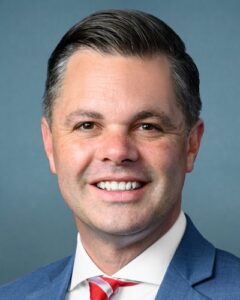
Tenure: 118th–119th Congresses
Years of Service: 2023–Present
Congressman Zach Nunn, a graduate of Drake University in 2002 and an Air Force veteran, has shown flashes of strong animal advocacy but then retreated from those positions when those issues came up for a vote. Nunn is a former state lawmaker, elected to the State House in Iowa in 2014 and then to the State Senate in 2018. He was elected to the US Congress in 2020.
Rep. Nunn was the Republican lead sponsor of the Greyhound Protection Act and helped shepherd it to passage in the House Agriculture Committee. But in a very curious move, he supported an effort on the House floor, in an amendment by Rep. Riley Moore, R-W.V., to gut the legislation. West Virginia is the last state in the nation to host racetracks, with 44 states having explicit bans on the wagering and organized racing of dogs.
In the end, even though Nunn had supported the hostile amendment, 28 Republicans joined all but three Democrats in opposing the bill and the Moore amendment was defeated. The intact Greyhound Protection Act passed the House as a provision of the 2026 Farm bill.
There was an eerily familiar embrace by Rep. Nunn of a second major animal welfare reform and then a retreat on the legislation. This concerned a bill to strengthen the national law against animal fighting. The Fighting Inhumane Gambling and High-Risk Trafficking (FIGHT) Act, led by Don Bacon, R-Neb., won endorsements of the Iowa Sheriffs and Deputies Association, the North Central Poultry Association, and the Animal Rescue League of Iowa, along with 1200 other major agencies and organizations, including the National Sheriffs Association and National District Attorneys Association.
The bill came up during the Farm bill mark up in March 2026, in an amendment from a Democrat from Michigan – an amendment that mirrored the free-standing bill, which had 75 Democrat cosponsors and 65 Republican cosponsors, including Nunn. During the mark-up, Rep. Tracy Mann, R-Kansas, offered an amendment to strike three of four provisions of the original amendment. As with the greyhound issue, Nunn retreated in his support for the anti-animal fighting reform. The 2nd degree amendment Nunn favored removed measures targeting the trafficking and shipment of fighting birds through the U.S. Postal Service, the criminal forfeiture of equipment and facilities used in the commission of dogfighting and cockfighting events, and denied citizens aggrieved by dogfighters and cockfighters the option to seek a federal court order to shut down staged animal fighting operations.
Nunn also cosponsored the Puppy Protection Act, which would strengthen federal standards of care for dogs kept by commercial breeders, and Goldie’s Act, which would strengthen enforcement of the Animal Welfare Act and improve protections for animals suffering abuse or neglect. The Agriculture Committee failed to include any core provisions of the Puppy Protection Act even though Rep. Nunn serves on the Agriculture Committee.
Along with all other lawmakers, Nunn did support House passage of the FDA Modernization Act 3.0, bipartisan legislation directing the FDA to update its regulations to fully implement the 2022 law allowing scientifically valid non-animal methods to be used instead of animal testing in drug development.
His record on wildlife protection, however, has been troubling as well. In both the 118th and 119th Congresses, Nunn voted for legislation removing federal Endangered Species Act protections from gray wolves across much of the United States. The 118th Congress measure would have returned management authority to the states, while the 119th Congress legislation also restricted judicial review of future wolf-management decisions. Wildlife advocates warned that removing federal protections would undermine science-based wildlife management and threaten the long-term recovery of gray wolf populations. Two votes in two Congresses to remove federal protections demonstrates a consistent willingness to support legislation narrowing the federal government’s role in protecting wolves.
Furthermore, Nunn has likewise twice voted to restrict federal authority to address the dangers posed by toxic lead ammunition and fishing tackle. In the 118th Congress, he voted for legislation barring the Department of the Interior and Department of Agriculture from prohibiting or regulating toxic lead ammunition and fishing tackle on federal lands and waters. In the 119th Congress, he again voted for the Protecting Access for Hunters and Anglers Act, which would prohibit federal land-management agencies from restricting lead ammunition and fishing tackle on public lands and waters. Lead poisoning is a serious threat to wildlife, including eagles, loons, condors, and other animals that ingest spent ammunition or lost fishing gear. These votes therefore represent another recurring area in which Nunn has supported limiting federal authority to protect wildlife.
Nunn’s 119th Congress record also includes votes to weaken broader federal wildlife protections. He voted for an amendment to exempt defense-related activities from the Endangered Species Act, potentially eliminating protections for threatened and endangered species and their critical habitat on military lands and during defense operations. He also voted for an amendment that would have prevented the Department of Defense from using federal funds for the research, development, procurement, or promotion of cell-cultured meat. Cell-cultured meat is an emerging alternative to conventional slaughter-based meat production and a hedge against protein shortages in a world where protein demand is surging. He also supported a bill to provide a seven-year delay in critical protections for North Atlantic right whales who get tangled in fishing gear. Only about 350 of these whales survive and they are classed as critically endangered.
Finally, Nunn also voted for the 2026 Farm Bill, which included provisions overturning state laws in California and Massachusetts that restrict the sale of fresh pork from farms that do not provide minimum space requirements for pregnant pigs. From an animal-welfare perspective, this vote supported federal preemption of state farm-animal welfare standards that provide more humane housing requirements for pregnant pigs. China’s Smithfield Foods, along with the Des Moines-based National Pork Producers Council, is pushing this subversion of state laws. They want to wipe out state laws for pig welfare but also oppose any federal standards of animal care.
Overall, Congressman Nunn’s record is one of noteworthy support but then equivocation when the key votes are called. His positive actions have been repeatedly undercut by his surprising votes to gut the FIGHT Act and the Greyhound Protection Act.
After four years in Congress, Nunn could have emerged as one of the House GOP Conference’s most prominent advocates for animal wellness. Instead, his record reflects a troubling disconnect between the animal-protection legislation he has sponsored and the votes he has cast when those protections have faced substantive challenges. What is missing is the fortitude required to stick with issues he agrees to support.
Notable Actions
119th Congress
✅ Cosponsor of the Fighting Inhumane Gambling and High-Risk Trafficking (FIGHT) Act, H.R. 3946, to strengthen federal enforcement against animal fighting and related criminal activity. But Nunn supported an amendment in the Agriculture Committee to remove three provisions of that bill.
✅ Cosponsor of the Greyhound Protection Act, H.R. 5017, to phase out U.S. greyhound racing, a practice long in decline and operational at just two tracks. But Nunn supported an amendment on the floor to exempt West Virginia from the bill’s prohibitions.
✅ Cosponsor of the Puppy Protection Act, H.R. 2253, bipartisan legislation to strengthen federal standards of care for dogs kept by commercial breeders by improving requirements for housing, veterinary care, exercise, socialization, and humane breeding practices.
✅ Cosponsor of Goldie’s Act, H.R. 349, bipartisan legislation to strengthen enforcement of the Animal Welfare Act by requiring more frequent inspections, faster reporting of violations, and improved protections for animals suffering abuse or neglect.
❌ Voted “Aye” on House Agriculture Committee Record Vote No. 24, approving Rep. Tracey Mann’s second-degree amendment to Rep. Shri Thanedar’s Amendment No. 119 during markup of the 2026 Farm Bill. The Mann amendment stripped away nearly all of the bipartisan FIGHT Act’s enforcement provisions—including measures targeting the trafficking and shipment of fighting birds, expanded civil enforcement authority, and other tools to combat organized animal fighting—leaving primarily language related to gambling on animal fighting. The committee adopted the amendment by a 29–22 vote. An “Aye” vote is the anti-animal position because it substantially weakened the FIGHT Act before the committee unanimously adopted the amended Thanedar amendment.
✅ Supported House passage of the FDA Modernization Act 3.0, H.R. 2821, which passed by voice vote under suspension of the rules on July 20, 2026. The bipartisan legislation directs the FDA to update its regulations to fully implement the 2022 law allowing scientifically valid non-animal methods to be used instead of animal testing in drug development.
❌ Voted “Aye” on H.R. 556, the Protecting Access for Hunters and Anglers Act (House Roll Call Vote 93), to prohibit federal land management agencies from restricting the use of toxic lead ammunition and fishing tackle on public lands and waters to protect wildlife from poisoning. The bill passed the House 215–202. An “Aye” vote is the anti-animal position because it limited the federal government’s ability to restrict toxic lead ammunition and fishing tackle that poison wildlife and contaminate the environment.
❌ Voted “Aye” on H.R. 845, the Pet and Livestock Protection Act (House Roll Call Vote 360), to remove federal Endangered Species Act protections for gray wolves across much of the United States and restricted judicial review of future wolf management decisions. The bill passed the House 211–204. An “Aye” vote is the anti-animal position because it removed Endangered Species Act protections for gray wolves and limited judicial review of future wolf management decisions.
❌ Voted “Aye” on the Riley Moore Amendment (House Roll Call Vote 149), to weaken the Farm Bill’s Greyhound Protection Act provisions by creating a special exemption allowing commercial greyhound racing to continue in West Virginia indefinitely. The House rejected the amendment 187–237. An “Aye” vote is the anti-animal position because it sought to weaken greyhound protections by allowing commercial greyhound racing to continue indefinitely in West Virginia.
❌ Voted “Aye” on H.R. 7567, the Farm, Food, and National Security Act (House Roll Call Vote 154), to pass the Farm Bill, which included a provision to overturn state laws in California and Massachusetts restricting in-state sales of fresh pork sourced from farms that do not provide minimum space requirements for the housing of pregnant pigs. The bill passed the House 224–200. An “Aye” vote is the anti-animal position because it supported overturning state farm animal welfare laws that require more humane housing standards for pregnant pigs.
❌ Voted “Aye” on the Biggs Amendment to H.R. 3838 (House Roll Call Vote 259), to exempt defense-related activities from the requirements of the Endangered Species Act, eliminating protections for endangered and threatened species and their critical habitat on military lands and during defense operations. The House rejected the amendment 200–228. An “Aye” vote is the anti-animal position because it sought to weaken Endangered Species Act protections for threatened and endangered wildlife on military lands.
❌ Voted “Aye” on the Greene Amendment to H.R. 3838 (House Roll Call Vote 254), to prohibit the Department of Defense from using FY2026 funds for the research, development, procurement, or promotion of cell-cultured meat, an emerging alternative to conventional slaughter-based meat production. The House rejected the amendment 194–236, with 1 voting present. An “Aye” vote is the anti-animal position because it sought to block federal support for the development of slaughter-free, cell-cultured meat alternatives that could reduce the number of animals raised and killed for food.
❌ Voted “Aye” on the Northeast Lobster Protection Act, H.R. 9436 (House Roll Call Vote 291), which would extend a pause on new federal fishing gear regulations intended to protect critically endangered North Atlantic right whales from 2028 to 2035, delaying potential protections for an additional seven years. An “Aye” is an anti-animal position because it supports extending the delay in fishing rope, a leading cause of injury and death.
118th Congress
✅ Cosponsor of Greyhound Protection Act, H.R. 3894, to phase out U.S. greyhound racing, a practice long in decline and operational at just two tracks.
✅ Cosponsor of Goldie’s Act, H.R. 1788, bipartisan legislation to strengthen enforcement of the Animal Welfare Act by requiring more frequent inspections, faster reporting of violations, and improved protections for animals suffering abuse or neglect.
✅ Cosponsor of the Puppy Protection Act, H.R. 1624, bipartisan legislation to strengthen federal standards of care for dogs kept by commercial breeders by improving requirements for housing, veterinary care, exercise, socialization, and humane breeding practices.
❌ Voted “Aye” on H.R. 764 (House Roll Call Vote 169), legislation to remove federal protections for gray wolves under the Endangered Species Act across most of the United States and return management authority to the states. Wildlife advocates warned that the bill would undermine science-based wildlife management and threaten the long-term recovery of gray wolf populations. The House passed the bill 209–205. An “Aye” vote is the anti-animal position because it removed Endangered Species Act protections for gray wolves across much of the United States, despite concerns that doing so would undermine their long-term recovery and science-based wildlife management.
❌ Voted “Aye” on H.R. 615 (House Roll Call Vote 167), legislation to bar the Department of the Interior and the Department of Agriculture from prohibiting or regulating the use of toxic lead ammunition and fishing tackle on federal lands and waters made available for hunting or fishing. Lead ammunition and tackle poison wildlife, including eagles, loons, condors, and other animals that ingest spent lead fragments or lost fishing gear. The House passed the bill 214–201. An “Aye” vote is the anti-animal position because it blocked federal agencies from restricting toxic lead ammunition and fishing tackle that poison eagles, loons, condors, and other wildlife.