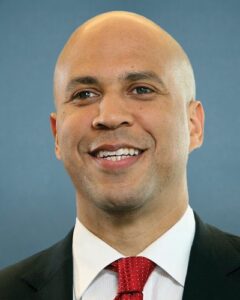
Tenure: 113th–119th Congresses
Years of Service: 2013–Present
An animal protection champion from “day one” in his first term in the U.S. Senate in a special election after the passing of New Jersey’s Frank Lautenberg, Cory Booker is the nation’s most active and consequential federal lawmaker on animal protection. Since coming to the Senate in 2013, he’s been central to nearly every major policy gains made at the national level since then. He was re-elected in 2014 and then 2020 and is now standing for re-election in 2026.
He’s worked with extraordinary effect in the major sectors of the economy — including drug development and pharmaceuticals; testing of chemicals for safety, farm, nutrition, and agriculture topics; and the trade in wildlife parts — to institute national reforms to benefit animals. His work addresses systemic forms of mistreatment of animals, but it also mitigates the spillover of social violence and viruses and other disease threats that originate in dangerous human behaviors toward animals.
In the 117th Congress, he and Senator Rand Paul, R-Ky., teamed up to pass the FDA Modernization Act 2.0, eliminating an animal-testing mandate for new drug development in place since the Depression era. It was the most significant policy change on the animal testing front, and perhaps the most consequential in any category of animal protection. That policy change has triggered the leaders at FDA to create a Roadmap to Reduce Animal Testing, offering the prospect of phasing out the annual use of millions of animals in drug development. He’s led a follow up effort with Sens. Eric Schmitt, R-Mo., and Paul to require FDA to modify its drug development regulations to conform them to the plan language of FDAMA 2.0. That latter bill is called the FDA Modernization Act 3.0, and it’s poised for final enactment, having passed the Senate two times and then subsequently passed the U.S. House.
In the 114th Congress, he was the architect of a provision in an update of the Toxic Substances Control Act (TSCA) to make animal testing a last resort when it comes to safety testing for thousands of chemicals in the commercial marketplace. The Environmental Protection Agency stated that since implementation, this provision in TSCA has spared hundreds of thousands of animals. EPA is now on a path to eliminate the use of mammals for chemical testing by 2035 or perhaps sooner.
In the 115th Congress, he introduced legislation to severely restrict any new research using non-human primates. In the 119th Congress, Senator Booker partnered with Senator Rick Scott to introduce legislation to ban NIH funding of animal testing outside the United States, and as a result NIH is now contemplating near term executive action to implement such a ban.
In the 117th Congress, Booker’s Shark Fin Trade Elimination Act was enacted into law, banning any domestic sale or exports of shark fins for soup. It is estimated that there were as many as 70 million sharks killed in global waters for the fin trade. He was also one of the very few Democrats to stand up and oppose the mass slaughter of North American barred owls in an unworkable and inhumane plan that may cost taxpayers more than $1.3 billion. He’s also been a supporter of the Bear Poaching Elimination Act and the Lead Endangers Animals Daily Act. He’s led effort to stymie efforts from Wisconsin Senator Ron Johnson and other GOP lawmakers to cherry-pick gray wolves from the federal list of threatened and endangered species. In August 2026, he spoke on the Senate floor about the economic and ecological benefits that wolves bring to the United States and how they occupy less than 10 percent of their historical range.
In addition to leading prior efforts (including sign-on letters from Senators to authorizing committee leaders) to block wolf de-listing, he’s fought to stop the import of sport-hunted trophies from threatened and endangered species. He has also introduced legislation and secured funding to help protect critically endangered Right Whales. In the 118th Congress, Senator Booker introduced legislation to provide lasting federal protections for bison, grizzly bears and wolves, modeled after past legislation that successfully provided permanent protections for bald and golden eagles. In prior years, he introduced legislation to ban leghold traps and other cruel and indiscriminate body-gripping traps on national wildlife refuges.
He’s a lead co-author of the Kangaroo Protection Act, with Senator Tammy Duckworth, D-Ill., to halt any imports or domestic trade in kangaroo products, which had long been used by the big athletic shoe companies for soccer cleats. Since that legislation was introduced, the nine top global athletic wear brands, including Adidas, New Balance, Nike, and Puma, have stopped sourcing kangaroo skins for their soccer cleats.
He’s been at the center of efforts to wipe out animal fighting in the United States. In the 115th Congress, his bill to apply the federal law against dogfighting and cockfighting to all of the U.S. territories became law as part of the 2018 Agricultural Improvement Act (“the Farm bill”), outlawing animal fighting in Puerto Rico, Guam, the U.S. Virgin Islands, the Commonwealth of the Northern Mariana Islands, and American Samoa, where animal fighting has been openly staged and occurring on a massive scale. He followed those efforts by leading the legislative campaign, with Sen. Kennedy, to pass the Fighting Inhumane Gambling and High-Risk Trafficking (FIGHT) Act to ban online and in-person gambling at dogfights or cockfights, to allow for seizure of property used in the commission of animal fights by convicted perpetrators of this violence against animals, to forbid shipping adult roosters through the U.S. Postal Service, and to allow private citizens to bring civil actions against dogfighters and cockfighters to secure court orders to shut them down.
Senator Booker’s leadership in working to eliminate cockfighting is motivated by his antipathy for cruelty to animals, but also his knowledge that trafficking of fighting animals spreads disease and leads to health crises for animals. It is documented that the movement of fighting birds has spread virulent Newcastle Disease and bird flu (H5N1), which alone has resulted in the killing of 170 million birds in the last three years and cost the federal government and consumers more than $20 billion. Similarly, he’s worked to ban mink farming, which was an acknowledged superspreader of SARS-CoV-2, resulting in a mutated virus that could have dramatically extended the COVID-19 contagion. Senator Booker has also spoken out against live-wildlife markets and worked with Senator John Cornyn, R-Texas, on legislation to address that incubator of viruses that threaten non-human animals and people alike.
Now a member of the Committee on Agriculture, Sen. Booker has been successfully leading the fight to block Congress from passing legislation to negate the state’s most important farm animal protection laws, such as Prop 12 in California and Question 3 in Massachusetts. He worked with former Agriculture Committee chairwoman Debbie Stabenow, D-Mich., to block that provision on the 2014 and 2018 Farm bills. Now in the minority, he’s so far managed to fend off that provision from being included in the 2026 Senate Farm bill, though that’s still a work in progress.
In the 119th Congress, he worked with Senators John Kennedy, R-La. and John Fetterman, D-Pa., and they shepherded to passage national legislation to give school kids more options at the breakfast table and lunch counter by allowing schools to offer plant-based milks to millions of kids who need an option. Since the 1940s, there’s been a mandate that all school kids get cow’s milk, even though perhaps 40% of them are lactose intolerant. This milk mandate has led to ill effects for food-insecure kids, who drink the milk despite their condition, or millions of other kids tossing out the milk (nearly 200 million gallons of milk a year).
Senator Booker has also introduced the Farm System Reform Act, which would put a national moratorium on any new large factory farms and would phase out all large factory farms by 2040. And he’s worked with Senator Mike Lee, R-Utah, to scale back a “check off” program for various agriculture industry trade associations that taxes rank-and-file farmers and enriches trade associations to pay for their staff and lobby against animal welfare policies.
A number of other major bills he cosponsored and advocated for have become law: the Pet and Women Safety Act (PAWS), the Big Cat Public Safety Act, the Prevent Animal Cruelty and Torture Act (PACT), and the Horseracing Integrity and Safety Act. No other Senator has ever amassed such a record of practical action for animals, dramatically changing the circumstances for countless millions of animals.
Notable Actions
119th Congress
✅ Lead cosponsor of the Puppy Protection Act, S. 4437, bipartisan legislation to strengthen federal standards of care for dogs kept by commercial breeders by improving requirements for housing, veterinary care, exercise, socialization, and humane breeding practices.
✅ Cosponsor of the AFTER Act, S. 4172, to provide a second chance for dogs, cats, rabbits, guinea pigs, hamsters, and nonhuman primates used in federally funded research by requiring facilities to pursue adoption or sanctuary placement whenever feasible.
✅ Lead sponsor of FDA Modernization Act 3.0, S. 355, to direct FDA to publish a final rule to implement a law enacted in December 2022 that eliminated a Depression-era requirement for animal testing in the Federal Food, Drug and Cosmetic Act (21 USC § 355) and allows for innovative 21st-century human-relevant test methods where appropriate.
✅ Lead cosponsor of the Kangaroo Protection Act, S. 2162, to stop the U.S. sale of commercial products made with kangaroo skins and other kangaroo parts.
✅ Lead cosponsor of the Opportunities for Fairness in Farming (OFF) Act, S. 1848, to reform agricultural checkoff programs, which funnel mandatory dues from small farmers to trade groups that lobby against animal welfare policies.
✅ Lead cosponsor of the Cease Animal Research Grants Overseas (CARGO) Act, S. 1802, bipartisan legislation to prohibit the National Institutes of Health from funding research involving live animals outside the United States, where NIH lacks direct inspection and oversight of animal-welfare practices.
✅ Lead cosponsor of the Captive Primate Safety Act, S. 1594, to prohibit the private ownership, breeding, sale, transport, and other commercial activities involving nonhuman primates by amending the Lacey Act, while exempting accredited zoos, sanctuaries, research facilities, and certain other qualified entities. The legislation is designed to protect both public safety and the welfare of highly intelligent primates by ending the commercial pet trade in these animals.
✅ Cosponsor of the Better CARE for Animals Act, S. 1538, to strengthen enforcement of the Animal Welfare Act by expanding federal authority to investigate and prosecute animal cruelty violations and improve coordination between the U.S. Department of Agriculture and the Department of Justice.
✅ Lead cosponsor of the Fighting Inhumane Gambling and High-risk Trafficking (FIGHT) Act, S. 1454, to strengthen federal enforcement against animal fighting and related criminal activity.
✅ Lead cosponsor of the Freedom in School Cafeterias and Lunches (FISCAL) Act, S. 1236, to end the National School Lunch Program’s decades-old “cow’s milk only” mandate by requiring schools to offer plant-based milk options to students with lactose intolerance. The bill’s core provisions were ultimately incorporated into the Whole Milk for Healthy Kids Act, passed unanimously by the Senate, approved by Congress, and signed into law by the President, ensuring schools may offer plant-based milk options and must provide dairy-free alternatives for students.
✅ Voted “Aye” on the motion to proceed to S.J. Res. 69 (Senate Roll Call Vote 597), a joint resolution under the Congressional Review Act to bring the measure before the Senate for consideration to overturn the U.S. Fish and Wildlife Service’s Barred Owl Management Strategy, which authorized the large-scale killing of barred owls in Washington, Oregon, and California. An “Aye” vote is the pro-animal position because it supported moving forward with a vote to repeal the barred owl kill plan.
118th Congress
✅ Cosponsor of the Captive Primate Safety Act, S. 4206, to prohibit the private ownership, breeding, sale, transport, and other commercial activities involving nonhuman primates by amending the Lacey Act, while exempting accredited zoos, sanctuaries, research facilities, and certain other qualified entities. The legislation is designed to protect both public safety and the welfare of highly intelligent primates by ending the commercial pet trade in these animals.
✅ Cosponsor of the Better CARE for Animals Act, S. 2555, to strengthen enforcement of the Animal Welfare Act by expanding federal authority to investigate and prosecute animal cruelty violations and improve coordination between the U.S. Department of Agriculture and the Department of Justice.
✅ Lead cosponsor of the Opportunities for Fairness in Farming (OFF) Act, S. 557, to reform agricultural checkoff programs, which funnel mandatory dues from small farmers to trade groups that lobby against animal welfare policies.
✅ Lead sponsor of the Fighting Inhumane Gambling and High-Risk Trafficking (FIGHT) Act, S. 1529, to strengthen federal enforcement against animal fighting and related criminal activity.
✅ Cosponsor of the Save America’s Forgotten Equines (SAFE) Act, S. 2037, to ban U.S.-based horse slaughter and the export of horses for slaughter for human consumption.
✅ Lead sponsor of FDA Modernization Act 3.0, S. 5046, to direct FDA to publish a final rule to implement a law enacted in December 2022 that eliminated a Depression-era requirement for animal testing in the Federal Food, Drug and Cosmetic Act (21 USC § 355) and allows for innovative 21st-century human-relevant test methods where appropriate.
✅ Cosponsor of the Kangaroo Protection Act, S. 5118, to stop the U.S. sale of commercial products made with kangaroo skins and other kangaroo parts.
✅ Cosponsor of the ADD SOY Act, S. 2943, to give kids access to a plant-based milk option in the National School Lunch Program, in addition to the existing cow’s milk offerings.
✅ Lead cosponsor of the Prevent All Soring Tactics (PAST) Act, S. 4004, to end the failed system of industry self-policing under the Horse Protection Act by banning devices associated with horse soring, increasing penalties for violators, and strengthening USDA enforcement to protect Tennessee Walking Horses and related breeds from intentional abuse used to exaggerate their gait in competitions.
✅ Voted “Nay” on S.J. Res. 23 (Senate Roll Call Vote 122), a Congressional Review Act resolution to overturn federal regulations governing the listing of endangered and threatened species and designation of critical habitat under the Endangered Species Act. A “Nay” vote is the pro-animal position because it opposed weakening federal protections for imperiled wildlife and their habitats.
117th Congress
✅ Lead cosponsor of the Captive Primate Safety Act, S. 1588, to prohibit the private ownership, breeding, sale, transport, and other commercial activities involving nonhuman primates by amending the Lacey Act, while exempting accredited zoos, sanctuaries, research facilities, and certain other qualified entities. The legislation is designed to protect both public safety and the welfare of highly intelligent primates by ending the commercial pet trade in these animals.
✅ Lead cosponsor of the Puppy Protection Act, S. 1385, bipartisan legislation to strengthen federal standards of care for dogs kept by commercial breeders by improving requirements for housing, veterinary care, exercise, socialization, and humane breeding practices.
✅ Cosponsor of the AFTER Act, S. 1378, to provide a second chance for dogs, cats, rabbits, guinea pigs, hamsters, and nonhuman primates used in federally funded research by requiring facilities to pursue adoption or sanctuary placement whenever feasible.
✅ Cosponsor of the Bear Poaching Elimination Act, S. 3472, to end trafficking of bear gall bladders and bile.
✅ Cosponsor of the Big Cat Public Safety Act, S. 1210, to reduce the number of tigers, lions and other big cats living in substandard conditions and to protect public safety by banning public contact activities with these animals and prohibiting their possession by individuals and entities lacking a USDA license. H.R. 263 – Big Cat Public Safety Act.
✅ Lead cosponsor of the Prevent All Soring Tactics (PAST) Act, S. 2295, to crack down on the cruel practice of soring, in which trainers inflict severe pain on the hooves and legs of Tennessee walking horses and related breeds to force them to perform an unnaturally high-stepping gait for competitions.
✅ Led the passage of the Shark Fin Sales Elimination Act, S. 1106, bipartisan legislation to shut down the U.S. market for shark fins by prohibiting their commercial possession, sale, purchase, and transport. The measure targeted the cruel practice of shark finning, in which sharks may have their fins removed and be discarded at sea. Booker’s legislation attracted 46 Senate cosponsors, and its core provisions were ultimately enacted into federal law in 2022, establishing a nationwide prohibition on the commercial shark-fin trade.
✅ Co-led the passage of the FDA Modernization Act 2.0, S. 5002, landmark bipartisan legislation with Senator Rand Paul to eliminate the outdated federal mandate for animal testing in new drug development and allow the use of modern, non-animal methods, including cell-based assays, human biology-based methods, and computer models. The measure passed the Senate unanimously, and its core provisions were enacted into law in 2022, marking a major federal policy shift toward reducing the use of dogs, primates, and other animals in drug testing.
✅ Voted “Nay” on Sen. Ron Johnson’s Motion to Instruct conferees on H.R. 4521 (Senate Roll Call Vote 152), which sought to reject a House-passed provision prohibiting commercial mink farming in the United States. A “Nay” vote is the pro-animal position because it supported retaining the House provision to end commercial mink farming.
116th Congress
✅ Lead sponsor of the Shark Fin Sales Elimination Act, S. 877, to end the U.S. commercial trade in shark fins by prohibiting their sale, purchase, and transport, helping reduce the global demand that drives the cruel practice of shark finning. Core provisions of the bill were later incorporated into the James M. Inhofe National Defense Authorization Act for Fiscal Year 2023, which was signed into law in December 2022, making the United States one of the world’s largest nations to ban the domestic shark fin trade.
✅ Lead cosponsor of the Humane Cosmetics Act, S. 2886, bipartisan legislation to phase out animal testing for cosmetics and prohibit the sale of cosmetics developed or manufactured using new animal testing. The bill encouraged the use of modern, non-animal testing methods while helping align U.S. policy with the growing international movement to end cosmetic testing on animals.
✅ Cosponsor of Horseracing Integrity Act, S. 1820, to address widespread doping—a key contributing factor in frequent horse fatalities on American racetracks—by banning race-day medication, increasing out-of-competition testing and establishing uniform national rules governing use of drugs in racehorses.
✅ Cosponsor of the Rescuing Animals With Rewards (RAWR) Act, S. 1590, to combat international wildlife trafficking by authorizing rewards for information leading to the disruption and prosecution of transnational wildlife trafficking networks.
✅ Cosponsor of the Prevent All Soring Tactics (PAST) Act, S. 1007, to crack down on the cruel practice of “soring,” in which trainers deliberately inflict severe pain on the hooves and legs of Tennessee walking horses and related breeds to force them to perform an unnaturally high- stepping gait for competitions.
✅ Lead cosponsor of the Big Cat Public Safety Act, S. 2561, to reduce the number of tigers, lions and other big cats living in substandard conditions and protect public safety by banning public contact activities with these animals and prohibiting their possession by individuals and entities lacking a U.S. Department of Agriculture license.
✅ Approved by unanimous consent the Preventing Animal Cruelty and Torture (PACT) Act, landmark legislation making the most egregious acts of intentional animal cruelty—including crushing, burning, drowning, suffocating, impaling, and other forms of torture—a federal felony when committed in interstate commerce, on federal property, or within federal jurisdiction. The measure strengthened the nation’s legal framework against animal cruelty and closed a longstanding gap in federal law by ensuring that the worst acts of animal abuse could be prosecuted even when state or local authorities could not act. The Senate passed the bill by unanimous consent.
115th Congress
✅ Cosponsor of the Pet and Women Safety (PAWS) Act, S. 322, which expands current federal domestic violence protections to include pets and authorizes grant money to help domestic violence shelters and other entities arrange shelter for survivors with pets.
✅ Led the Senate effort to extend federal animal-fighting laws to all U.S. territories, introducing the Parity in Animal Cruelty Enforcement (PACE) Act, S. 2971, and working with a bipartisan group of senators to secure the reform in the 2018 Farm Bill. The provision, enacted into law, closed a major loophole by applying federal prohibitions against dogfighting and cockfighting to Puerto Rico and all other U.S. territories.
✅ Cosponsor of the Prevent All Soring Tactics (PAST) Act, S. 2957, to crack down on the cruel practice of “soring,” in which trainers deliberately inflict pain on the hooves and legs of Tennessee walking horses and related breeds to force them to perform an unnaturally high-stepping gait for competitions.
✅ Cosponsor of the Safeguard American Food Exports (SAFE) Act, S. 1706, to protect horses and consumers by prohibiting the transport and export of U.S. horses to slaughter for human consumption. American horses are not raised for food and are routinely given drugs that can be toxic to people if ingested. Horse slaughter is cruel, and the U.S. public overwhelmingly opposes it.
✅ Approved by unanimous consent the Preventing Animal Cruelty and Torture (PACT) Act, S. 654, bipartisan legislation to make the most egregious acts of intentional animal cruelty—including crushing, burning, drowning, suffocating, impaling, and other forms of torture—a federal felony when committed in interstate or foreign commerce or within federal jurisdiction. The Senate passed the legislation by unanimous consent in December 2017.
✅ Voted “Nay” on H.J. Res. 69, a Congressional Review Act (Senate Roll Call Vote 92) resolution to overturn an Obama administration rule prohibiting killing bear cubs and wolf pups in their dens, baiting bears with food to shoot them at close range, and aerial shooting of wolves and other predators. The resolution passed the Senate 52–47. A “Nay” vote is the pro-animal position because it sought to retain the rule forbidding these inhumane and unsporting predator-killing practices on national wildlife refuges in Alaska.
✅ Voted “Yea” on the conference report for the Agriculture Improvement Act of 2018 (Farm Bill), H.R. 2 (Senate Roll Call Vote 259), which included major animal-protection provisions prohibiting dog and cat meat consumption, extending the federal animal-fighting prohibition to all U.S. territories, and providing protections for domestic-violence survivors and their pets. The final bill also excluded the House-passed King Amendment, which threatened state animal-welfare laws. The Senate approved the Farm Bill 87–13.
114th Congress
✅ Key figure in passage of reforms to reduce animal testing under the Toxic Substances Control Act, negotiating the bipartisan Frank R. Lautenberg Chemical Safety for the 21st Century Act. Booker fought to include provisions requiring EPA to reduce and replace vertebrate-animal testing where practicable and scientifically justified, promote modern alternative testing methods, and require consideration of non-animal approaches before new vertebrate-animal tests are conducted. The reforms were enacted into federal law in 2016, establishing a major federal policy to move chemical safety testing away from reliance on animals.
✅ Lead sponsor of the Animal Welfare in Agricultural Research Endeavors (AWARE) Act, S. 388, to extend Animal Welfare Act humane-treatment standards to farm animals used in federal research and laboratory facilities.
✅ Lead sponsor of the Shark Fin Trade Elimination Act, S. 3095, to prohibit the possession, sale, purchase, transport, and trade of shark fins and products containing shark fins, helping combat the cruel and unsustainable shark-fin trade.
✅ Cosponsor of the Preventing Animal Cruelty and Torture (PACT) Act, S. 1831, to make extreme acts of intentional animal cruelty a federal crime when committed in interstate or foreign commerce or within federal jurisdiction.
✅ Cosponsor of the Pet and Women Safety (PAWS) Act, S. 1559, which expands current federal domestic violence protections to include pets and authorizes grant money to help domestic violence shelters and other entities arrange shelter for survivors with pets.
✅ Cosponsor of the Safeguard American Food Exports (SAFE) Act, S. 1214, to protect horses and consumers by prohibiting the transport and export of U.S. horses to slaughter for human consumption. American horses are not raised for food and are routinely given drugs that can be toxic to people if ingested. Horse slaughter is cruel, and the U.S. public overwhelmingly opposes it.
✅ Cosponsor of the Prevent All Soring Tactics (PAST) Act, S. 1121, to crack down on the cruel practice of “soring,” in which trainers deliberately inflict pain on the hooves and legs of Tennessee walking horses and related breeds to force them to perform an unnaturally high-stepping gait for competitions.
✅ Lead sponsor of the Refuge from Cruel Trapping Act, S. 1081, to prohibit the use or possession of body-gripping traps in the National Wildlife Refuge System and protect wildlife from cruel and indiscriminate trapping methods.
113th Congress
✅ Cosponsor of the Egg Products Inspection Act Amendments, S. 820, to establish federal housing and welfare standards for egg-laying hens and transition the egg industry away from conventional barren battery cages.
✅ Cosponsor of the Animal Fighting Spectator Prohibition Act, S. 666, bipartisan legislation to strengthen federal animal fighting laws by prohibiting knowingly attending or bringing a child to a dogfight, cockfight, or other illegal animal fighting venture, increasing penalties for those who support these cruel criminal enterprises.
✅ Cosponsor of the Safeguard American Food Exports (SAFE) Act, S. 541, to protect horses and consumers by prohibiting the transport and export of U.S. horses to slaughter for human consumption. American horses are not raised for food and are routinely given drugs that can be toxic to people if ingested. Horse slaughter is cruel, and the U.S. public overwhelmingly opposes it.
✅ Cosponsor of the Captive Primate Safety Act, S. 1463, bipartisan legislation to prohibit the interstate trade of monkeys, apes, and other nonhuman primates for the exotic pet trade, protecting these highly intelligent animals from exploitation while reducing public health and safety risks associated with private ownership.
✅ Cosponsor of the Prevent All Soring Tactics (PAST) Act, S. 1406, to crack down on the cruel practice of “soring,” in which trainers deliberately inflict pain on the hooves and legs of Tennessee walking horses and related breeds to force them to perform an unnaturally high-stepping gait for competitions.