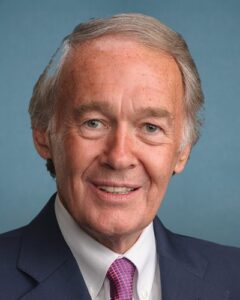
Tenure: 113th–119th Congresses (House service: 95th–113th Congresses)
Years of Service: 2013–Present
Sen. Ed Markey has spent five decades in Congress, first elected to the U.S. House in late 1976 and moving to the Senate in 2013. His record on animal protection is substantial and, over many years, very broadly favorable.
He has been a reliable supporter of legislation addressing animal cruelty, horse soring, captive primates, puppy mills, big cats, animal fighting, horse slaughter, animal testing, farm-animal confinement, and wildlife protection. He was a cosponsor of the Preventing Animal Cruelty and Torture (PACT) Act, signed into law by President Trump in 2019, and also backed other critical measures that made it into law, including the Big Cat Public Safety Act in 2022 and the Animal Fighting Spectator Prohibition Act.
The most consequential recent concern about his animal protection record is his vote in 2025 in opposition to S.J. Res. 69, a Congressional Review Act resolution, led by Sen. John Kennedy, R-La., to overturn the U.S. Fish and Wildlife Service’s strategy for killing barred owls in the Pacific Northwest.
The federal strategy calls for shooting and trapping nearly a half million native North American barred owls in California, Oregon, and Washington, ostensibly to reduce interspecies competition with the Northern spotted owl. Markey voted “nay” on the motion to proceed to the CRA resolution, leaving the killing plan intact.
His position on barred owl killing contrasts with the position now espoused by Rep. Seth Moulton, who is supporting efforts to nix the barred owl kill plan. While Moulton and Markey agree on a raft of animal issues, they do not agree on this one, and a coalition of 450 organizations, including 40 local Audubon societies, opposes the massacre of owls protected under the Migratory Bird Treaty Act since 1918.
Markey’s best example of leadership of pro-animal legislation is the Sea Turtle Rescue Assistance and Rehabilitation Act, introducing it with Sen. John Cornyn, R-Texas, in 2025 and helping pass it in the Senate in March 2026. The legislation establishes federal funding for sea turtle rescue, rehabilitation, recovery and research. Markey’s office appropriately describes it as his bipartisan legislation.
He also deserves credit for joining Sen. Cory Booker’s significant Farm System Reform Act, which sought structural changes to the industrial livestock system rather than merely incremental improvements in animal welfare. At this point, it has only a handful of Democratic cosponsors and it is a messaging bill, but it’s important that Markey has signed his name to it to challenge the destructive factory farming model that harms animals, the environment, and family farmers.
And Markey has been a defender of state farm animal welfare law. In the 119th Congress, he co-led opposition, with Sens. Elizabeth Warren of Massachusetts and Adam Schiff and Alex Padilla of California, to the Save Our Bacon Act. In a May 2026 letter signed by a total of 32 senators, that group of four lawmakers called on Agriculture Committee leaders to omit the SOB Act provision from any Farm Bill measure moving forward. The SOB Act and its derivatives remain a continuing threat to the present and future state policy making in this issue area.
Markey’s Senate record also contains an impressive range of animal-protection cosponsorships. Among them are the PAST Act to combat horse soring, Big Cat Public Safety Act to halt interstate trade in big cats as pets, Captive Primate Safety Act to halt trade in primates as pets, Puppy Protection Act, the SAFE Act to combat horse slaughter for human consumption, Humane Cosmetics Act, Horseracing Integrity Act, Animal Welfare in Agricultural Research Endeavors Act, Refuge from Cruel Trapping Act, Egg Products Inspection Act amendments, Animal Fighting Spectator Prohibition Act, and the Farm System Reform Act.
In the 119th Congress, he has not exhibited the same level of commitment to newly constituted animal welfare reforms, most of which have strong bipartisan support.
For example, he’s not a cosponsor of the FIGHT Act, LEAD Act to ban lead ammunition on national wildlife refuges, the Freedom in the School Cafeterias and Lunches Act to provide plant-based milk options to kids participating in the National School Lunch Program (that provision was included as an amendment to the Whole Milk for Health Kids Act in 2026), the CARGO Act to stop U.S. taxpayer funding for animal tests conducted in other nations, FDA Modernization Act 3.0, Kangaroo Protection Act to halt the trade in kangaroo parts, or the Congressional Review Act resolution on barred owls, which did come to the floor for a roll call vote, with Markey opposing it.
On the other hand, the FDA Modernization Act 3.0 passed the Senate by unanimous consent, and Markey deserves credit for allowing it to clear the chamber, but he was not a cosponsor of that measure or the FDA Modernization Act 2.0, which was enacted in 2022 and eliminated an animal-testing mandate that had been in place since the federal Food, Drug, and Cosmetics Act of 1938 became law. This has become too common for Markey in recent years – a lack of strong support and leadership for key proposals and high-priority measures.
Markey remains deeply active on climate, energy, environmental justice, technology and other issues with consequences for animals, with episodic engagement on animal issues. He’s strong on animal protection issues, but not in the top tier of animal protection leaders in the Senate.
Notable Actions
119th Congress
✅ Cosponsor of the Captive Primate Safety Act, S. 1594, to prohibit the private ownership, breeding, sale, transport, and other commercial activities involving nonhuman primates by amending the Lacey Act, while exempting accredited zoos, sanctuaries, research facilities, and certain other qualified entities. The legislation is designed to protect both public safety and the welfare of highly intelligent primates by ending the commercial pet trade in these animals.
❌ Voted “Nay” on the motion to proceed to S.J. Res. 69 (Senate Roll Call Vote 597), a joint resolution under the Congressional Review Act to bring the measure before the Senate for consideration to overturn the U.S. Fish and Wildlife Service’s Barred Owl Management Strategy, which authorized the large-scale killing of barred owls in Washington, Oregon, and California. A “Nay” vote is the anti-animal position because it opposed moving forward with a vote to repeal the barred owl kill plan.
118th Congress
✅ Cosponsor of the Opportunities for Fairness in Farming (OFF) Act, S. 557, to reform agricultural checkoff programs, which funnel mandatory dues from small farmers to trade groups that lobby against animal welfare policies.
✅ Cosponsor of the Captive Primate Safety Act, S. 4206, to prohibit the private ownership, breeding, sale, transport, and other commercial activities involving nonhuman primates by amending the Lacey Act, while exempting accredited zoos, sanctuaries, research facilities, and certain other qualified entities. The legislation is designed to protect both public safety and the welfare of highly intelligent primates by ending the commercial pet trade in these animals.
✅ Cosponsor of the Prevent All Soring Tactics (PAST) Act, S. 4004, to end the failed system of industry self-policing under the Horse Protection Act by banning devices associated with horse soring, increasing penalties for violators, and strengthening USDA enforcement to protect Tennessee Walking Horses and related breeds from intentional abuse used to exaggerate their gait in competitions.
✅ Voted “Nay” on S.J. Res. 23 (Senate Roll Call Vote 122), a Congressional Review Act resolution to overturn federal regulations governing the listing of endangered and threatened species and designation of critical habitat under the Endangered Species Act. A “Nay” vote is the pro-animal position because it opposed weakening federal protections for imperiled wildlife and their habitats.
117th Congress
✅ Cosponsor of the Captive Primate Safety Act, S. 1588, to prohibit the private ownership, breeding, sale, transport, and other commercial activities involving nonhuman primates by amending the Lacey Act, while exempting accredited zoos, sanctuaries, research facilities, and certain other qualified entities. The legislation is designed to protect both public safety and the welfare of highly intelligent primates by ending the commercial pet trade in these animals.
✅ Cosponsor of the Puppy Protection Act, S. 1385, bipartisan legislation to strengthen federal standards of care for dogs kept by commercial breeders by improving requirements for housing, veterinary care, exercise, socialization, and humane breeding practices.
✅ Cosponsor of the Big Cat Public Safety Act, S. 1210, to reduce the number of tigers, lions and other big cats living in substandard conditions and to protect public safety by banning public contact activities with these animals and prohibiting their possession by individuals and entities lacking a USDA license. H.R. 263 – Big Cat Public Safety Act.
✅ Cosponsor of the Prevent All Soring Tactics (PAST) Act, S. 2295, to crack down on the cruel practice of soring, in which trainers inflict severe pain on the hooves and legs of Tennessee walking horses and related breeds to force them to perform an unnaturally high-stepping gait for competitions.
✅ Voted “Nay” on Sen. Ron Johnson’s Motion to Instruct conferees on H.R. 4521 (Senate Roll Call Vote 152), which sought to reject a House-passed provision prohibiting commercial mink farming in the United States. A “Nay” vote is the pro-animal position because it supported retaining the House provision to end commercial mink farming.
116th Congress
✅ Cosponsor of the Humane Cosmetics Act, S. 2886, bipartisan legislation to phase out animal testing for cosmetics and prohibit the sale of cosmetics developed or manufactured using new animal testing. The bill encouraged the use of modern, non-animal testing methods while helping align U.S. policy with the growing international movement to end cosmetic testing on animals.
✅ Cosponsor of Horseracing Integrity Act, S. 1820, to address widespread doping—a key contributing factor in frequent horse fatalities on American racetracks—by banning race-day medication, increasing out-of-competition testing and establishing uniform national rules governing use of drugs in racehorses.
✅ Cosponsor of the Rescuing Animals With Rewards (RAWR) Act, S. 1590, to combat international wildlife trafficking by authorizing rewards for information leading to the disruption and prosecution of transnational wildlife trafficking networks.
✅ Cosponsor of the Prevent All Soring Tactics (PAST) Act, S. 1007, to crack down on the cruel practice of “soring,” in which trainers deliberately inflict severe pain on the hooves and legs of Tennessee walking horses and related breeds to force them to perform an unnaturally high- stepping gait for competitions.
✅ Cosponsor of the Big Cat Public Safety Act, S. 2561, to reduce the number of tigers, lions and other big cats living in substandard conditions and protect public safety by banning public contact activities with these animals and prohibiting their possession by individuals and entities lacking a U.S. Department of Agriculture license.
✅ Approved by unanimous consent the Preventing Animal Cruelty and Torture (PACT) Act, landmark legislation making the most egregious acts of intentional animal cruelty—including crushing, burning, drowning, suffocating, impaling, and other forms of torture—a federal felony when committed in interstate commerce, on federal property, or within federal jurisdiction. The measure strengthened the nation’s legal framework against animal cruelty and closed a longstanding gap in federal law by ensuring that the worst acts of animal abuse could be prosecuted even when state or local authorities could not act. The Senate passed the bill by unanimous consent.
115th Congress
✅ Cosponsor of the Pet and Women Safety (PAWS) Act, S. 322, which expands current federal domestic violence protections to include pets and authorizes grant money to help domestic violence shelters and other entities arrange shelter for survivors with pets.
✅ Cosponsor of the Parity in Animal Cruelty Enforcement (PACE) Act, S. 2971, bipartisan legislation to close a loophole in federal law by banning animal fighting in all U.S. territories, including cockfighting, and ensuring consistent enforcement of the Animal Welfare Act nationwide.
✅ Cosponsor of the Prevent All Soring Tactics (PAST) Act, S. 2957, to crack down on the cruel practice of “soring,” in which trainers deliberately inflict pain on the hooves and legs of Tennessee walking horses and related breeds to force them to perform an unnaturally high-stepping gait for competitions.
✅ Cosponsor of the Safeguard American Food Exports (SAFE) Act, S. 1706, to protect horses and consumers by prohibiting the transport and export of U.S. horses to slaughter for human consumption. American horses are not raised for food and are routinely given drugs that can be toxic to people if ingested. Horse slaughter is cruel, and the U.S. public overwhelmingly opposes it.
✅ Approved by unanimous consent the Preventing Animal Cruelty and Torture (PACT) Act, S. 654, bipartisan legislation to make the most egregious acts of intentional animal cruelty—including crushing, burning, drowning, suffocating, impaling, and other forms of torture—a federal felony when committed in interstate or foreign commerce or within federal jurisdiction. The Senate passed the legislation by unanimous consent in December 2017.
✅ Voted “Nay” on H.J. Res. 69, a Congressional Review Act (Senate Roll Call Vote 92) resolution to overturn an Obama administration rule prohibiting killing bear cubs and wolf pups in their dens, baiting bears with food to shoot them at close range, and aerial shooting of wolves and other predators. The resolution passed the Senate 52–47. A “Nay” vote is the pro-animal position because it sought to retain the rule forbidding these inhumane and unsporting predator-killing practices on national wildlife refuges in Alaska.
✅ Voted “Yea” on the conference report for the Agriculture Improvement Act of 2018 (Farm Bill), H.R. 2 (Senate Roll Call Vote 259), which included major animal-protection provisions prohibiting dog and cat meat consumption, extending the federal animal-fighting prohibition to all U.S. territories, and providing protections for domestic-violence survivors and their pets. The final bill also excluded the House-passed King Amendment, which threatened state animal-welfare laws. The Senate approved the Farm Bill 87–13.
114th Congress
✅ Cosponsor of the Animal Welfare in Agricultural Research Endeavors (AWARE) Act, S. 388, to extend Animal Welfare Act humane-treatment standards to farm animals used in federal research and laboratory facilities.
✅ Cosponsor of the Big Cat Public Safety Act, S. 2541, to prohibit private breeding and possession of lions, tigers, leopards, cheetahs, jaguars, cougars, and their hybrids, protecting big cats from exploitation and improving public safety.
✅ Cosponsor of the Preventing Animal Cruelty and Torture (PACT) Act, S. 1831, to make extreme acts of intentional animal cruelty a federal crime when committed in interstate or foreign commerce or within federal jurisdiction.
✅ Cosponsor of the Pet and Women Safety (PAWS) Act, S. 1559, which expands current federal domestic violence protections to include pets and authorizes grant money to help domestic violence shelters and other entities arrange shelter for survivors with pets.
✅ Cosponsor of the Safeguard American Food Exports (SAFE) Act, S. 1214, to protect horses and consumers by prohibiting the transport and export of U.S. horses to slaughter for human consumption. American horses are not raised for food and are routinely given drugs that can be toxic to people if ingested. Horse slaughter is cruel, and the U.S. public overwhelmingly opposes it.
✅ Cosponsor of the Prevent All Soring Tactics (PAST) Act, S. 1121, to crack down on the cruel practice of “soring,” in which trainers deliberately inflict pain on the hooves and legs of Tennessee walking horses and related breeds to force them to perform an unnaturally high-stepping gait for competitions.
✅ Cosponsor of the Refuge from Cruel Trapping Act, S. 1081, to prohibit the use or possession of body-gripping traps in the National Wildlife Refuge System and protect wildlife from cruel and indiscriminate trapping methods.
113th Congress
✅ Cosponsor of the Egg Products Inspection Act Amendments, S. 820, to establish federal housing and welfare standards for egg-laying hens and transition the egg industry away from conventional barren battery cages.
✅ Cosponsor of the Animal Fighting Spectator Prohibition Act, S. 666, bipartisan legislation to strengthen federal animal fighting laws by prohibiting knowingly attending or bringing a child to a dogfight, cockfight, or other illegal animal fighting venture, increasing penalties for those who support these cruel criminal enterprises.
✅ Cosponsor of the Safeguard American Food Exports (SAFE) Act, S. 541, to protect horses and consumers by prohibiting the transport and export of U.S. horses to slaughter for human consumption. American horses are not raised for food and are routinely given drugs that can be toxic to people if ingested. Horse slaughter is cruel, and the U.S. public overwhelmingly opposes it.
✅ Cosponsor of the Puppy Uniform Protection and Safety (PUPS) Act, S. 395, to strengthen federal oversight of large-scale commercial dog breeders, including online puppy sellers, and require humane standards for housing and daily exercise.
✅ Cosponsor of the Captive Primate Safety Act, S. 1463, bipartisan legislation to prohibit the interstate trade of monkeys, apes, and other nonhuman primates for the exotic pet trade, protecting these highly intelligent animals from exploitation while reducing public health and safety risks associated with private ownership.
✅ Cosponsor of the Prevent All Soring Tactics (PAST) Act, S. 1406, to crack down on the cruel practice of “soring,” in which trainers deliberately inflict pain on the hooves and legs of Tennessee walking horses and related breeds to force them to perform an unnaturally high-stepping gait for competitions.
109th Congress
✅ Approved by unanimous consent the Pets Evacuation and Transportation Standards (PETS) Act, H.R. 3858, requiring state and local emergency preparedness plans to account for the rescue, care, shelter, and evacuation needs of people with household pets and service animals during disasters. The Senate passed the measure with an amendment by unanimous consent on August 4, 2006, and it became law.