Tenure: 112th–119th Congresses
Years of Service: 2011–Present
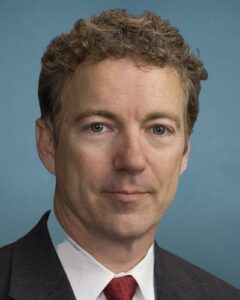
Dr. Rand Paul, one half of the first father-son duo ever to serve concurrently in separate chambers of Congress, is the most libertarian-leaning Republican to be elected to the U.S. Senate in modern times. An eye surgeon educated at Duke University Medical School, Paul was first elected in the Tea Party midterm wave of 2010, and since then he has built a legislative record on animal welfare that reflects his commitment to a broader laissez-faire philosophy.
Paul’s first bill to become law was the FDA Modernization Act (FDAMA) 2.0, which passed the U.S. Senate unanimously and was signed into law by President Biden as part of a larger package at the end of 2022. Lifting a 1930s-era mandate in federal law that required extensive animal tests on all developmental new drug candidates despite the availability of superior animal-free alternative testing methods, FDAMA 2.0 was the most significant standalone federal bill to reform animal testing since the 1960s. Link to Sen. Paul’s floor speech on FDA Modernization Act 2.0 – Animal testing mandate eliminated – Hesperos Inc..
Paul has also cosponsored other biomedical research policies that would benefit animals, including the Worldwide Animal Testing Compliance and Harmonization (WATCH) Act, which would apply U.S.-level animal welfare standards to overseas laboratories receiving federal funds; the Cease Animal Research Grants Overseas (CARGO) Act, which would prohibit the National Institutes of Health from funding animal research conducted outside the U.S.; and the FDA Modernization Act 3.0, a follow-up measure to ensure that the statutory reforms of his landmark FDAMA 2.0 are fully implemented by regulators.
In 2021, Paul also spearheaded an oversight letter signed by six U.S. senators to the National Institute of Allergy and Infectious Diseases (NIAID) posing questions about federally funded experiments on dogs whose vocal cords had been severed for nonmedical reasons.
In the 119th Congress, Paul was an original cosponsor of a resolution under the Congressional Review Act to override a U.S. Fish and Wildlife Service rule that called for an unprecedented killing of nearly half a million native North American owls in the Pacific Northwest. He also voted in favor of a procedural motion to advance that resolution on the Senate floor.
For many consecutive Congresses, Paul has also been a cosponsor of the Opportunities for Fairness in Farming (OFF) Act, which would reform agricultural “checkoff” programs, which use mandatory dues from small livestock producers to fund trade associations that often lobby against animal welfare priorities, in addition to incentivizing the government to promote greater consumption of animal-derived products.
Senator Paul allowed a series of animal-welfare measures to pass the Senate and to be signed into law, including the Preventing Animal Cruelty and Torture Act (2019), the Horseracing Integrity and Safety Act (2021), and the Big Cat Public Safety Act (2022).
Overall, Paul’s record on animal welfare reflects his broader interest in reducing federal spending, removing regulatory burdens, and lifting unnecessary government mandates that harm people and animals alike. He has become more alert to animal welfare concerns over time, become more active on animal-testing issues more recently and not voting against or placing “legislative holds” on some major animal welfare legislation as he did earlier in his Senate service.
Notable Actions
119th Congress
✅ Cosponsor of the Cease Animal Research Grants Overseas (CARGO) Act, S. 1802, bipartisan legislation to prohibit the National Institutes of Health from funding research involving live animals outside the United States, where NIH lacks direct inspection and oversight of animal-welfare practices.
✅ Lead cosponsor of S.J. Res. 69, to nullify the FWS Plan to Kill 450,000 Barred Owls across 24 million acres, including 14 national parks and 17 national forests, and is now going to be used as a “mitigation measure” to allow incidental take of spotted owls – turning this plan into an effort to shoot barred owls and to kill spotted owls by cutting down the trees they require to survive.
✅ Lead cosponsor of FDA Modernization Act 3.0, S. 355, to direct FDA to publish a final rule to implement a law enacted in December 2022 that eliminated a Depression-era requirement for animal testing in the Federal Food, Drug and Cosmetic Act (21 USC § 355) and allows for innovative 21st-century human-relevant test methods where appropriate.
✅ Lead cosponsor of the Opportunities for Fairness in Farming (OFF) Act, S. 1848, to reform agricultural checkoff programs, which funnel mandatory dues from small farmers to trade groups that lobby against animal welfare policies.
❌ Voted “Yea” on S.J. Res. 23 (Senate Roll Call Vote 122), a Congressional Review Act resolution to overturn federal regulations strengthening implementation of the Endangered Species Act, including protections governing the listing of imperiled species and designation of critical habitat. A “Yea” vote is the anti-animal position because it supported eliminating stronger protections for threatened and endangered wildlife and their habitat.
✅ Voted “Aye” on the motion to proceed to S.J. Res. 69 (Senate Roll Call Vote 597), a joint resolution under the Congressional Review Act to bring the measure before the Senate for consideration to overturn the U.S. Fish and Wildlife Service’s Barred Owl Management Strategy, which authorized the large-scale killing of barred owls in Washington, Oregon, and California. An “Aye” vote is the pro-animal position because it supported moving forward with a vote to repeal the barred owl kill plan.
118th Congress
✅ Lead cosponsor of FDA Modernization Act 3.0, S. 5046, to direct FDA to publish a final rule to implement a law enacted in December 2022 that eliminated a Depression-era requirement for animal testing in the Federal Food, Drug and Cosmetic Act (21 USC § 355) and allows for innovative 21st-century human-relevant test methods where appropriate.
✅ Cosponsor of S. 2397, the Worldwide Animal Testing Compliance and Harmonization (WATCH) Act, to subject foreign laboratories that receive federal funds and that conduct animal research to U.S. animal welfare regulations.
✅ Lead cosponsor of the Opportunities for Fairness in Farming (OFF) Act, S. 557, to reform agricultural checkoff programs, which funnel mandatory dues from small farmers to trade groups that lobby against animal welfare policies.
117th Congress
✅ Lead Sponsor of S. 5002, the FDA Modernization Act 2.0, to eliminate a Depression-era requirement for animal testing in the Federal Food, Drug and Cosmetic Act (21 USC § 355) and allows for innovative 21st-century human-relevant test methods where appropriate.
✅ Cosponsor of S. 2861, the Opportunities for Fairness in Farming (OFF) Act to reform agricultural checkoff programs, which funnel mandatory dues from small farmers to trade groups that lobby against animal welfare policies.
✅ Approved by unanimous consent, the Big Cat Public Safety Act, H.R. 263, to prohibit most private ownership and breeding of lions, tigers, and other big cats while restricting public contact with these dangerous wild animals. The law was designed to curb the exploitation of big cats in roadside zoos and cub-petting operations, improve animal welfare, and enhance public safety by limiting private possession of these species.
❌ Voted “Yea” on Sen. Ron Johnson’s Motion to Instruct conferees on H.R. 4521 (Senate Roll Call Vote 152), which sought to reject a House-passed provision prohibiting commercial mink farming in the United States. A “Yea” vote is the anti-animal position because it supported removing the House provision to end commercial mink farming.
116th Congress
✅ Cosponsor of S. 935, the Opportunities for Fairness in Farming (OFF) Act to reform agricultural checkoff programs, which funnel mandatory dues from small farmers to trade groups that lobby against animal welfare policies.
✅ Sen. Rand Paul and five Senate Republicans wrote a letter to Anthony Fauci, director of the U.S. National Institute of Allergy and Infectious Diseases (NIAID), about allegations of cruel experimentation on beagle puppies.
✅ Approved by unanimous consent the Preventing Animal Cruelty and Torture (PACT) Act, landmark legislation making the most egregious acts of intentional animal cruelty—including crushing, burning, drowning, suffocating, impaling, and other forms of torture—a federal felony when committed in interstate commerce, on federal property, or within federal jurisdiction. The measure strengthened the nation’s legal framework against animal cruelty and closed a longstanding gap in federal law by ensuring that the worst acts of animal abuse could be prosecuted even when state or local authorities could not act. The Senate passed the bill by unanimous consent.
115th Congress
✅ Cosponsor of S. 741, the Opportunities for Fairness in Farming (OFF) Act to reform agricultural checkoff programs, which funnel mandatory dues from small farmers to trade groups that lobby against animal welfare policies.
✅ Approved by unanimous consent the Preventing Animal Cruelty and Torture (PACT) Act, S. 654, bipartisan legislation to make the most egregious acts of intentional animal cruelty—including crushing, burning, drowning, suffocating, impaling, and other forms of torture—a federal felony when committed in interstate or foreign commerce or within federal jurisdiction. The Senate passed the legislation by unanimous consent in December 2017.
❌ Voted “Aye” on H.J. Res. 69, a Congressional Review Act (Senate Roll Call Vote 92) resolution to overturn an Obama administration rule prohibiting killing bear cubs and wolf pups in their dens, baiting bears with food to shoot them at close range, and aerial shooting of wolves and other predators. The resolution passed the Senate 52–47. An “Aye” vote is the anti-animal position because it repealed the rule protecting wildlife from these inhumane and unsporting predator-killing practices on national wildlife refuges in Alaska.
❌ Voted “Nay” on the conference report for the Agriculture Improvement Act of 2018 (Farm Bill), H.R. 2 (Senate Roll Call Vote 259), which included major animal-protection provisions prohibiting dog and cat meat consumption, extending the federal animal-fighting prohibition to all U.S. territories, and providing protections for domestic-violence survivors and their pets. The final bill also excluded the House-passed King Amendment, which threatened state animal-welfare laws. The Senate approved the Farm Bill 87–13.
112th Congress
❌ Voted “Nay” on the Vitter Amendment (S.Amdt. 2363) to the Agriculture Reform, Food, and Jobs Act of 2012, S. 3240 (Senate Roll Call Vote 154), which clarified the federal prohibition on attending animal fighting ventures. The amendment passed the Senate 88–11. A “Nay” vote is the anti-animal position because it opposed strengthening federal protections against animal fighting.