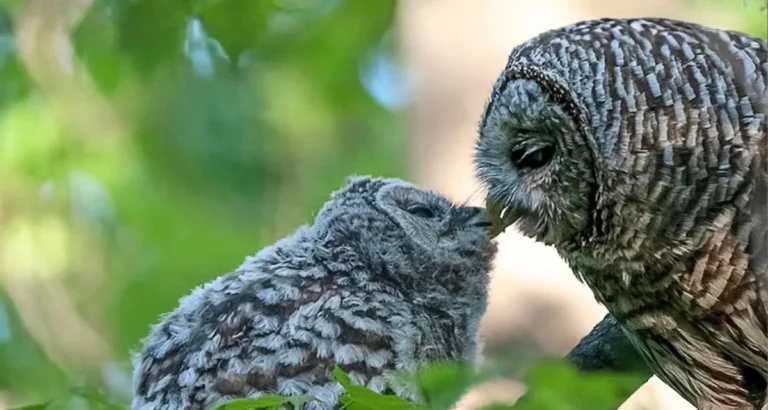
The Federal Government’s Plan to Kill Barred Owls Is a Scam
The U.S. Fish and Wildlife Service has hatched one plan to directly kill barred owls and a second to destroy the habitats of spotted owls.
- By Wayne Pacelle and Scott Edwards
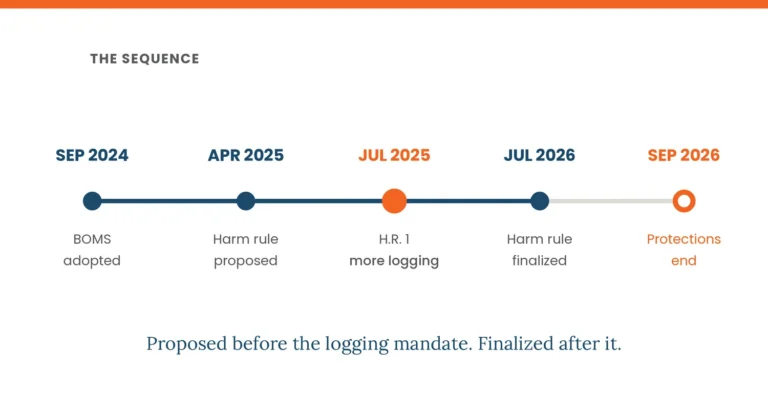
The July 2026 plan from the U.S. Fish and Wildlife Service to weaken the Endangered Species Act tells us everything we need to know about its September 2024 plan to kill barred owls.
The earlier plan — to hatch a scheme to shoot 450,000 North American barred owls over 30 years, at a potential cost of $1.35 billion — was designed “to reduce barred owl populations to improve the survival and recovery of northern spotted owls,” according to the agency’s “Barred Owl Management Strategy.”
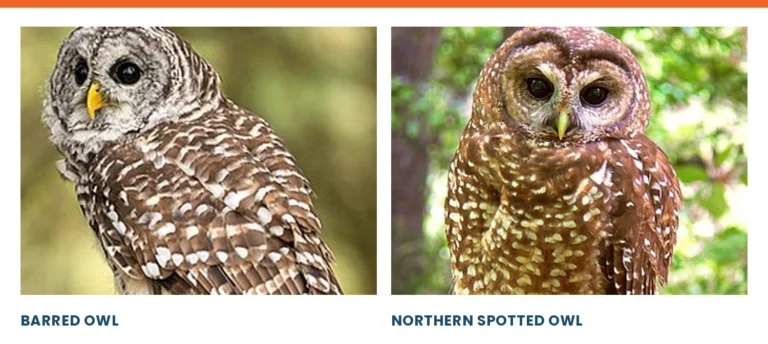
But if protecting threatened spotted owls is its purpose, why would the same agency, in a separate rulemaking action, take away vital habitat-protection safeguards in the Endangered Species Act?
That latter rule is called the “Rescinding the Definition of ‘Harm’ Under the Endangered Species Act” (July 2026).
The two plans by the agency tell us all we need to know: the original barred owl kill plan is a con job. It’s a plan to target the old-growth trees that the forest owls need to survive.
If the two plans are not derailed, the body count of barred owls and spotted owls will be staggering. And the harvest of Douglas firs and other giant trees in the Pacific Coast states will occur at levels not seen in four decades.
Law Built to ‘Save All the Parts’
The northern spotted owl is at the center of this story. It’s a threatened subspecies of forest owl, occupying the cathedral-like forests of California, Oregon, and Washington. Its population plummeted over the last century because logging companies in the 19th and 20th centuries cut down the trees where the owls lived as sentinels of the forests.
In response to their decline, and to the collapse of populations of dozens of other species, Republican President Richard Nixon and a Democratic Congress teamed up to enact the landmark Endangered Species Act of 1973, shielding animals from a range of human threats. The law halted direct shooting, trapping, and poisoning of scarce species. Just as importantly, it protected the forests, prairies, and ocean ecosystems that the animals need to survive.
It was a legislative act of mercy and a check on unrestrained destruction of nature. The naturalist Aldo Leopold, decades before the law was conceived, foretold its premise by noting that the “first rule of intelligent tinkering is to save all the parts.”
USFWS Turns from Protector to Persecutor of Wildlife
In June, we were in federal court, challenging the startlingly deficient USFWS BOMS plan that turned the ESA from a shield into a sword. The stated premise of the BOMS is that spotted owls cannot compete with the more adaptive barred owl; therefore, a mass killing of barred owls needs to be carried out so that the spotted owl can survive.
“Although it calls itself a ‘strategy,’ in reality, the Program is a shot in the dark, with potential adverse impacts on spotted owls and other species that the USFWS fails to meaningfully evaluate,” wrote our attorneys in a pleading to a U.S. District Court Judge in Portland. “Instead of describing a scientifically grounded conservation intervention with specific actions, measurable outcomes, and a clear pathway for success, the Program opens the door for the haphazard killing of barred owls, in unpredictable but potentially immense numbers, at unspecified locations within a vast range, at an unknown pace and frequency, for an indeterminate period lasting up to 30 years.”
It is an unprecedented avian predator-control scheme. Shooting barred owls was to happen across 24 million acres across three West Coast states and include shooting in 17 national forests and 14 National Park Service units, including in Yosemite National Park, Crater Lake National Park, and Olympic National Park.
The BOMS plan is both spare on details and chock full of defects, including a shooting area that is too vast to be practical. Keeping spotted owls and barred owls away from each other is like spitting into the ocean to change the tides. Shooting barred owls here and there will have only the most fleeting effect, with surrounding barred owls replacing them and filling the void, putting the United States on a killing treadmill it can never dismount.
The regulatory changes unleashing the shooters were coordinated with a public relations plan executed by the USFWS and the timber industry to smear the reputation of barred owls — falsely labeling the North American owls as “invasive,” even though the birds live only in North America and have long been protected by the Migratory Bird Treaty Act of 1918. The barred owls have engaged in a modest range expansion over the last 150 years, along with hundreds of other bird species adapting to human impacts on forests, grasslands, and the atmosphere.
But there’s more to this whole plan than just shooting owls; at its core, it’s really a textbook example of industry capture of government agencies.
Kill the Owls, Log the Forest
The barred owl plan does more than authorize shooting owls. It also creates a regulatory opening: once the USFWS allows timber companies and others to kill barred owls, it triggers the issuance of incidental take permits to timber companies for displacing, harming, and killing spotted owls. Kill the barred owls, count it as an offset, log the forest.
This is why we argued in court that the plan was presented as a plan to help spotted owls, but was really about using barred owl killing as a tool to cut down forests.
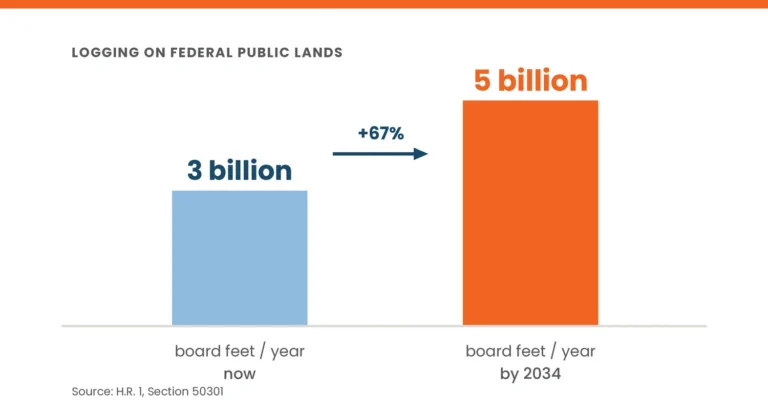
The BOMS logging-for-killing scheme became even more relevant with the passage of H.R. 1 in 2025, the so-called One Big Beautiful Bill Act that Congress enacted less than a year ago. Section 50301 of that federal law directs an increase in logging on our federal public lands by more than 60% — from an annual cut of 3 billion board feet to 5 billion board feet by 2034.
Fast forward to July 2026, and the USFWS plan to remove habitat destruction from the definition of harm under the ESA. The agency now has two regulatory tools in motion that allow them to take a swing at old-growth forests. That was the design all along, and the barred owl plan was just the first regulatory tool to unlock cutting down the trees that the owls depend upon. We break down how these two plans work together on the latest episode of our podcast.
Turning the ESA Inside Out, Upside Down
The barred owl kill plan, seen through a different prism, amounts to an alarming example of government overreach — a scheme to manage social relations between species in nature. But competition between species is at the heart of ecological systems. Our playing God by favoring one native species over another one amounts to a form of unnatural selection.
If barred owls and spotted owls breed together, consider it a pathway chosen by spotted owls to preserve their kind in slightly modified form. Interbreeding between very similar species is part of the very explanation for the diversity of species we see in the world. It’s at the heart of animal behavior and natural selection.
Nixing the BOMS will stop the shooting of barred owls and prevent the corresponding assault on threatened spotted owls and their habitats, too. But it won’t be enough. The “harm” rescission takes effect in September, and when it does, the habitats protections that have anchored the Endangered Species Act for 50 years simply stop existing.
The outcome isn’t settled yet. We are in court right now over the barred owl plan, and we are renewing our efforts in Congress, and in the upcoming elections, to stay the plans that would slay the owls. Stopping the shooting is the first fight only. Keeping the government’s hands off one of the most important animal protection laws ever enacted is the second one.
We cannot win this fight, with its complexities and challenges, without your financial support and your personal engagement. Stand with us in this fight.
Wayne Pacelle, president of Animal Wellness Action and the Center for a Humane Economy, is the author of two New York Times bestselling books, “The Bond” and “The Humane Economy.” Scott Edwards, general counsel for Animal Wellness Action and the Center, has been deeply involved in educational, environmental, and animal advocacy for more than 30 years.