Senate Agriculture Committee Moves Ahead with Partisan Farm Bill, Omitting SOB Act but Excluding Protections for Animals
Senate version does not preempt state farm animal welfare laws, but does subsidize mink farming by repealing a 30-year-old pro-taxpayer, pro-animal law.
- Wayne Pacelle
Wayne Pacelle, president of Animal Wellness Action and the Center for a Humane Economy, is the author of two New York Times bestselling books, “The Bond” and “The Humane Economy.”
I am going to give you the good news first.
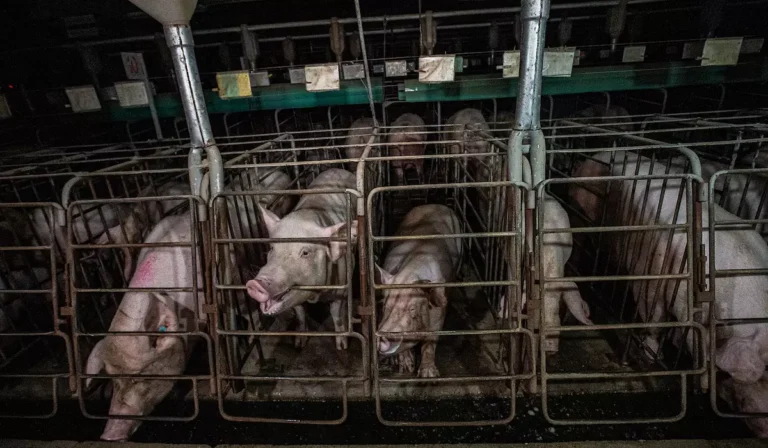
After a failed attempt in early August, the Senate Agriculture Committee this week advanced Chairman John Boozman’s Farm Bill 2.0, the Agricultural Act of 2026. That bill omits the Save Our Bacon (SOB) Act or any scaled-down version of it. The SOB Act was written to federally preempt state farm animal welfare laws, including California’s Prop 12, addressing extreme confinement of farm animals, with the focus on breeding sows locked in immobilizing gestation crates.
The bad news, as a refresher, is that the House Farm bill passed in April does include the SOB Act. If the full Senate passes its version of the Farm bill in the weeks ahead, then the two chambers will have to pass a single measure negotiated between them.
Here’s why this matters: Smithfield Foods, owned by Chinese interests following the acquisition of America’s largest pork producer 13 years ago, already controls 25% of U.S. pig production, and the SOB Act is a bold legislative maneuver by that company and its surrogates to gain a larger share of control of American land and animals used in food production.
China has already pioneered massive, multistory pig-production facilities, including high-rise operations that house hundreds of thousands of animals in vertically integrated, extreme-confinement production systems.
GOP lawmakers pushing the SOB Act are bucking the tide of American public opinion that has moved solidly against extreme confinement of animals and the jaw-dropping extent of foreign control over the U.S. pig industry.
In January, Ohio joined the growing list of states that have restricted the practice, bringing the total to 11 states with anti-gestation-crate policies. And more than 60 major food retailers, restaurant chains, and food-service companies — including McDonald’s, Costco, and Safeway — have announced policies moving away from pork sourced from gestation-crate systems.
China’s Smithfield Foods, the National Pork Producers Council (where Smithfield holds two board seats), and its surrogates have lost every statewide ballot measure proposing a ban on gestation-crate confinement. And they’ve lost 24 of 24 federal court cases challenging state farm animal protection laws, including a direct challenge to Prop 12 in NPPC v. Ross before a conservative U.S. Supreme Court. And they previously failed to federally preempt state animal welfare standards in both the 2014 and 2018 Farm bills.
Erasing the votes of more than 10 million Americans who approved these laws after vigorous public debate is no small matter. That’s why House Agriculture Chairman Glenn Thompson, R-Pa., worked so hard to deny Republicans and Democrats a chance on the House floor to offer their amendment to strike the SOB provision. He knew that if the amendment to strike the SOB had been brought up for consideration, it would have passed with a two-to-one majority.
A Multimillion-Dollar Taxpayer Subsidy for Mink Industry Tucked in Farm Bill
Aside from the omission of the SOB Act, there’s nothing good about the Senate Farm bill.
In a slap to the animal welfare community, the Farm bill has a provision to repeal a longstanding prohibition on using federal funds to provide market-promotion assistance to the mink industry.
Mind you, there’s no stand-alone bill in either congressional chamber to repeal the 30-year-old law forbidding mink subsidies, and no evidence of bipartisan support, but Sen. Boozman and House Agriculture Chairman Glenn Thompson inserted it in their Farm bill offerings, apparently at the urging of some yet-to-be-named lawmaker. There were no hearings, no discussion, no explanation of the rationale for spending millions of your tax dollars on such a lavish gambit to promote a luxury for which U.S. and global consumer demand has sharply declined.
A segment of China’s elites buy up American mink pelts. And it’s a good deal for the Chinese Communist Party to allow them to buy American mink pelts but to outsource the threat of viral spread from mink factory farms to our homeland. Remember, it was China where the SARS-CoV-2 virus originated, and it’s a safer play for the country to hedge its bets and transfer animal-disease risk to the United States. Mink farms are widely known as superspreaders of avian influenza, SARS-CoV-2, and other zoonotic diseases.
Even with China providing such an important export market — which the Farm bill provision seeks to grow — the U.S. mink industry is on life support. In 1969, the industry produced 5.46 million pelts, and in 2024, it had dropped to 771,200. Its gross revenues were $28 million, with expenses almost certainly exceeding revenues, and an annual rate of mink-farm failures standing at about 15% of operations per year.
What is Congress doing by propping up a failing industry headed for extinction, at a time when the nation has a $40 trillion debt? Reckless and misguided spending decisions like this one provide the explanation for the embarrassing American balance sheet.
Farm Bill Leaders Dismiss Substantive, Popular Animal Welfare Reforms
Each of the four prior Farm bills previously enshrined in law in the 21st century has included animal welfare provisions. But so far, not this one.
In the Senate Farm bill, there are three important policies missing from the committee-passed Senate version:
- The FIGHT Act, led by Sens. John Kennedy and Cory Booker, to strengthen federal enforcement against dogfighting and cockfighting.
- The SAFE Act, led by the late Sen. Lindsey Graham, R-S.C., and Sen. Ben Ray Luján, D-N.M., to prohibit the slaughter of American horses for human consumption and their export for that purpose.
- The Greyhound Protection Act, to close out the last two tracks that operate in the United States, after the closure of more than 50 tracks in the last quarter century.
Dogfighting and cockfighting, horse slaughter, and greyhound racing are all widely prohibited practices in the United States. The three legislative measures described above would close out these deeply unpopular, generally illicit activities.
With the slaughter of American horses for human consumption already banned in the United States, the SAFE Act simply seeks to stop exports of live horses to slaughter to Canada or Mexico.
Greyhound racing is outlawed in 44 states and not staged in the other five states or any of the five U.S. territories. The Greyhound Protection Act — driven by an understanding of the massive number of on-track injuries of the dogs — seeks to phase it out in West Virginia, the holdout state for greyhound racers.
Dogfighting and cockfighting are classified as felonies under federal law and are also outlawed by every state. But federal enforcement has been lacking, and in some settings, nonexistent. The FIGHT Act would amp up enforcement tools so the practices can finally be wiped away in America. American law enforcement — led by the National Sheriffs’ Association, the National District Attorneys Association, and the Major County Sheriffs of America — stands with us in backing this carefully drafted, high-impact legislation.
The Bottom Line on the Farm Bill
For the millions of Americans who care about the humane treatment of animals — whether on factory farms, in fighting pits, in cages at kennels at greyhound races, or in horse trailers bound for foreign slaughter plants — the provisions of the Farm bill matter.
To see China’s fingerprints all over the House Farm bill especially is a deeply distressing example of the pay-to-play reality of American politics and the unyielding foreign influence within the American legislative and political process.
The Farm bill process is not done, and there’s still time for repairs, but it shouldn’t be this hard to balance the promotion of American agriculture with a healthy respect for American values, including bedrock concerns related to animal welfare, democratic decision-making, and respect for states’ rights.
Help us defeat the SOB Act and protect state animal welfare laws!
Dear reader: If you support substantive policy work to protect animals, please consider donating to Animal Wellness Action here. You can give any amount one time, or make it a monthly gift, as many of our supporters do. Thank you for helping us fight for all animals.