
Los Angeles mobile billboards applaud Korean Air’s policy change and spotlight need also to close Vietnam route for cockfighting traffickers
LOS ANGELES — Animal Wellness Action and the Center for a Humane Economy today urged Korean Air to close remaining routes used to transport American fighting birds to Asia from flights originating in the United States after the groups’ investigators documented cockfighting traffickers routing birds through Vietnam to circumvent the airline’s restrictions forbidding rooster shipments to the Philippines.
In April 2026, Korean Air told Agence France-Presse that it had suspended the transportation of roosters of all ages on routes from the United States to the Philippines. The decision followed investigations by Animal Wellness Action, the Center for a Humane Economy and The Dallas Morning News that documented a trafficking pipeline moving U.S.-raised fighting birds to the Philippines.
But investigators have since documented aggressive workaround maneuvers by U.S.-based smugglers of fighting animals. On July 2, they reported that fighting birds were traveling on Korean Air flights from the United States to Vietnam before being transferred to another carrier for the final leg to Manila. The organizations are asking Korean Air to close the remaining route and make its prohibition on transporting fighting roosters clear in its published policies.
“Korean Air did the right thing once, and we said so publicly at the time,” said Wayne Pacelle, president of Animal Wellness Action and the Center for a Humane Economy. “We are asking Korean Air to finish the good work it started by making it plain to animal traffickers that they cannot use Korean Air for transports of fighting animals. U.S. law is unambiguous: no smuggling of fighting animals in interstate or foreign commerce.”
As many as 40,000 fighting birds are shipped from the United States to the Philippines each year, according to estimates cited by the organizations. The trade is estimated to generate $80 million annually for U.S. breeders. Individual fighting cocks can sell for as much as $2,000.
The organizations’ investigation found that U.S. breeders and brokers have supplied birds for the international cockfighting trade, with Korean Air previously serving as a major transportation link between the United States and the Philippines. Investigators have also documented commercial shipping arrangements used to move birds ultimately destined for cockfighting.
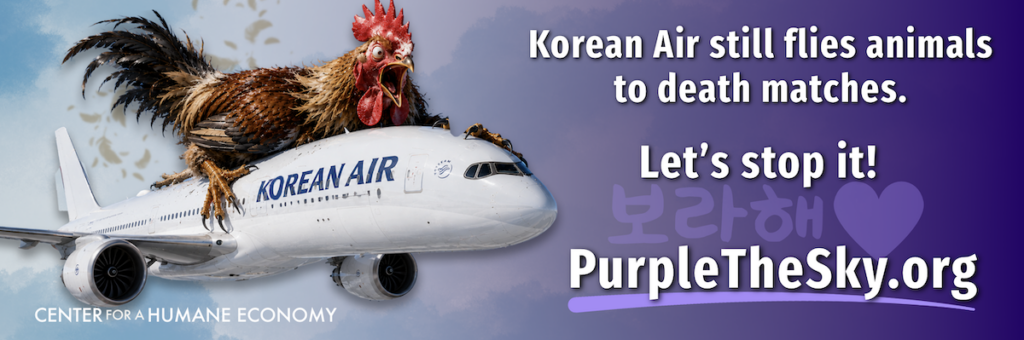
The organizations have launched the Purple the Sky campaign, inviting members of the K-pop community, many of whom travel on Korean Air, to add their names to the request. The campaign uses purple, a color strongly associated with K-pop fandom, as a visual symbol of support for the birds and opposition to cockfighting.
“This is an invitation, not a boycott, and it will stay one,” Pacelle said. “These are Korean Air’s own customers, and they’re simply asking the airline to finish what it started.”
The campaign includes mobile billboards in Los Angeles thanking Korean Air for its April decision and urging the airline to close the remaining routes used by cockfighting traffickers.
The groups are also urging Congress to advance legislation aimed at cutting off commercial air transportation of fighting animals, including the No Flight, No Fight Act, H.R. 7371, introduced by Rep. Troy Nehls, R-Texas. That legislation has 16 Republican and 15 Democrat cosponsors, many of them on the Transportation & Infrastructure Committee.
Learn more and join the campaign at PurpleTheSky.org.