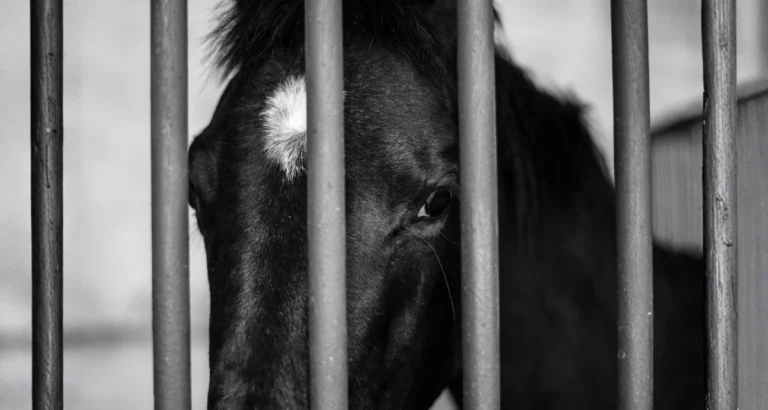
Canadian Slaughter Plant That Butchered U.S. Horses Shuts Down
With just one slaughter plant remaining in Canada, and none in the U.S., we must mount a discharge petition to shut down live horse exports to Mexico for slaughter
- Wayne Pacelle
Bouvry Exports — the Alberta-based horse slaughter operation long fed a supply of kidnapped American horses to be butchered, with the cuts of meat then exported from Canada to Japan — has been shuttered. That leaves just one remaining horse slaughter plant in Canada: Viande Richelieu in Quebec.
This is one more poleaxe blow to the rickety and disreputable trade in equines killed for a small handful of diners in Japan. The horse meat trade has just one-tenth the volume it did 40 years ago, yet the trafficking of horses from the United States to Canada and Mexico persists.
But one horse butchered for this obscure meat trade is too many, and it’s time we closed the book on U.S. involvement in it. Testifying about the Vietnam War in 1971, future U.S. senator John Kerry asked a congressional committee, “how do you ask a man to be the last man to die for a mistake?” In the same spirit, we might ask how we can justify the slaughter of one more beautiful equine to serve a dying industry.
For years, Animal Wellness Action, working alongside Animals’ Angels and other allies, has investigated and exposed the realities of the horse slaughter pipeline.
These are not animals raised for food production. They were born into the world for horse show competition, horse racing, law enforcement, and other non-lethal pursuits, yet they are discarded by their owners or kidnapped by “kill buyers” and jammed into open-cab trucks for a dangerous and harrowing passage that may exceed 40 hours without sustenance or offloading.
This is a betrayal of our bond with horses, burros, and other equines. Horses helped settle the continent, powered agriculture and transportation, carried soldiers into battle, and today continue to serve in sport, ranching, recreation, therapy, and law enforcement. They are not throwaway items. They deserve better than to be funneled into the horse slaughter pipeline.
Because more people all over the world understand these arguments, the trends are moving in our direction. The number of American horses sent to slaughter has fallen from nearly 400,000 annually in 1990 to roughly 25,000 today.
And the sky-is-falling claptrap from the horse-slaughter crowd that justifies this predatory business — “if we don’t slaughter horses, people will abandon them” — has proved meritless. With the horse slaughter trade down 90 percent, there’s been no uptick in abandonment or cruelty cases.
Despite this fact pattern, and the features of this ruthless trade, U.S. House Agriculture Committee Chairman Glenn Thompson, R-Penn., recently blocked efforts led by Reps. Vern Buchanan, R-Fla., Jan Schakowsky, D-Ill., and more than 225 other members of Congress to include a provision in the Farm Bill that would permanently prohibit the slaughter of American horses and their export for slaughter abroad.
We are calling on the Senate to include the SAFE Act, S. 775, led by Sens. Lindsey Graham, R-S.C., and Ben Ray Luján, D-N.M., in its version of the Farm Bill. And it’s time to send a signal to Chairman Thompson that he cannot singlehandedly control the national debate over animal welfare and thwart a House supermajority to stop various forms of animal cruelty. We are calling on the House of Representatives to approve a discharge petition to bring the SAFE Act to the floor for a vote.
I am confident that nearly all Democrats will sign it, and it’s my hope that plenty of Republicans will join this humane effort demanded by the American public.
Closing Down Cruel and Archaic Industries
The fight to wipe out horse slaughter in North America is part of a broader strategy to dismantle various forms of animal exploitation that provide no meaningful social benefits or economic value to our nation. Cockfighting and greyhound racing fall into the same bucket as horse slaughter as enterprises that do no good for society.
During consideration of the Farm Bill earlier this year, Chairman Thompson not only denied the House a fair vote on the SAFE Act, he also blocked consideration of the FIGHT Act — bipartisan legislation supported by nearly 500 American law enforcement groups to stamp out dogfighting and cockfighting tied to organized crime and other forms of violence.
We’d have won a vote on the anti-animal fighting amendment led by Rep. Troy Nehls, R-Texas, in a landslide. And as with horse slaughter and the shuttering of Bouvry, we saw a private industry action that highlights our progress and signals to congressional leaders that they must get on the right side of history on this issue.
Korean Air adopted a new policy to stop shipping fighting birds from the United States to the Philippines, one of the world’s largest cockfighting hubs. For years, traffickers exploited commercial airline cargo systems under the guise of shipments of “breeding birds” while fueling a barbaric international bloodsport tied to gambling, narcotics trafficking, and violence.
This corporate reform effort from Korean Air closes off the biggest artery in the global trade of cockfighting birds.
There is also corporate progress on our quest to end greyhound racing — which is barely hanging on at all in the United States — with 58 of 60 U.S. racing tracks shuttered in the last 40 years or so.
Delaware North — the Buffalo-based food service, hospitality, and gaming company that owns the last two operational greyhound tracks in the United States — is quietly working in favor of the Greyhound Protection Act. The company itself has acknowledged that commercial dog racing is no longer a viable business model. But under West Virginia law, the state still requires continued greyhound racing operations as a condition for maintaining casino licenses tied to the facilities.
In other words, the races continue not because of public demand, but because of outdated state government mandates propping up a declining industry built on the exploitation of dogs.
Whether confronting horse slaughter, cockfighting, or greyhound racing, our approach is the same: investigations, legislation, corporate engagement, coalition-building, litigation strategies, media exposure, and grassroots activism aimed at closing down obsolete industries rooted in systematic cruelty.
The closure of Bouvry, the new policy by Korean Air to stop shipping roosters to the Philippines, and the movement against greyhound racing by Delaware North are harbingers of what’s ahead. The resistance of backward-looking politicians will crumble as the American public loudly rejects these cruel enterprises that offer no redeeming social or economic value to our communities.
We will continue to hammer away until we succeed.
Wayne Pacelle, president of Animal Wellness Action & the Center for a Humane Economy, is the author of two New York Times bestselling books, “The Bond” and “The Humane Economy.”
Dear reader: If you support substantive policy work to protect animals, please consider donating to Animal Wellness Action here. You can give any amount one time, or make it a monthly gift, as many of our supporters do. Thank you for helping us fight for all animals.