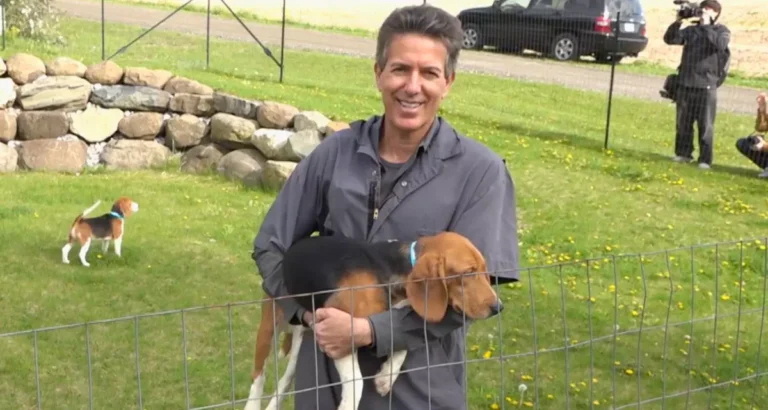
We are rescuing dogs from Ridglan Farms because the FDA Modernization Act 2.0 enabled it
The machinery of the animal testing complex is breaking down. Animal testing is unreliable and inferior to 21st-century drug-screening strategies
- Wayne Pacelle
I’ve done a lot of things during a long run in animal advocacy.
As a young man, I ran out onto a field to free pigeons about to be shot at the Hegins pigeon shoot. Later, I went up to the ice in Atlantic Canada to fight the clubbing of harp and hooded seals and saw firsthand the horror of men killing these babies in a frigid, open-air nursery.
I helped lead a chaotic rescue of 10,000 animals from New Orleans and other surrounding areas after Katrina walloped the coast. I went to Nuremberg and spoke before Adidas executives and its board of directors, and made my case to stop sourcing kangaroo skins for shoes, pleading with them to use alternative fabrics and to spare the joeys and the adults.
I sat with Michael Vick for a 60 Minutes interview after he got out of prison for his dogfighting horrors, engaging and spending time with a guy who did things so foreign to my instincts and so shockingly at odds with my values.
I talked with Oprah multiple times about animal issues on her shows, including in the run-up to the win on Prop 2 in California to stop extreme confinement of animals on factory farms.
With all of that, and so much more in my rearview mirror, there was something that will stick with me about my stepping onto the grounds of Ridglan Farms last Friday.
I’ve known a lot of dogs, and I see the good in all the breeds fanciers have formed, even though I am biased toward the blended ones.
My wife and I adopted a fragile little beagle mix some years ago, and we always wondered about her backstory and desperately wanted to unpack it. Despite whatever abuse and travails she had endured, she was the most unfailingly gentle dog I’d known. It wasn’t that she was exceedingly compassionate — and I have known dogs who showed that attribute in spades — it was just that she was so unassuming, compliant, and modest in all she did.
Walking into the first of the buildings at Ridglan, we rescuers couldn’t hear ourselves think with 100 beagles barking out of rhythm and at the top of their lungs upon seeing us. The concrete walls and metal roof amplified it all, producing a sort of beagle chaos.
The dogs were jumping and positioned at the sides of the cages closest to us. But when we opened the cages, they moved back in the opposite direction. Scared. Uncertain. Worried. And who knows what else was rushing inside their beagle brains. Their body movements, including the absence of movement, told their confusing story.
But when I put my hands on them, in a way that was firm and gentle, they submitted. No aggression. A surrender of sorts.
That reaction is noteworthy to me. The reason I’ve done all this work for animals is because I fight. I hate that some people hurt animals, and I have lived my life to do something about it. So, I fight. Not with firsts, but with advocacy for them.
These dogs didn’t have much fight in them, perhaps because they know the odds are stacked against them. They were going to behave just one way, whether the man or woman on the outside of the cage was a savior or an executioner.
The folks in the laboratory animal world take advantage of the good nature of beagles. They get to do whatever they want to the dogs, and they know that there’s no immediate consequence. Not a scratch from a paw or a bite. Not even a snarl.
We must be the ones who snarl. We must fight for them.
And not just for the beagles at Ridglan. For the ones at Amgen. At Marshall BioResources.
And frankly, for all the other animals conscripted into laboratories for archaic tests.
Listen, the science of those involved in animal testing is not all a fraud. They can put animals through torments, large or small, and they can learn something. If you put enough quarters into a slot machine, you’ll get a return. Though not a very good one.
But honestly, we’ve been hurting animals for a century in what we might refer to as the common era of science. In fact, the Federal Food, Drug, and Cosmetic Act mandated animal testing for all new drug protocols starting in the 1930s.
And that law stood until we passed the FDA Modernization Act 2.0 in 2022 — also a very proud moment for me and my colleagues, other partners like Laurie McGrath and Gary Michelson, and the other groups, like PETA, who worked on it with us.
It’s so clear to me that using animals in testing is looking increasingly obsolete. And that’s validated by data that reveals it just doesn’t work reliably. Drugs tested on animals have a 90% failure rate when they move to the clinical trial stage with humans.
It shouldn’t surprise us that changes in technology drive changes in the way businesses behave. Look at the revolution in telecommunications — from the telegraph key to the crank phone to the rotary phone to the iPhone. Look at automobiles — from the Model T to the Dodge Dart to the Tesla. Look at the planes flown in World War I or World War II, and look at the fighter jets of today.
Please, let’s move on from this madness of tormenting animals in laboratories and embrace the genius of human innovation and ingenuity. The tools are here, and they’ll keep getting better. Organ chips. AI. And more. Pick them up. Turn them on. Use them.
The beagles can teach us many things. But not in the way that the people in the laboratory animal world think.
They are especially good teachers when it comes to gentleness and modesty.
With the inspiration of their good nature, we have one task. Let’s get those dogs.
Help us today with our ongoing work to rescue and rehome the Ridglan beagles!
Wayne Pacelle, president of Animal Wellness Action & the Center for a Humane Economy, is the author of two New York Times bestselling books, “The Bond” and “The Humane Economy.”