Cockfighting’s Trafficking Pipeline is Hiding in Plain Sight
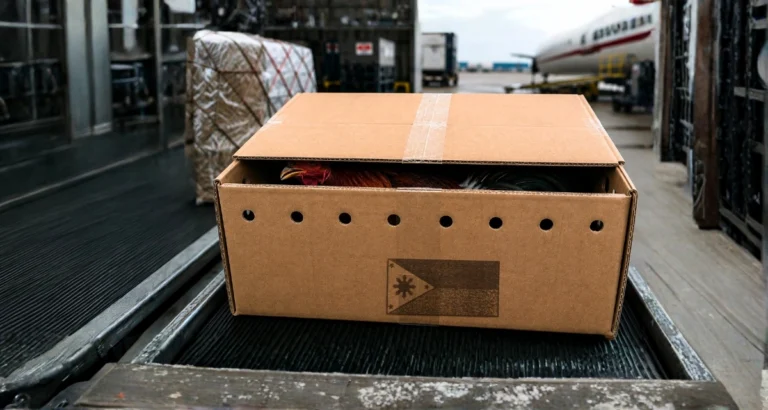
Fighting-bird traffickers count on carriers to move roosters to fighting pits at home and abroad. We have a plan to shut it all down.
- Wayne Pacelle
Staged animal fighting is a crime in all 50 states. Federal law bans cockfighting on every inch of U.S. soil, including Puerto Rico, Guam, and the other U.S. territories.
Yet our investigations have documented that cockfighters illegally rear and train millions of fighting birds on gamecock farms across the nation. They stage life-and-death battles in clandestine pits in the U.S., and they sell fighting birds to other cockfighters in the United States and in other nations, where the birds meet the same grim fate.
Cockfighters who are in the business of animals fighting advertise their fighting birds on Facebook, leaving more than a trail of popcorn for law enforcement to follow. Mind you, it’s a crime not only to stage fights but also to possess the animals with the intent to fight them or to sell them for cockfighting.
Breeders claim they raise thousands of birds only for show — the equivalent of a heroin producer claiming that his poppies are for a local flower show and a ribbon.
U.S. law enforcement should laugh at that kind of cosplay. It should exhibit zero tolerance for these gamecock farms, with their distinct breeds used for fighting and easily differentiated from chickens used in agricultural production.
A decade ago, a report from the U.S. Department of Agriculture estimated that there may be as many as 24 million fighting birds in the United States, with California topping the list with as many as 8 million birds.
Federal Enforcement against Cockfighting Has Failed
Cockfighting is a gambling crime, and a cockfighter can make money by gambling. But he can lose money, too.
The reliable way to make money — and it’s a vast source of profits — is to sell fighting birds.
Here’s how they do it: they win cockfighting derbies and then tout the fighting abilities of their birds. Other cockfighters want winning birds — “good cutters” in the parlance of cockfighting.
For the far-flung cockfighting community, with cockfighters all around the nation and the world connected by Facebook and other social media platforms and looking to purchase birds, there are two primary transportation services: 1) the U.S. Postal Service for domestic shipments, and 2) foreign-based airlines, including Korean Air and Qatar Airways, for transport of the birds to the Philippines, Mexico, Vietnam, India, Ecuador, Colombia, and other nations, mainly in Asia and Latin America.
Conservatively, there are more than a million birds trafficked every year. At $2,000 a bird — which is what a very good fighting cock commands — that’s $2 billion a year in commerce and contraband.
All illegal. As illicit as the drug trade. Or human trafficking.
These illicit dealings are always bound up with gambling crimes, money laundering, and tax evasion. And very often commingled with narcotics trafficking, illegal firearms, and human violence.
Buyers and sellers include individuals associated with criminal networks in Mexico and organized crime operations in the Philippines.
An Appalling Record of Inaction
With this contraband openly handed off to personnel at our post offices and loaded into the cargo holds of commercial flights at international airports in America, enforcement actions hardly have a high degree of difficulty. Our federal law enforcement agencies don’t need to have the deductive abilities of Sherlock Holmes, the tough-on-crime attitude of Dirty Harry, or the persistence of Columbo to take down these criminals.
But here’s the kicker: in 24 years, federal law enforcement — whether it’s the U.S. Postal Inspection Service, the FBI, the USDA Office of Inspector General, or others — has pushed ahead with ZERO cases involving postal transport of crowing fighting birds shipped in boxes or on airlines with crated birds from distinct breeds known as fighting birds.
That’s right. Not a single one.
From a management perspective, how do you describe that kind of performance? Do you call it “poor” or “weak” or “coming up short”?
No, you call it a “miserable failure” or, better yet, a “colossal abdication of responsibility to act on the will of Congress and the American people.”
We are talking about people committing felonies and crimes of violence. People involved in cluster crimes. Career scofflaws who are at the heart of organized crime networks.
Congress Can Shut Down the Cockfighting Pipeline
We’ve been investigating these criminals alongside our partners at Showing Animals Respect and Kindness (SHARK). We’re documenting their open-air gamecock farms as well as their fighting pits at home and abroad. We’ve tracked illegal shipments by USPS and by Korean Air, Qatar Airways, and Turkish Airlines. And we have videos of it all.
We are asking — no, we are demanding — that Congress address these crimes and the failure of our agencies to enforce the laws. And we are joined in that demand by the National Sheriffs’ Association, the National District Attorneys Association, and 40 state associations of sheriffs and district attorneys, among more than 1,000 other endorsing agencies and organizations.
The Fighting Inhumane Gambling and High-Risk Trafficking (FIGHT) Act, S. 1454 and H.R. 3946, re-engineers and reboots enforcement mechanisms in our national animal fighting law, including directing the USPS to simply stop accepting roosters at the front end. And the No Flight, No Fight Act, H.R. 7371, signals the same thing to the airlines: don’t accept any roosters in the cargo hold.
This is all a thinly veiled masquerade. No farmer is shipping a rooster through the USPS for $200 a bird for anything but fighting. Nor would they ship a bird on Korean Air to Vietnam for $200. The economics make no sense. The only birds with value that exceeds that shipping cost are fighting birds. Period. End of story.
We got Korean Air to stop shipping birds to the Philippines. And that’s progress. But it’s just as illegal for Korean Air to ship the birds to Vietnam or Indonesia knowing that they are being used in fighting ventures. The company needs a consistent policy. And it is duty-bound to obey U.S. law. Foreign companies must respect our laws, too.
And the USPS leadership needs to wake up. Cockfighting is a crime involving live animals destined to die in fighting pits. Heed the law. Stop this nonsense.
With your help, we can shut all of this illicit commerce down. Without the revenues generated with the help of the USPS and airline shipments, the cockfighting clan will be starved of profits. And it will wither.
Please take note of our strategy to win this fight. And please join us. Please help financially and support the campaign by reaching your federal lawmakers in support of FIGHT and No Flight, No Fight.
Tell Congress to shut down the cockfighting trafficking pipeline!
Wayne Pacelle, president of Animal Wellness Action and the Center for a Humane Economy, is the author of two New York Times bestselling books, “The Bond” and “The Humane Economy.”
Dear reader: If you support substantive policy work to protect animals, please consider donating to Animal Wellness Action here. You can give any amount one time, or make it a monthly gift, as many of our supporters do. Thank you for helping us fight for all animals.