Don’t Blame Animals for Adapting to Changes Wrought by an Immense Human Footprint
How human-driven changes to climate and habitat are pushing wildlife into new territory. Animals shouldn’t pay the price for adapting.
- Wayne Pacelle
The beavers have arrived.
In northern Quebec.
That’s where the Inuit, in the village of Umiujaq on the eastern shore of Hudson Bay, say the flat-tailed rodents are newcomers. Now the industrious animals, with their gnawing abilities, are building dams, creating ponds, and transforming the valleys around the village.
The starting gun for their race northward was climate change. In the Arctic and subarctic regions of Canada and Alaska, the winters are shorter, snow melts earlier, and shrubs are spreading into places that were once too cold and barren for them.
Like most other mammals, beavers have wanderlust. They colonize habitats, especially when humans shuffle the ecological deck. It’s called range expansion, and it’s as fundamental a behavior for animals as reproduction or food gathering.
Take a look at butterflies in the Northeast United States. In Massachusetts, researchers studying nearly two decades of observations found warm-adapted species increasing near their northern range limits while many cold-adapted species declined near their southern limits — a biological fingerprint of a warming climate.
It is a redistribution of life. Driven by us.
Across the world, species are moving because of temperature rise; surging or declining precipitation; fires, and floods, and drought; and forest and grassland alterations. A 2026 analysis of 1,758 butterfly species found that 80% had experienced range expansion, with climate change and extreme weather associated with most of the documented range shifts.
Former U.S. Fish and Wildlife Service scientist Kent Livezey reported in a scholarly article that 111 North American bird species had recently expanded their breeding ranges into areas where they had not previously bred.
We are scrambling ecosystems. Animals, in turn, are adapting. They are shifting their settlements.
Timber Barons Plan to Fell Forest Owls
In July, the Fish and Wildlife Service finalized a rule rescinding the regulatory definition of “harm” under the Endangered Species Act. For decades, that definition has included certain habitat modification or degradation when it results in injury or death to protected wildlife by significantly impairing essential behaviors such as breeding, feeding, or sheltering. The new rule removes that regulatory definition.
There are many observers who believe that this policy was implemented to take aim, more than at any other species, at the Northern spotted owl. The threatened owls occupy old-growth forests, and environmental groups sued the government for decades to stop the cutting of those trees to save the spotted owls.
Eliminate the habitat protection standards in the ESA, and the bulldozers and the chainsaws can go to work.
That rewrite of the ESA regulations comes less than two years after the agency developed a plan to spend $1.35 billion to kill 450,000 North American barred owls. That plan was ostensibly designed “to reduce barred owl populations to improve the survival and recovery of northern spotted owls,” according to the agency’s Barred Owl Management Strategy.
But if protecting threatened spotted owls is its purpose, why would the same agency, in a separate rulemaking action, take away vital habitat-protection safeguards in the Endangered Species Act?
Putting the two plans under the microscope tells us all we need to know: the original barred owl kill plan is a con job. It’s a plan to target the old-growth trees that the forest owls need to survive.
The public justification is saving spotted owls.
But the larger policy direction points toward something else: making it easier to cut and alter the old-growth forests on which those owls depend.
The barred owl kill plan is a bait-and-switch, distracting the public from the forest harvesting that sent the spotted owls into a population spiral decades ago.
Blaming the Victim
How do we humans respond to adaptations by wildlife? By blaming the victim.
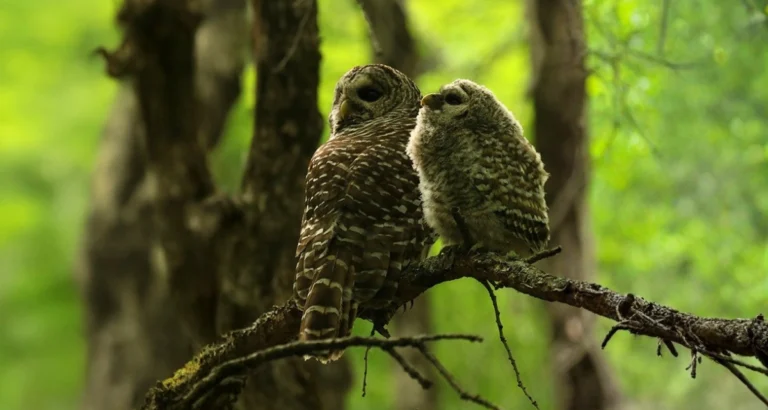
Barred owls are native to North America. For most of their history, they lived primarily in the eastern part of the continent, with some populating as far as the eastern Dakotas. During the past century, they moved even farther westward, eventually landing in the trees of the Pacific Northwest.
Why did they move?
Because they are forest owls. In some cases, we allowed reforestation to occur. And in other cases, we pushed them northward so they could access Canada’s boreal forests that stretch from New Brunswick to British Columbia.
The barred owls followed the trees.
The U.S. Fish and Wildlife Service has labeled North American barred owls “invasive” because they now live in West Coast forests. I cannot think of a more ecologically ignorant, dim-witted characterization.
That false branding creates the predicate for their mass slaughter.
We don’t regard competition between owls — there are 19 species of them in the United States — as a problem. That’s nature. We don’t target great horned owls because they occasionally kill spotted owls or barred owls. And when it comes to other raptors, we don’t target golden eagles because they overlap in habitat with bald eagles.
The remarkable thing about the barred owl campaign is that we have taken an ordinary ecological relationship and turned it into a case for extermination.
And the more closely we examine the story, the stranger it becomes.
The northern spotted owl was already in serious trouble before barred owls arrived. Its old-growth forest habitat had been devastated by logging. When the spotted owl was listed under the Endangered Species Act in 1990, the Fish and Wildlife Service estimated that its habitat had declined by 60 to 88% since the early 1800s.
We destroyed the forest. And the spotted owl suffered.
The barred owl found a way into the altered landscape.
And now we propose to kill the barred owl.
What would we expect the birds to do instead?
The same questions arise as we think about the mass of wildfires burning forests from northern Canada to New Mexico.
Across the West, enormous fires are transforming forests. Some are natural parts of forest ecology; others are intensified by a combination of climate change, drought, accumulated fuels and human alteration of fire regimes.
When a wildfire destroys an animal’s forest home, what exactly is our expectation?
That it stay behind and face the flames?
Animals do not have the luxury of philosophical arguments about historical range.
They have to survive. Move. Scrape out an existence. Follow the food, water, vegetation and shelter that remain.
Owl Sex as Adaptation
Scientists have genetically identified hybrids carrying genetic material from both barred and spotted owls. The government sees this mixing as another reason for concern, warning about the potential loss of the spotted owl’s genetic identity.
But there is another way to look at it.
What if hybridization is not contamination? What if it’s a survival strategy?
We tend to think of species as fixed entities, with bright genetic lines that nature itself has drawn and humans must defend. But evolution doesn’t work that way. Closely related animals have always exchanged genes, and hybridization can introduce genetic variation that helps populations respond to changing conditions.
We cannot know whether barred-spotted owl hybrids will ultimately thrive, struggle, or disappear. But why should our presumption be that the mixing itself is a catastrophe?
The spotted owl is a closely related owl whose habitat we have devastated. The two encounter one another, compete — and sometimes mate.
Perhaps that is not nature breaking down. Perhaps it’s nature at work.
That possibility should make us pause before we pay people to start slaughtering owls in America.
Animals are responding to crises of our making. Their responses have many forms, and we err in saying that they are the problem.
The beavers did not cause the Arctic to warm.
The butterflies did not change the climate.
The barred owls did not cut down the old-growth forests.
And when wildfire burns an animal’s forest home, the animal did not strike the match.
Animals do what they have always done: find a way to survive.
If we want to assign responsibility for the ecological conflicts of the Anthropocene, we should start by looking in the mirror.
Wayne Pacelle, president of Animal Wellness Action and the Center for a Humane Economy, is the author of two New York Times bestselling books, “The Bond” and “The Humane Economy.”
Dear reader: If you support substantive policy work to protect animals, please consider donating to Animal Wellness Action here. You can give any amount one time, or make it a monthly gift, as many of our supporters do. Thank you for helping us fight for all animals.