From Ridglan’s Beagles to New York’s Carriage Horses
We helped secure a humane future for Ridglan’s beagles. Now we’re prepared to help New York’s carriage horses find safe homes of their own.
- Wayne Pacelle
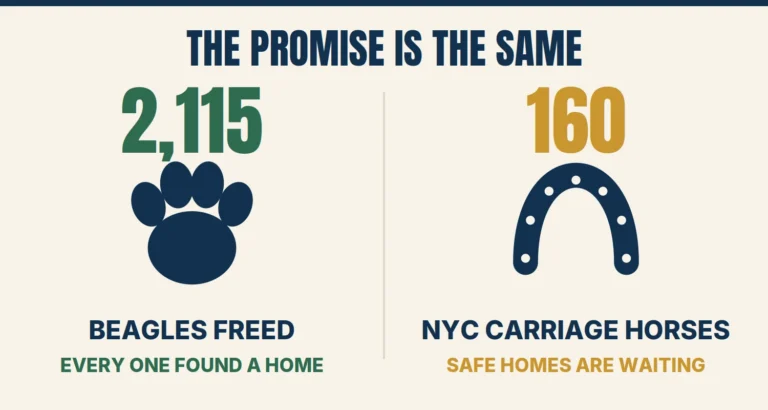
This week, the rescue of the beagles from Ridglan Farms reached its humane finale. A total of 2,115 dogs were pulled from their cages in windowless buildings. The Center for a Humane Economy led the negotiations to free them all and set them on a path for better lives.
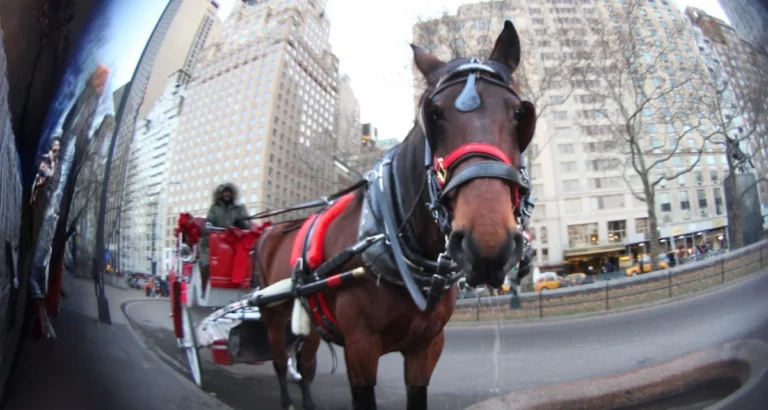
This week, we announced our plans for a new rescue — the 160 carriage horses conscripted into dangerous, forced labor in the heart of Manhattan.
Yesterday, I announced that if local lawmakers ban horse-drawn carriages in the heart of Manhattan, the Center will work with our partners on this campaign — NYCLASS, the Coalition for Responsible Carriage Horse Retirement, and others — to give a safe landing to every carriage horse.
“Opponents of the New York City Council bill to phase out horse-drawn carriage rides (Intro 943) have again trotted out a tired refrain in their persistent efforts to stymie reform: falsely asserting that the 160 horses at issue will be condemned to slaughterhouses unless the carriage wheels keep turning,” I wrote in yesterday’s New York Daily News.
“The carriage horse owners are presumably as unfamiliar with the wide network of horse sanctuaries and rescue options as they are with the extraordinary decline, and impending collapse, of the rickety horse slaughter industry in America,” I continued.
In 1990, 400,000 American horses were butchered in the United States, Canada, and Mexico for human consumption. That number is now down to 25,000 — an almost 95% reduction in the number of American horses facing the terror-stricken march up a plank into an abattoir.
I’ve been fighting to end horse slaughter for a quarter-century, and I’ve never seen us so close to success. This despicable trade is on the cusp of collapse. It’s time to finish it off.
Just six weeks ago, driven by concerns about the spread of New World screwworm, the U.S. Department of Agriculture suspended the export of American horses to Mexico for slaughter. Just prior to that announcement, one of Canada’s last two horse slaughter plants was shuttered. And there is major momentum in Congress to stop the export of American horses for slaughter abroad. We worked with 17 GOP lawmakers in Congress to ask President Trump to make permanent the restriction on exports of horses to Mexico for slaughter.
Ridglan Beagles, Central Park Horses
In April, the Center for a Humane Economy and a partner organization inked a deal with Ridglan Farms brass to start the process of moving out more than 2,000 beagles from the lab supplier — just one of two major such suppliers in the United States.
That 60-year-old business is now, for all practical purposes, closed.
Now it’s time to end the 150-year-old inhumane horse-carriage racket in New York.
Horses should not be conscripted into a working environment filled with the cacophony of construction sites and racing traffic, sirens blaring, and the honking of horns from taxis, buses, delivery trucks, and motorcycles. This chaos, movement, and sharp sounds startle horses, threatening the horses, pedestrians, and paying carriage-riders.
Case in point: in June, Romanch Mahajan, an Indian national celebrating his acceptance to college with a trip to New York, was killed after the horse pulling the carriage in which he was riding with three of his family members bolted through Central Park. As the carriage heaved left and right, the 18-year-old man tried to prevent his mother from being tossed to the ground, and in the process, he tumbled out at high speed and suffered a fatal head injury.
For decades, city officials have tightened regulations and promised stronger enforcement. Yet deaths, injuries, and close calls continue to mount.
Yet today, the New York City Council seems prepared to act to close out this archaic enterprise.
The network of hundreds of horse sanctuaries, rescue organizations, and caring horse lovers will welcome these beleaguered animals, just as so many shelters and rescue groups were eager to make room for 2,000 beagles from Ridglan Farms.
We will not allow the rehoming of 160 horses to become an obstacle to passing Intro 943. Transferring these horses to safe homes is a promise that the animal welfare community is fully prepared — and thrilled — to deliver on.
If these horses are released from their yokes and harnesses, they can spend the rest of their lives grazing on pasture instead of standing on asphalt, breathing fresh air instead of exhaust fumes, and enjoying the company of others of their kind, not working 10-hour days only to be stabled in a prison-like parking garage.
Help support the front-end policymaking and corporate reform campaigns that drive decisions to free the animals. And then help us on the back end as we work with partners to deliver animals in crisis into safe and secure settings.
We can only do this work with you at our side. Please give generously.
Wayne Pacelle, president of Animal Wellness Action and the Center for a Humane Economy, is the author of two New York Times bestselling books, “The Bond” and “The Humane Economy.”
Dear reader: If you support substantive policy work to protect animals, please consider donating to Animal Wellness Action here. You can give any amount one time, or make it a monthly gift, as many of our supporters do. Thank you for helping us fight for all animals.