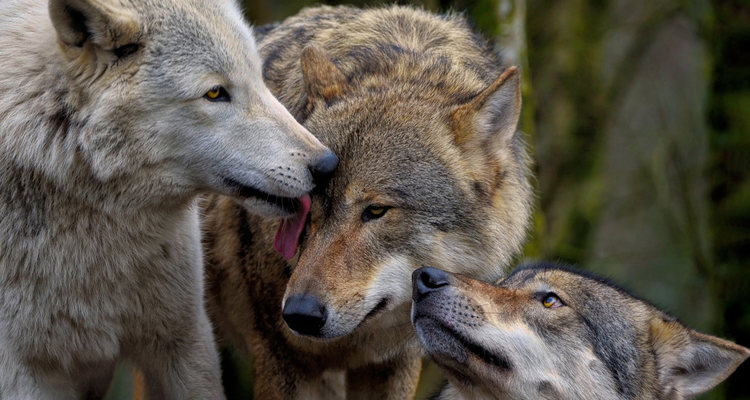
Midterm 2026 Elections Throw Lifeline to Gray Wolves
Tom Tiffany, Lauren Boebert, and Dan Sullivan — who led efforts to promote killing wolves — got the boot. Their anti-wolf work didn’t help them.
- Wayne Pacelle
While gray wolves face persecution in Alaska, Idaho, Montana, and Wyoming, the animals may rest easier in their dens in 20 other states after midterm elections unseated their most determined tormentors. Reps. Tom Tiffany, R-Wis., and Lauren Boebert, R-Colo., and U.S. Sen. Dan Sullivan, R-Alaska — who spread fear and phony narratives about wolves – came up short in their election efforts.
You can count the cases of recorded wolf attacks on people in North America on one hand. There are more dog attacks on people during the lunch hour of a single day than wolf attacks on people in the last hundred years. America’s largest wild canids don’t hunt bipeds. They give us a wide berth.
Irrational fear of wolves is also ahistorical as seen through an even longer lens. Wolves and humans started mingling more than 30,000 years ago, with that first flirtation eventually leading to domestication. The forebears of the dog set in motion a remarkable association that forever changed the fortunes of humanity.
Serious-minded wildlife scientists have shattered the canard that wolves harm prey populations. Wolves evolved with their deer, elk, moose, and caribou, and they are crucial to their collective health and well-being.
That cleansing function matters more than ever after humans introduced chronic wasting disease (CWD) to deer and elk in the late 1960s. CWD is now recognized as a long-term threat to cervid survival across North America, with the disease raging in 37 states and five Canadian provinces.
Wolves and mountain lions are the only answer to the incurable, infectious, and contagious brain-wasting protein that causes CWD. They stalk and kill the afflicted animals, denaturing the CWD protein via their digestive tracts and leaving the uninfected animals to thrive. In Wisconsin, CWD infection rates are 20 times higher in areas without wolves.
Ironically, it’s wolves who may keep human hunting of deer and elk — a multi-billion-dollar enterprise — alive in the second half of the 21st century.
Beyond the benefit to deer and elk, the predatory strategies of wolves bring other benefits to people. A peer-reviewed study in Wisconsin found that the arrival of wolves in a county was associated with about a 24% reduction in deer-vehicle collisions, with the economic benefits of fewer collisions dwarfing the costs of verified wolf predation on livestock (which accounts for a fraction of 1% of livestock deaths in the field). Add in the effects of wolf control on cervids when it comes to commercial forests and agricultural crops, and you can think of billions in value that wolves bring to the economy.
Tiffany Beaten in Race for Wisconsin Governor
Wolves must have been howling with joy when the first precincts across Wisconsin reported David Crowley trouncing Congressman Tiffany in the race for governor. Animal Wellness Action conducted an independent expenditure campaign against Tiffany, whose top priority in Congress appeared to be promoting wolf killing.
As a state Assembly member in Madison, Tiffany worked in 2011 to require the Wisconsin DNR to conduct a trophy hunting and trapping program as soon as wolves lost their protected status under the federal Endangered Species Act. According to Paul Collins, Wisconsin state director of Animal Wellness Action, that legislation gave hunters the opportunity to use packs of dogs to hunt wolves, to bait them, to conduct night hunts, and to use steel-jawed leghold traps or neck snares.
But Tiffany didn’t stop there. When he won a state senate seat, Tiffany sponsored legislation in 2017 prohibiting law enforcement personnel from enforcing federal and state laws governing wolf protection. That pro-poaching effort failed.
The 2011 “Tiffany provision” turned into live ammunition at the very end of the first term of President Trump, when his Interior Department removed federal protections for wolves on the eve of the November 2020 election. With federal protections lifted for wolves in the Upper Great Lakes, a trophy hunting group led by Luke Hilgemann — who subsequently financed the failed effort in Colorado to pass Amendment 83 to establish a “right to hunt and trap” — sued the state of Wisconsin to trigger the automatic “season” on wolves.
Trophy hunters and trappers killed 218 wolves in about 48 hours in February 2021, doubling the kill limit imposed by the DNR. A remarkable 86% of the wolves were killed with the aid of packs of dogs, who chased down and attacked wolves in deep snow. Animal Wellness Action and the Center for a Humane Economy subsequently sued and stopped a repeat plan slated for autumn. But terrible damage had already been done to wolf communities in the winter blitz, with perhaps 20% of the state’s entire wolf population massacred.
In a separate legal case, Animal Wellness Action and the Center for a Humane Economy won a restoration of Endangered Species Act protections for gray wolves across most of their range. Tiffany had already made wolf delisting a legislative priority after entering Congress, introducing the Managing Predators Act in September 2020 and reintroducing it in January 2021.
For the past five years, he’s teamed up with Rep. Lauren Boebert, R-Colo., on a series of bills to remove federal protections for wolves. In December 2025, the House narrowly passed the Tiffany-Boebert legislation, by a vote of 211–204. His Wisconsin Republican colleague, Sen. Ron Johnson, attempted to pass that bill in the Senate on August 3, 2026, by unanimous consent, but Sen. Cory Booker, D-N.J., objected and halted it.
Tiffany’s exit from the public stage is good news indeed for wolves and other animals and takes the wolves’ most vitriolic killing out of legislative chambers in either Madison or Washington.
Rep. Boebert and Sen. Dan Sullivan Also Ousted
Rep. Boebert’s defeat in her rural and Republican district also signals that promoting the killing of wolves is not a winning strategy. Constituents want more from their lawmakers than prejudice, mythmaking, and hatred toward wolves.
While there may be other GOP lawmakers who grab the torch, there’s little running room for them. The expected new leader of the House Natural Resources Committee, Rep. Jared Huffman, D-Calif., is expected to sideline any congressional delisting legislation. The same can be said for Sen. Jeff Merkley, D-Ore., who is seeking to take over the Senate Environment and Public Works Committee. As the top Democrat on the Interior spending subcommittee, Merkley’s already been instrumental in blocking anti-wolf riders on the annual spending bills.
In his new role as EPW chairman, the Oregon Democrat also won’t have the counterweight of U.S. Sen. Dan Sullivan, R-Alaska, and his anti-wolf maneuvering. Sullivan appears to have come up short in his race against former Rep. Mary Peltola, who dominated the rural vote in Alaska.
While Sullivan has supported federal delisting efforts for gray wolves across the nation, he’s been particularly focused on blocking federal actions to protect wolves on national wildlife refuges and National Park Service lands in Alaska.
Sullivan was the lead author of S.J. Res 18 in 2017 to nullify a U.S. Fish and Wildlife Service rule to forbid shooting or trapping wolves and their pups while in their dens in the spring; using airplanes to scout, land, and shoot grizzly bears; trapping of grizzly bears and black bears with steel-jawed leghold traps and wire snares; and killing of denning black bear mothers and cubs during hibernation across 74 million acres of national wildlife refuges in Alaska.
The FWS rule adopted those strictures after years of public engagement and with the support of so many Alaskans. Sullivan’s resolution to nix it squeaked by on a largely party-line vote.
Sullivan has also been fighting to nullify a similar rule applying to 20 million acres of National Park Service lands, and thus far, he’s largely succeeded.
It’s our intention to revive these critical federal protections against ruthless killing of wolves and bears on 100 million acres of public lands in Alaska. These lands were never intended to be playgrounds for trophy hunters, bear baiters, aerial gunners, and others who relish killing wild animals in remote areas where they are no threat to anyone. And the last election has shown that there is also no place in the halls of Congress or in any governor’s mansion for those who support this kind of barbarism and malice.
Wayne Pacelle, president of Animal Wellness Action and the Center for a Humane Economy, is the author of two New York Times bestselling books, “The Bond” and “The Humane Economy.”
Dear reader: If you support substantive policy work to protect animals, please consider donating to Animal Wellness Action here. You can give any amount one time, or make it a monthly gift, as many of our supporters do. Thank you for helping us fight for all animals.