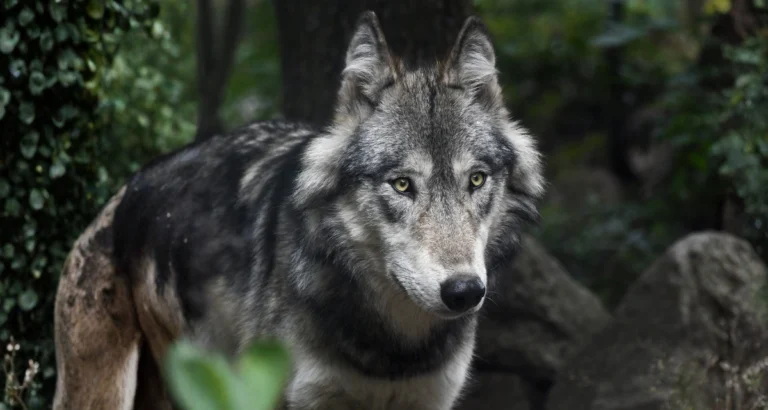
The Persistence of the Myth of the Big Bad Wolf
It’s not the job of Congress to pluck wolves or any other species from the endangered list.
- Wayne Pacelle
A week ago, Sen. Ron Johnson, R-Wis., stood at his desk in the ornate chamber and told a story about wolves older than the republic. Without ranting or raving, the three-term senior senator from Wisconsin suggested that wolves menaced game populations, ate up livestock, and caused kids to scurry away from school bus stops.
Then he asked the Senate to pass the so-called Pet and Livestock Protection Act — already approved in the House by a narrow margin, 211–204, and co-led by Rep. Tom Tiffany, R-Wis. He was a hair’s breadth away from sending the bill to President Trump for his signature.
Sen. Cory Booker stood in the breach. Deciding which rare creatures live under the shield of the Endangered Species Act, he noted, is not a job for senators, who may be under the sway of Farm Bureau or the trophy hunting lobby. It’s a job for wildlife scientists hewing to the conservation standards in the law, with their work, too, subject to judicial review.
Booker’s objection blocked the anti-wolf bill.
The narrative special interest groups proffered about wolves was more myth than fact, more supposition than science, more “Jaws” than David Attenborough documentary.
I know it’s a myth, because I’ve stood where the truth lives. I lived with wild wolves.
Wolves and Men
During a summer in college, I spent more than three months in the wilds of Isle Royale National Park, whose rocky shores are buffeted by the swells of Lake Superior.
There are no permanent settlements on the 210-square-mile World Heritage Site. It’s closed for half the year, when the wildlife has the run of the place. And even though its shimmering aspens and white birches, its rocky ridgelines, and crystalline inland lakes together compose a breathtaking landscape, it draws fewer visitors than any U.S. national park. It’s that remote.
Photo credit Johnathan Irish
There’s a minor cluster of National Park Service buildings and a rustic commercial hotel at Rock Harbor, and a smaller set of log cabin buildings on the other end of the island. But that’s about it for the human footprint. No matter where you roam, you find wildness.
I spent days on backcountry patrols and plenty of nights camping alone, with the moon and the heavens forming a dazzling ceiling that speckled the trees and lakes with light.
Three wolf packs stalked their territories, collectively covering every inch of the island.
I never worried about a wolf attack. Not for a second.
The black flies, the mosquitoes, and the ticks were the animals who gave me anxiety. I had a few thoughts that I might spook a moose and stir a charge by a 1,200-pound bull or a riled-up 800-pound mama. The giant cervids typically ignored me, focused on swallowing up leafy greens as they waded in the island’s bogs.
There have been a handful of documented attacks in North America, but no established modern record of a healthy wild wolf killing a person in the United States.
So, when Sen. Johnson read the script from the Farm Bureau about Wisconsin children waiting at bus stops and suggesting that wolves are something they should fear, it was more storytelling than reality.
A child at a bus stop has bigger worries than wolves: a reckless or a distracted driver, a falling tree, even a lightning strike.
Wolves Make People Safer
The irony is that wolves make Wisconsinites safer.
A peer-reviewed study in Wisconsin found that the arrival of wolves in a county was associated with about a 24% reduction in deer-vehicle collisions, with the economic benefits of fewer collisions dwarfing the costs of verified wolf predation on livestock.
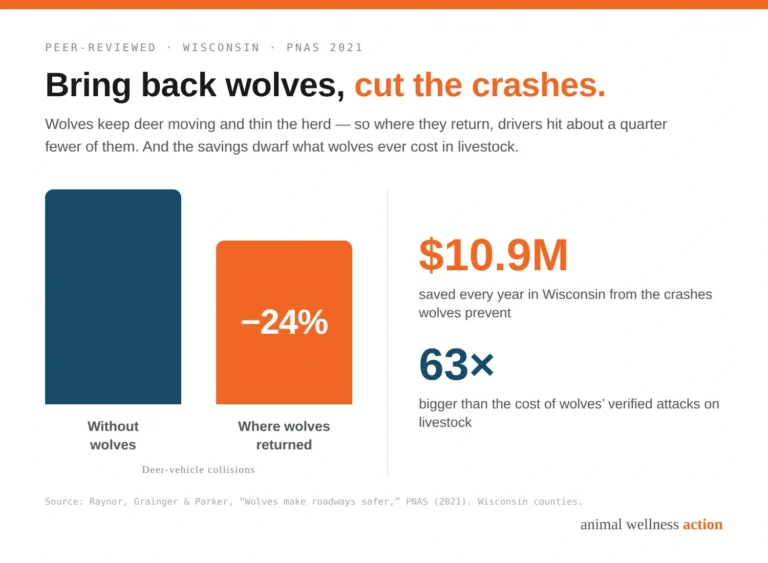
Think about that for a moment. The animal being presented as a threat to Wisconsin families helps protect those families from collisions between speeding vehicles and animals in the road.
Wolves keep deer, elk, and moose populations in check, and that phenomenon has been studied longer at Isle Royale than in any other place. Wolves are the bioengineers whose hunting keeps ecosystems humming.
That matters even more in the 37 states and four Canadian provinces struggling with chronic wasting disease (CWD), the fatal neurological disease afflicting deer and elk and said to be a long-term threat to their survival across North America.
In northern Wisconsin, where there are wolves, there’s almost no CWD in deer. Wolves read the vulnerability in afflicted animals and take them out, leaving the uninfected animals to thrive. In southern Wisconsin, where wolves have been purged, CWD is rampant. CWD-infected deer, or “zombie deer” as they are known, may be a human health threat to hunters who consume the animals. The human variant of CWD is Creutzfeldt-Jakob disease, and it’s always fatal in people, just as it is in deer and elk.
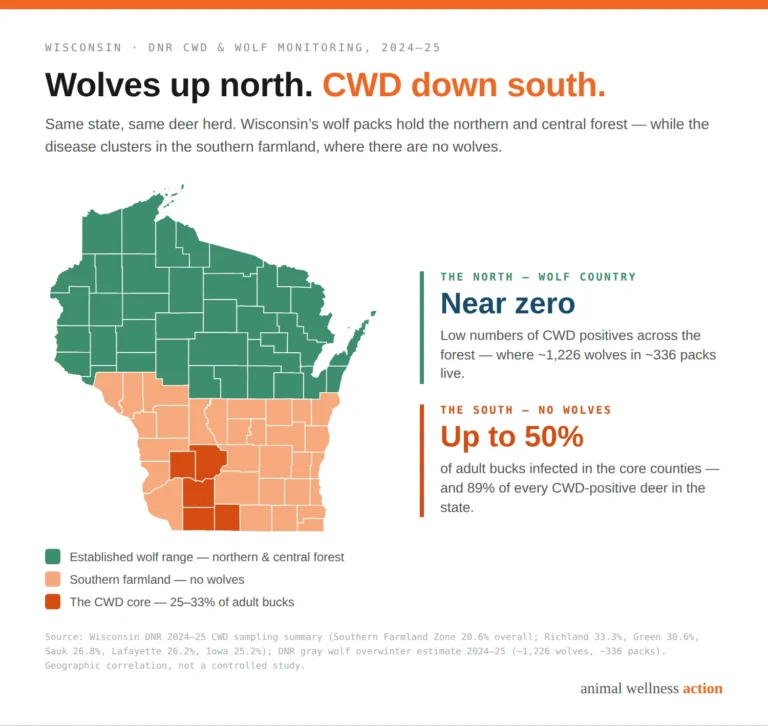
Why would Wisconsin officials want fewer wolves when stable wolf populations check the spread of this deadly disease? Keep the deer herd healthy? Keep the deer hunting economy alive and well? Allow the collection of organic meat from animals who’ve never known confinement?
State and federal authorities provide compensation for farmers and ranchers who lose sheep or calves to wolves. And the best farmers and ranchers deploy nonlethal methods to deter wolves, whether guard dogs, or night penning, or fladry, or lights to deter the wolves.
Wolves: The forebears of the Domesticated Dogs in Our Lives
Congress enacted the Endangered Species Act in response to mass killing driven by bloodlust, commerce, and prejudice. The combination of human appetites and technology was devastating to hundreds of species. As for wolves, we poisoned, trapped, and shot them down to small remnant populations in northeastern Minnesota and on Isle Royale by the 1970s, eliminating them from nearly all of the Lower 48.
The ESA turned that around. But within the last decade, states revived persecution in Idaho, Montana, and Wyoming, where wolves had been reintroduced in the mid-1990s. Hunting with packs of dogs. Steel-jawed traps. Night hunting. Even the return of bounties. It’s been a scorched earth policy.
Cory Booker put the brakes on expanding the killing we’re seeing in the Northern Rockies.
He asked other senators not only to honor the code of mercy but to read the science and heed the law and dispense with the mythmaking.
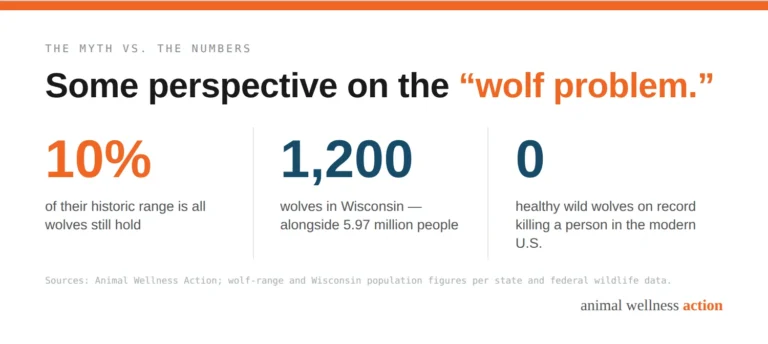
Wolves occupy just 10% of the land they once roamed before people waged war on them.
There are 1,200 or so wolves in Wisconsin. And there are 5,970,000 or so people.
Too many wolves?
These men doth protest too much, me thinks.
Wayne Pacelle, president of Animal Wellness Action and the Center for a Humane Economy, is the author of two New York Times bestselling books, “The Bond” and “The Humane Economy.”