What Element is Most Dangerous: Plutonium, Arsenic, Mercury, or Lead?
It’s a close call, but lead is the only one that 60 million Americans are eating regularly
- Wayne Pacelle
If someone had it out for hunters and wanted to harm them and their families, that person might break into their homes and head for their gun cabinets. Wearing gloves to prevent leaving prints or DNA behind, they’d swap in lead bullets for copper or steel ammunition and sneak off.
Within days, the hunter would go afield in pursuit of a deer or elk or a dove or rabbit. With his pulse rate soaring and his breathing labored, he’d track the animal or lay in wait and shoot.
He’d dress out the game, taking home the meat, leaving a gut pile behind for other animals to gorge upon.
At home, he’d pack the meat in the freezer, knowing that there’d be plenty of meat at the center of the plate for weeks or months ahead. The next day, he might say grace before serving some of the meat to his wife and kids.
But maybe he wouldn’t realize that the bullets had been swapped. A single lead round can shatter into millions of small fragments that travel up to 18 inches away from the bullet’s wound channel, especially when it strikes bone. One recent study shows that lead dust cannot even be picked up by a microscope or X-ray, never mind the human eye.
The lead, which never breaks down, would then go to work on the brain, heart, and other organs. The inorganic element had poisoned the meat. Nobody would have a clue as they digested their meal.
“Lead not only produces health impacts after short, acute exposures, but can accumulate in bone over the lifetime,” wrote Aisha S. Dickerson, PhD, an epidemiologist at the Johns Hopkins Bloomberg School of Public Health. “These lead deposits can be released into the blood stream as bone metabolizes during pregnancy and lactation, exposing unborn children and infants during critical periods of development. Furthermore, these same bone deposits can metabolize as bones age, increasing the risk of cognitive decline in older adults.”
According to one peer-reviewed article, “Within the brain, lead-induced damage … can lead to a variety of neurological disorders, such as brain damage, mental retardation, behavioral problems, nerve damage, and possibly Alzheimer’s disease, Parkinson’s disease, and schizophrenia.”
Yet no diabolical person needs to execute such a sinister, murderous plan. Hunters are choosing to use lead ammunition, and presenting wild game meat laced with the toxic element for consumption by 60 million Americans.
There is a scientific consensus that there is no safe level of lead. Not even a fragment the size of a corn kernel. Or a dust particle.
Lead Banned from Other Commercial Uses
There was good reason for the federal government and the states to ban lead in gasoline, toys, and paint. It impairs human organ function. It accumulates in the bones. It circulates in the blood, visiting every organ. It degrades brain function and a person’s quality of life. It speeds death.
But even in other commercial applications, no consumers planned on consuming the lead. Gasoline went into fuel tanks. Paint went on the wall. But it was enough of a hazard to breathe in the aerosolized gasoline at the pump, or for a child to pick lead paint off a wall and put the fragment into his or her mouth, to prompt public health authorities to take action.
But habits can dull our sensibilities, and uninformed buying habits can distort markets.
There may be no better example of this kind of psychology at work than the widespread use of lead in hunting. It’s an uncritical purchasing habit of hunters to think that lead ammunition is not only acceptable, but the only way to go.
It’s true I’m a lifelong animal advocate, and some hunters distrust me because of my work to restrict baiting, hounding of predators, canned hunts, and other inhumane and unsporting activities. But the toxicity of lead ammo is a verifiable fact. They should heed the message and stop obsessing on the messenger.
Perhaps if the bullets were made of arsenic, or mercury, or cadmium, more hunters would grasp the danger of ingesting elements not meant to mingle with the human body.
Even if they thought their own bodies were somehow immune to these poisons, perhaps they wouldn’t be quite so quick to feed them to their family and friends. Giving them lead is, to say the least, a risk they are stubbornly foisting upon those closest to them.
And what about the food banks that take in millions of pounds of venison? All those hungry people thinking they are getting organic meat but have no clue there’s lead in those loins.
When Vladimir Putin or his agents used polonium-210 in the 2006 assassination of Alexander Litvinenko in London, it was murder. There was a motive and an intention to kill. If there’s no intention to kill but you act in a reckless way, the law says it’s manslaughter.
It’s bad enough that perhaps 10 million hunters use lead and put themselves at risk of early death, long-term cognitive decline, heart attacks, and other degenerative diseases and diminished capacities. But what about the 50 million others who also get in on the wild-game feast?
The children in hunting families have no choice. The home kitchen is not a diner with an endless menu. A parent prepares a single meal. It comes with an instruction to eat your peas and your deer meat. The child will follow the command.
In the United States, we have two federal agencies — the Food and Drug Administration and the Department of Agriculture — responsible for enforcing safety standards to keep us safe from dangerous substances in foods. Neither agency would ever allow commercial sales of meat containing the levels of lead that contaminate deer or doves taken by hunters for consumption.
Wildlife Health
Top scientists with the U.S. Fish and Wildlife Service and the National Park Service say that we must put an end to the use of lead ammunition in sport hunting because of its effects on wildlife. The EPA says that hunters annually disperse as much as 80,000 tons of lead. That lead is spread across the vast majority of the 2 billion acres of land of the United States, the third largest country in the world by land area.
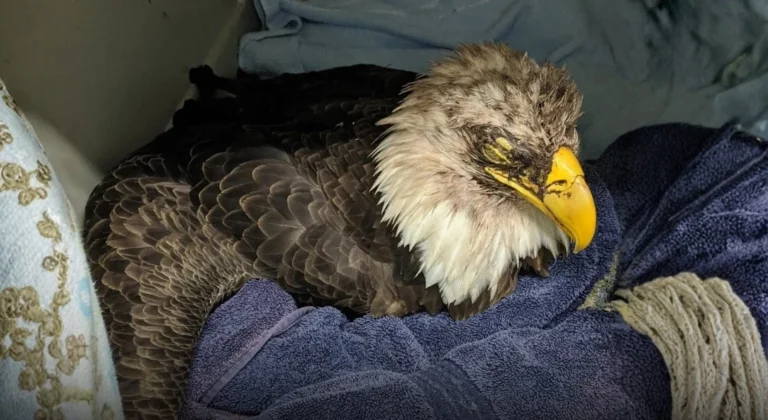
Let’s just take the plight of eagles, supposedly protected in America under two statutes — the Bald and Golden Eagle Protection Act and the Migratory Bird Treaty Act. A landmark 2022 study published in the journal Science documented continent-wide lead poisoning in bald and golden eagles. The eight-year study of 1,210 eagles across 38 states found that nearly half of the eagles had bone lead levels consistent with chronic poisoning, and roughly one-third showed evidence of acute exposure.
According to the Wildlife Center of Virginia, veterinarians at its hospital treated a record 76 bald eagles in 2025. Fully 70% of them tested positive for lead poisoning. A wildlife rehabilitation center in Iowa says it’s never had so many eagles as patients, according to the Des Moines Register, noting that the “eagles with lead poisoning usually don’t survive.”
The Lansing State Journal quoted a veterinarian at an Eaton Rapids wildlife rehab center in Michigan: “He was only 5 lbs.” and “starving to death because he no longer was able to hunt due to the lead poisoning shutting down his system … . He passed away overnight … . [J]ust barely 5 years old … we could tell because he still had some juvenile feathers. It’s sad, we’re sad.”
Hunting writer Ted Williams wrote in the (Maryland) Star Democrat that “[a]mmo companies introduced copper bullets — not to prevent plumbism, but to kill game more effectively, and they do.” He went on to quote the New York Department of Environmental Conservation, which said, “Fortunately, today’s harder copper and other copper alloy bullets and [shotgun] slugs typically remain intact on impact, transferring more energy to the target by folding downward into ‘petals’ that greatly expand the surface area. The result is a very effective, quick, humane kill.”
This Pain and Suffering of Wildlife Is All Avoidable
Thirty-five years ago, ammo companies fought with tooth and claw against efforts by animal advocates and conservationists to stop the poisoning of ducks and geese with lead ammunition. Then, under pressure from groups like ours, the U.S. Fish and Wildlife Service restricted the use of lead shot for waterfowl hunting nationwide.
The results were dramatic: the policy is estimated to save 1.4 to 3.9 million ducks and geese every year.
Today, there’s more lead-free ammunition on the market, and it’s easier to access. Hunters can shop in the online, national marketplace and get ammo delivered to their door within days. If the transition to steel shot was doable 35 years ago, it’s a no-brainer today.
There are at least 134 species at risk of poisoning from spent lead ammo. Hawks, vultures, foxes, and other scavengers quickly descend on those remains of hunter-shot animals. There’s no waste in nature. The animals pick the rotting carcass clean — lead fragments and all.
Lead harms every creature exposed to it, humans included. If hunters want to protect themselves and their families, and if a commitment to conservation and to clean kills is more than lip service, this madness of hunting with poison must end.
Wayne Pacelle, president of the Center for a Humane Economy and Animal Wellness Action, is the author of two New York Times bestselling books, “The Bond” and “The Humane Economy.”
Dear reader: If you support substantive policy work to protect animals, please consider donating to Animal Wellness Action here. You can give any amount one time, or make it a monthly gift, as many of our supporters do. Thank you for helping us fight for all animals.