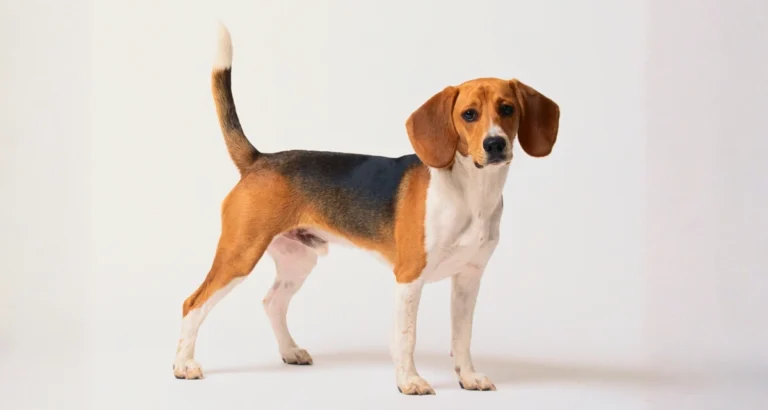
A Beagle Breakthrough
We’re on the ground in south-central Wisconsin, poised to lay our hands on 1,500 beagles who were born in a complex owned by Ridglan Farms
- Wayne Pacelle
I’m writing you just minutes before our press conference in Madison, Wis., to announce a whiplash-like turnaround in the fortunes of beagles held since birth at the second-largest beagle breeding and research facility in the nation.
Through the work of our sister organization, the Center for a Humane Economy, and our partners at Big Dog Ranch Rescue, we are co-leading a plan to empty out a large portion of dogs held at Ridglan Farms — the second largest beagle breeding and research facility in the nation.
We negotiated a deal, in the works for weeks, with Ridglan Farms to rescue and rehome 1,500 beagles that had been bred for use in the laboratory animal trade.
And if I am gushing today about our work through the Center for Humane Economy, you must understand I’ve transformed into a hardcore beagle fanatic. I am currently owned by my rescue boy — a black-and-tan beagle named Arthur Asher.
Soon, 6,000 beagle paws will, for the first time, feel soft grass and soil. They will sweep the ground with their glistening noses and discover smells beyond our capacity to detect or process. They’ll be smothered with human affection, have their own beds and bowls.
This effort represents one of the largest transfers of dogs from the research supply system ever undertaken.
But as meaningful as this moment is for those 1,500 animals, it is also a signal of something much larger.
The Dusk of Animal Testing?
For decades, beagles have been bred in large numbers for labs — a system built on assumptions about science that are as outdated as bloodletting and as discredited as electroshock therapy.
Since the Great Depression in the 1930s, drug developers have operated under a rigid federal mandate requiring animal testing to gauge the safety and effectiveness of drugs.
With the passage of the FDA Modernization Act 2.0 — formulated by the Center for a Humane Economy, and led by Sens. Rand Paul, R-Ky., and Cory Booker, D-N.J. — Congress eliminated an 84-year-old requirement that new drugs be tested in animals before advancing to human trials.
Just three years since that landmark law took effect, scientists are liberated to use superior testing methods grounded in human biology — for example, organ-on-chip systems, computational modeling, and advanced cell-based assays.
The federal government, long an impediment in this domain, is now working to accelerate change.
The new leadership at the FDA is actively driving changes to reduce reliance on animal testing, guided by the authority provided by FDA Modernization Act 2.0. At the same time, Health and Human Services Secretary Robert F. Kennedy, Jr., has pledged to move the nation decisively toward animal-free testing methods.
From Policy Change to Real-World Impact
What we are witnessing with the transfer of these 1,500 beagles is the real-world consequence of that transformation.
As the demand for animal testing begins to decline, the infrastructure of institutionalized exploitation built around it — laboratory breeding facilities, contract testing labs, animal smugglers — is fraying. And in some cases, it’s being dismantled and the contract labs and breeding facilities depopulated.
I cannot imagine, any longer, any scientist in America proudly announcing at a dinner party or a cocktail hour that he or she tests on beagles. That’s a career choice to hide, not to tout.
With the help of our rescue partners — led by the remarkable team at the Beagle Freedom Project, and our first-rate local partners, the Wisconsin Puppy Mill Project and the Dane County Humane Society — the dogs at the center of this effort will be moved from Ridglan Farms in short order.
Some will stay in Wisconsin. Many will travel far beyond it. All of them will begin new lives defined by caring, not by confinement and crowding.
Our agreement will leave our set of animal welfare partners with three-quarters of the dogs who’d been at Ridglan Farms just last week. We’re looking forward to continuing to engage with the leaders at the company there to secure an exit strategy for the rest. No beagle left behind is our aspiration.
A Mile Marker — But Not the Finish Line
Even as we celebrate this happy moment, we understand that tens of thousands of dogs are still used in research and testing across the United States. That is why we are pressing forward — with legislative campaigns, scientific engagement, and direct rescue efforts — to accelerate this transition.
We are working to ensure that fewer animals are born into circumstances like these. And we are working toward a day when there are no rescues required for beagles in contract labs or breeding facilities. Our goal is to see them all shuttered.
If you’ve ever wondered whether your support makes a difference, consider these 1,500 little souls. (I’ll be sending pictures soon!)
But please understand, especially for our rescue partners, that the transfer of 1,500 dogs to safety is a massive undertaking. It requires resources for transport, medical care, rehabilitation, and adoption. So, too, does our policy work.
And we have so much more to do on the policy side — passing the FDA Modernization Act 3.0, pushing the National Institutes of Health to stop funding beagle and primate testing, and to drive the acceptance and use of alternative methods.
We’re taking on the problem on all fronts.
But freedom for these dogs isn’t free for us. Please consider making a contribution today to help us carry out this rescue, support our partners, and continue our efforts to wind down animal testing and realize the dawn of a new era of animal-free science.
And I will let you know soon where the beagles have landed.
Dear reader: If you support substantive policy work to protect animals, please consider donating to Animal Wellness Action here. You can give any amount one time, or make it a monthly gift, as many of our supporters do. Thank you for helping us fight for all animals.