
Hunting and fishing are already legal in Colorado, and 83 would invite costly lawsuits, constrain the work of Colorado Parks and Wildlife, and could bring back steel traps and bear baiting
DENVER — Animal Wellness Action, an opponent of Amendment 83, is releasing letters from three professors with the University of Colorado School of Law and the University of Denver Sturm College of Law detailing how that constitutional amendment if approved would invite costly litigation, handcuff Colorado Parks and Wildlife, and put past and future voter-approved wildlife protections at risk of constitutional challenge.
In separate written legal opinions, DU law professor Justin Marceau, Colorado Parks and Wildlife Commissioner and DU Animal Law Program assistant director Jess Beaulieu, and CU Adjunct Professor of Law Steven C. Silverman caution voters that Amendment 83 is a threat to wildlife protection laws and to the established systems of decision-making on wildlife policy in the state.
“As a constitutional law scholar, I find Amendment 83 an unsuitable use of a state constitutional amendment,” wrote Justin Marceau, professor of law and Brooks Institute Faculty Research Scholar of Animal Law and Policy at the University of Denver Sturm College of Law, in his September 21 letter. “Constitutions establish government structures and protect enduring principles, not enshrine a highly ideological wildlife-management philosophy.”
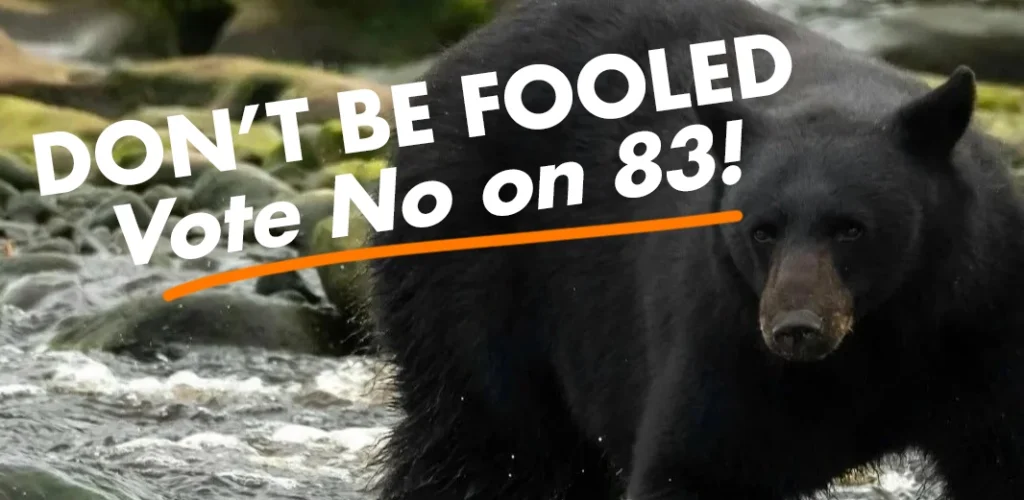
Amendment 83 would do three things. It would add a right to hunt and fish to the state Constitution, including by “traditional methods.” It would make hunting and fishing the state’s “preferred means” of managing wildlife. And it would allow the state to regulate hunting and fishing only when a law is “necessary” for “sound scientific” wildlife management, public safety, or preserving future hunting and fishing opportunities. Amendment 83 omits any definitions of these consequential terms.
“The central problem is not that the amendment protects hunting. It is that the terms it uses are so open-ended that no one can predict how courts will apply them,” said Jess Beaulieu, an attorney and assistant director of the University of Denver Animal Law Program in her September 23rd analysis. Beaulieu serves on the Colorado Parks and Wildlife Commission. CPW Commissioner Jay Tutchton has also publicly and separately criticized the measure as overreaching.
“The measure offers no baseline for determining which practices qualify as ‘traditional’ or what evidence would satisfy its science exception,” Beaulieu added. “Once undefined constitutional language takes root, attorneys and judges, not wildlife biologists, not the legislature, not the Colorado Parks and Wildlife Commission, become the ultimate arbiters of wildlife policy.”
The resulting lawsuits, she notes, would be paid for out of the agency’s Wildlife Cash Fund, which is sustained primarily by hunting and fishing license revenue and finances the majority of the state’s wildlife management, conservation, and research operations, draining resources from the very agency responsible for managing Colorado’s wildlife.
“An out-of-state trophy hunting organization spending heavily to constitutionalize its preferred management approach should give every Coloradan pause, particularly when the measure’s ambiguity would give that same organization new constitutional grounds to challenge any restriction it dislikes,” Beaulieu wrote. Colorado Attorney General Phil Weiser is also publicly opposed Amendment 83 on similar grounds.
Steven Silverman, an adjunct professor of law at the University of Colorado School of Law, argues that shutting down Colorado’s ongoing public debate over hunting practices is precisely why certain groups put the measure on the ballot. “I see Amendment 83 as an attempt to turn back the clock on reforming hunting practices and hijack future wildlife management decisions from the people of Colorado,” he said.
The amendment “freezes progress in time by protecting ‘traditional methods’ of hunting and opens up the possibility of legal challenges to reverse proscribed hunting methods, such as bear baiting or the use of steel-jawed leghold traps, under the premise that these were long-practiced activities before voters outlawed their use,” Professor Silverman warns.
“American history is full of wildlife practices that once seemed traditional and even sensible but later proved disastrous,” he wrote in his letter, pointing to the nineteenth-century slaughter of bison, the systematic eradication of predators, and the extinction of the passenger pigeon.
“When Colorado achieved statehood in 1876, its ‘traditional’ legal system prevented women from voting, permitted racial discrimination, and accepted child labor. The drafters of Amendment 83 have deliberately avoided defining traditional. Why would they not want clarity on a key term in their constitutional provision?” he added.
Silverman notes that “it’s not even clear whether reforms adopted decades ago by voters, such as the 1992 ban on spring bear hunting, will survive judicial scrutiny if Amendment 83 succeeds and creates a constitutional right to hunt by ‘traditional means.’”
He adds that the 2020 ban on wildlife killing contests and the recent effort to place daily bag limits on 17 furbearing species such as beavers, badgers, and bobcats would not have “survived a court challenge had Amendment 83 been on the books at the time.”
Because it is a proposed constitutional amendment, Amendment 83 requires a supermajority of 55 percent of votes cast on the measure to pass. Colorado Governor Jared Polis has also publicly recommended voters oppose Amendment 83, calling Amendment 83 “reckless” and “dangerous.”